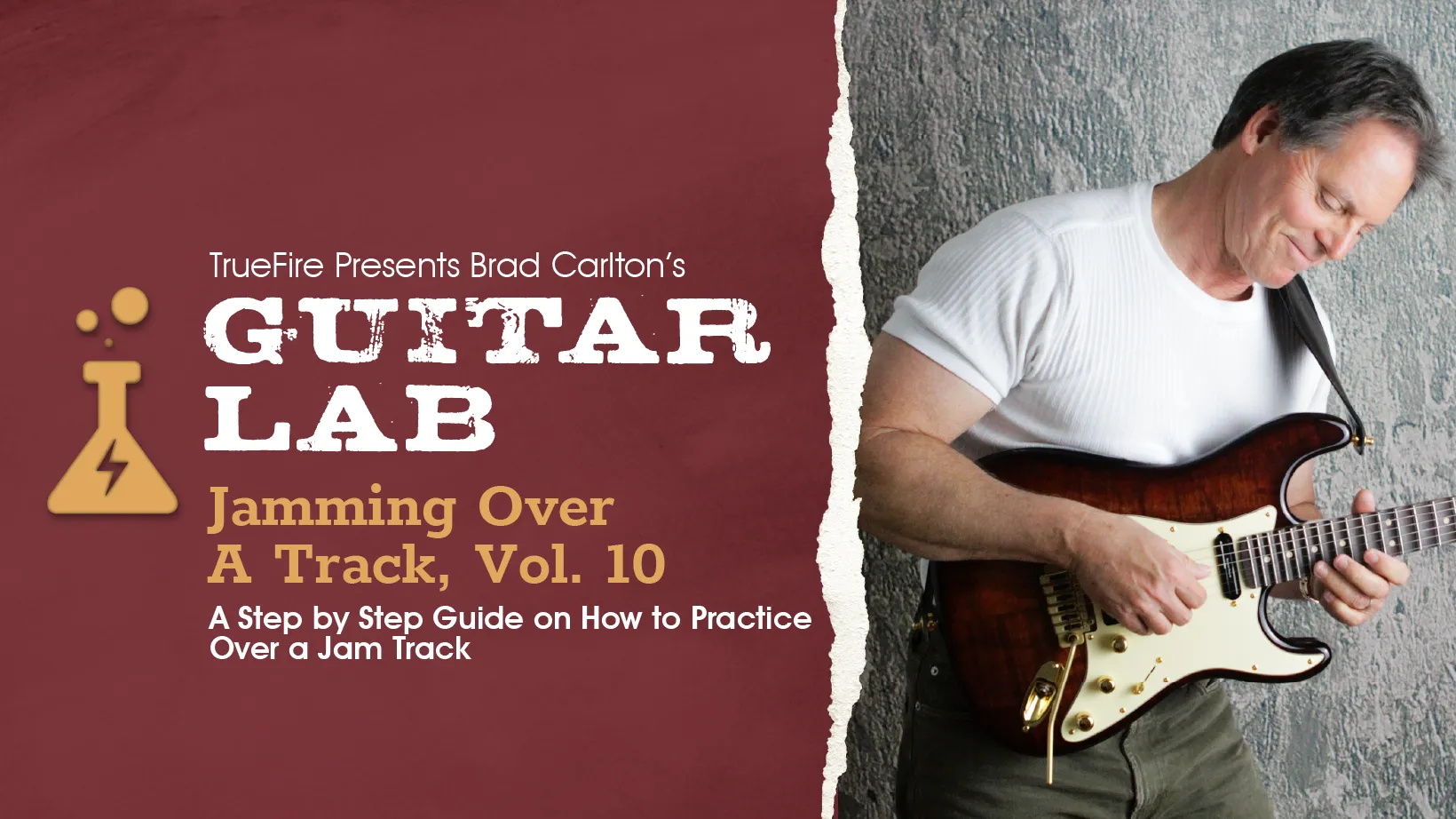
Guitar Lab: Jamming Over A Track, Vol. 10

Break Through the Wall. Jam With Confidence.

Marty FriedmanTommy EmmanuelSteve VaiEric GalesEric Johnson

Get this course and 1,000+ more with All Access

Try 14 days free. Cancel any time.

Purchase Individual Course for $5.00
Guitar Lab: Jamming Over A Track, Vol. 10

About this course

Ready to level up your improvisation game? In Jamming Over a Track, Vol. 10, the final volume of Brad Carlton’s acclaimed series, you'll take the leap from soloing over static chords to confidently navigating real chord changes. If you've ever felt stuck soloing over just one chord, this is your breakthrough moment.

Brad keeps the material accessible—this isn’t about tackling complex tunes right away. Instead, you’ll build a rock-solid foundation with key concepts like common tones, smooth scale transitions, and essential arpeggio patterns. It's all designed to help you develop the skills and instincts to jam musically through harmonic movement.

Pick up your guitar, press play, and jam your way through the changes

What you'll learn

  • Apply scale changes to match chord progressions
  • Use arpeggio patterns to outline chord changes
  • Break through the single-chord improvisation plateau
  • Understand the principles of improvising over chord changes
  • Learn to identify and use common tones between chords
Release date: 04/01/2025 • 1h 37m runtime
Start Course
Sample lessons
E Funk | Track Analysis
Lesson & Demonstration

What's included

6 lessons • 1 charts • 3 Jam Tracks

Jamming Over a Track Vol. 10
Hi, it's Brad Carlton with Volume 10 of "Jamming Over a Track."

Now, I could keep going on and on, but I'm gonna give you guys a break. In this volume, we're going to talk about that brick wall you have to break through as an improviser. Everything we've done up to this point has been based on just one chord. Now, we're going to dive into how to navigate through chord changes—and I’m going to keep it easy.

You’re not going to learn how to play giant steps in this particular course, but I’ll get you started with the principles—common tones, scale changes, things like that, maybe some arpeggio patterns.

So, grab your guitar, and let’s jam over a track!
E Funk | Track Analysis
Alright, let’s dive into a funk track. First, we’ll give it a listen, then break it down rhythmically and harmonically. It’s a super tight, one-bar phrase that just loops—which is really common in funk. Sometimes you’ll see two or four-bar phrases, but this one keeps it short and punchy. We’re in the key of E, which is perfect for funk, especially on bass—open E gives you that nice slap and pop, and the E minor pentatonic fits right under your fingers on a four-string. That’s the core of what’s happening here, and in the next lesson, we’ll dig into the bassline.
E Funk |Bass Line
Alright, we’re diving into an E funk bassline, and the key here is the E minor pentatonic—not major, because funk usually thrives on that gritty, soulful minor vibe. If you don’t recognize the scale, you won’t know how to use it, so we’re focusing on the diagonal scale forms to really see the fretboard clearly. The groove is a straight 16th-note rhythm, and we’re counting it out—one-e-and-a, two-e-and-a—with the real funk living in the “e’s” and the “a’s,” those offbeat upstrokes. I’ll guide you through muting techniques, accenting notes by adjusting pick pressure, and using proper left-hand posture to clean up your tone. We’ll slow things down, strip out the bass from the track, and really get into the feel, layering rhythmic variations and even adding in power chords from the E minor pentatonic. Whether you’re just starting out or brushing up, take it slow, stay systematic, and you'll start building real funk chops
E Funk | Harmonic and Melodic Options
Alright, let’s talk harmonic options over this E funk groove. The bassline gives us the root, flat seven, and flat third—three key notes from the E minor pentatonic scale. From there, we can build everything from simple power chords to more colorful voicings like E minor 7, E9, and beyond. The idea is to explore what scales fit over the groove—E Dorian, Mixolydian, and even the half-whole diminished scale for that funk-fusion edge. I touch on using double stops, hybrid picking, and voicing choices to add texture, and I revisit concepts like implied harmonies and scale-tone mapping across the fretboard. The main message? Don’t just play the same shapes—dig into your scales, understand what’s under your fingers, and constantly evolve. Record yourself, reflect, and remember: true improvisation is about taking risks, staying creative, and never settling into a rut.
Dm to G | Harmonic and Melodic Options
Alright, we’re stepping into something new here—finally introducing chord changes after nine volumes of jamming over a single chord. Up until now, I’ve kept it simple so you could focus on rhythm, harmony, scale forms, and phrasing without worrying about what’s coming next. Now, we’re working with a four-bar loop that moves from D minor to G7, a classic II-V in the key of C, and we’re learning how to articulate that change musically. I break down chord voicings, shell structures, and guide tones, showing how a single note shift—like C to B—can signal the change from Dm7 to G7. I demonstrate ways to build rhythm parts, voice chords creatively, and move through the changes using Dorian and Mixolydian concepts, all while keeping things grounded in funk. The big takeaway? Learn to hear and see how notes function over changing chords, practice playing rhythm parts that support a soloist, and always record yourself to make sure your phrasing and choices are musical. Whether you’re laying down a groove or soloing, this is about expanding your harmonic vision and really learning to improvise over changes.
Em/D to D | Harmonic and Melodic Options
We’re diving into a common pop diatonic progression—E minor over D, resolving to D major—with a pedal tone in the bass, and it gives you a ton of expressive options. It’s all in the key of D major, so D major pentatonic works beautifully over both chords, but what really matters is which notes you emphasize. You can bring out the chord changes by highlighting certain tones, or blur the lines a bit for a more flowing sound. I walk you through how each note in the scale functions differently over each chord, how to use arpeggios musically (without sounding like you're running patterns), and how to add flavor with bluesy elements like the flat 3 and flat 7. You can also use chromaticism and switch between E minor pentatonic and D major pentatonic to outline the harmony more directly. The big message is: learn how each note sounds in context, use your ear, and record yourself. That’s how you develop melodic phrasing and learn to play through changes in a way that actually sounds musical.

Reviews

1 result

Joey

04/02/25

Guitar Lab: Jamming Over A Track, Vol. 10

Once again, Brad has put out a great series in this final part of the *Guitar Lab: Jamming Over A Track, Vol. 10*. I really had a great time with this series. Thanks Brad !


Stop searching. Start improving with All Access.

Try 14 days free. Cancel any time.