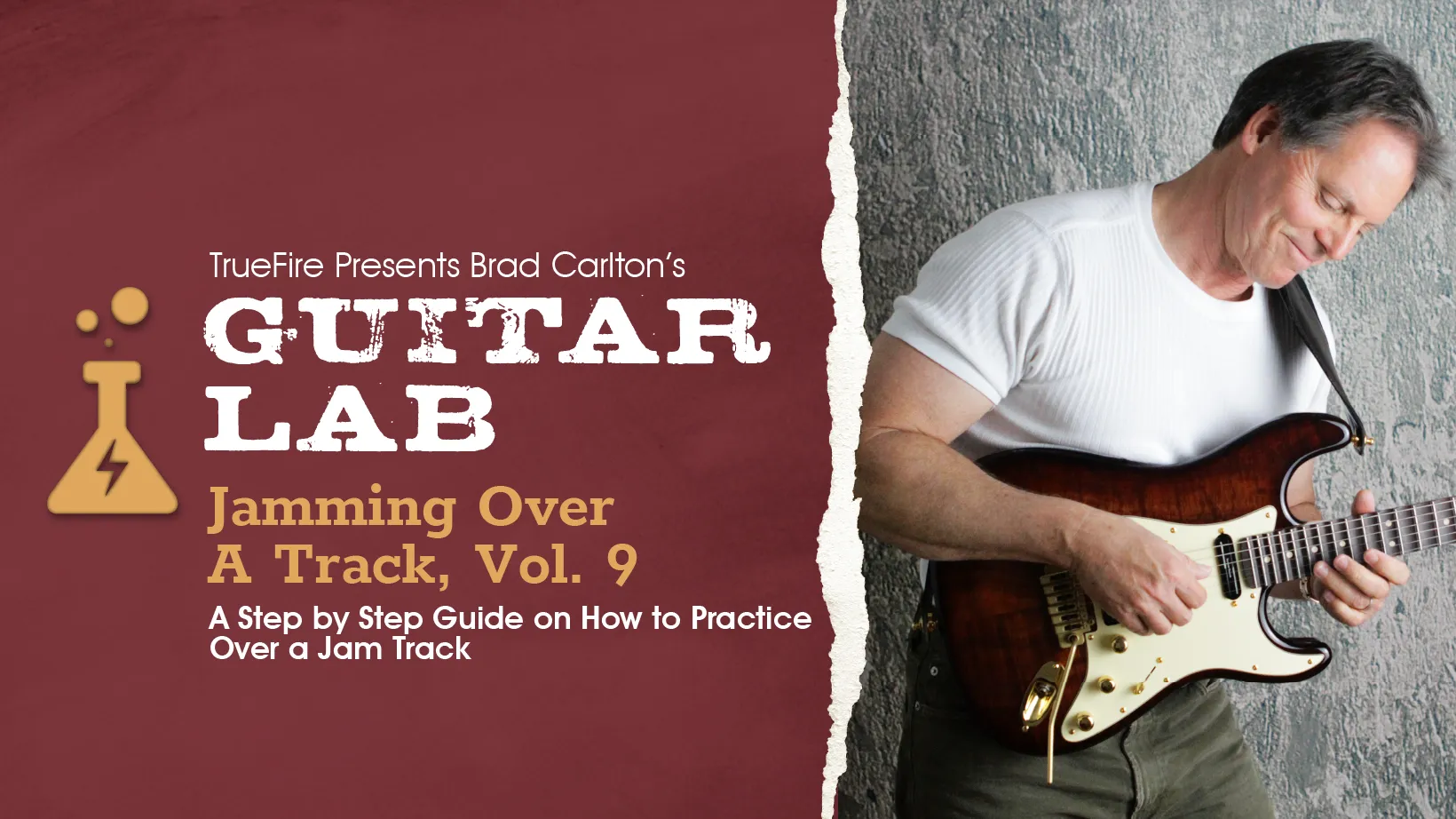
Guitar Lab: Jamming Over A Track, Vol. 9

Master the Modes. Elevate Your Sound. Jam with Confidence!

Marty FriedmanTommy EmmanuelSteve VaiEric GalesEric Johnson

Get this course and 1,000+ more with All Access

Try 14 days free. Cancel any time.

Purchase Individual Course for $5.00
Guitar Lab: Jamming Over A Track, Vol. 9

About this course

Unlock New Levels of Improvisation with Jamming Over a Track: Volume 9!

Join Brad Carlton as he takes you deeper into the world of improvisation using the same tracks from Volume 8, but with fresh modal approaches. In this edition, you'll explore Mixolydian, Lydian, Dorian, and Aeolian while mastering essential concepts like subsets, pentatonic subscales, intervals, chords, and melodic development. Learn how to approach chord tones effectively and develop your ear to recognize modal colors with confidence.

Ready to elevate your playing? Grab your guitar and let's jam!

What you'll learn

  • Apply B major scale forms to create E Lydian across the fretboard
  • Target specific chord tones for melodic emphasis
  • Visualize the sharp 4 within major scale fingering patterns
  • Apply Mixolydian, Lydian, Dorian, and Aeolian modes over backing tracks
  • Develop melodic ideas using modal intervals and subsets
Release date: 03/01/2025 • 1h 37m runtime
Start Course
Sample lessons
Soloing with Lydian | Heptatonic Scale
Lesson & Demonstration

What's included

9 lessons • 1 charts • 1 Jam Tracks

Jamming Over A Track Vol. 9
I'm Brad Carlton with Volume 9 of Jamming Over a Track. We're taking the same two tracks from Volume 8 and diving deeper into new modes. We'll explore Mixolydian, Lydian, Dorian, and Aeolian, covering key concepts such as subsets, pentatonic subscales, intervals, chords, melodic development, and how to approach specific chord tones. Make sure to study these concepts and play a ton of notes until you can truly hear them. Now, grab your guitar, and let's jam over a track!
Soloing with Lydian | Heptatonic Scale
In this lesson, we’re applying the Lydian mode over jam tracks in E, using the same track as before. Since the bass line stays on E, you can use any scale containing E, but E Lydian introduces a distinct sound with its sharp fourth. Compared to Ionian (the major scale), Lydian’s raised fourth creates a bright, floating tonality, often heard in rock and soundtracks. You can approach modes through the formula method—modifying the major scale—or by using the parent scale concept, where E Lydian derives from B major. Practicing visualization is key: recognize scale degrees, intervals, and their relationships to chord forms across the fretboard. Training your ear by singing the notes and locking into their sonic character strengthens improvisation. While finger patterns can guide you, deeper mastery comes from knowing note names and scale degrees, allowing for more intentional playing and composition.
Soloing with Lydian | Hexatonic Scales
In this lesson, we explore hexatonic scales by removing one note from the seven-note heptatonic scale, allowing for more control over tonal color. By strategically omitting notes, you emphasize specific sounds—like maintaining Lydian’s distinctiveness by keeping the sharp 4 while experimenting with leaving out the 7. This selective approach helps develop musical awareness, enabling you to weave between different subsets and create dynamic phrasing. Viewing scales through multiple perspectives—whether subtracting from a full mode or adding to a pentatonic scale—enhances flexibility in improvisation. Restricting certain notes forces intentional choices and breaks autopilot playing, helping you hear and control tonal shifts. These techniques open doors for deeper improvisation, giving you a lifetime of creative exploration over an E Lydian groove.
Soloing with Lydian | Pentatonic Scales
In this lesson, we explore how different pentatonic scales interact with the Lydian mode, shaping the overall sound and harmonic outcome. Starting with E major pentatonic (1, 2, 3, 5, 6), we get a classic, stable Southern Rock feel. Moving to B major pentatonic (6, 7, 2, 3, 5), the natural 7 adds richness, creating an E major 13 sound. The third option, F# major pentatonic (2, 3, #4, 6, 7), highlights Lydian’s signature sharp 4, producing a more complex, extended harmony. By shifting between these pentatonic subscales, we can control tension and resolution, leading to more expressive phrasing. Developing an awareness of these choices—root-based for stability, fifth-based for color, and second-based for an ethereal Lydian feel—deepens improvisational ability. Just as understanding extended harmonies broadens musical appreciation, experimenting with these subsets refines soloing and composition across all styles.
Soloing with Lydian | Add#4 Arpeggio
In this lesson, we explore add four arpeggios to emphasize the Lydian sound by selectively building from the ground up rather than playing full scales. Using notes like 1, 2, #4, and 5, we create open, melodic structures such as Esus2(#4) and gradually add complexity. This approach refines phrasing by focusing on strong chord tones instead of playing all available notes. By understanding modes in relation to their parent scales—like visualizing E Lydian through B Ionian or C# Dorian—we unlock new improvisational possibilities. Extracting arpeggios from the parent scale, such as F#7 or C#m(add9), highlights lush extensions like E6/9(#11) or Emaj7(6), expanding harmonic depth. The key is blending theory with ear training for structured, expressive playing, always focusing on long-term growth and deeper musical understanding.
Soloing with Lydian | Lydian Arpeggios
Lydian arpeggios provide a structured way to approach soloing by focusing on triads within the mode’s parent scale. Since E Lydian stems from B major, its I, IV, and V chords—B, E, and F#—form a strong harmonic foundation for melodic ideas. Playing triads instead of full scales avoids predictability and enhances phrasing, while skipping strings or changing directions adds angularity. Understanding how these major triads fit into any mode helps with improvisation across various tonalities. Additionally, minor triads (C#m, D#m, G#m) and the diminished triad (A#dim) provide further melodic options, allowing for a blend of arpeggios, pentatonics, and full-scale ideas. Mastering these elements both harmonically and rhythmically strengthens improvisation, ensuring a dynamic, expressive approach to soloing in the Lydian mode.
Soloing with Mixolydian | Various Subsets
In this lesson, we shift from Lydian to E Mixolydian, the fifth mode of A major, and explore how to apply it musically. Understanding Mixolydian requires recognizing its parent scale, A major, and focusing on E as the root instead of A. This approach ensures that the mode sounds natural rather than like a standard major scale. We explored triads, pentatonic subscales (E major, D major, and A major pentatonic), and arpeggios within A major to build melodic phrases and highlight Mixolydian’s defining ♭7. Additionally, cross-thinking allows us to enter E Mixolydian through different perspectives, such as B Dorian or D Lydian, providing alternative improvisational pathways. The key takeaway is to apply these concepts methodically—mastering individual ideas before layering complexity—while always prioritizing musicality over just technical execution.

+ 2 more lessons

Start Course

Reviews

2 results

Ohio5665

Verified buyer

04/04/25

Guitar Lab: Jamming Over A Track, Vol. 9

As with the other volumes in this collection and all of Brad Carlton's courses this volume is full of great information and concepts to keep me busy and improve my playing.


Joey

03/01/25

Brad Carlton's Guitar Lab: Jamming Over A Track, Vol. 9

Another great one that will keep me busy and happy for a while ! Thank you Brad

Stop searching. Start improving with All Access.

Try 14 days free. Cancel any time.