




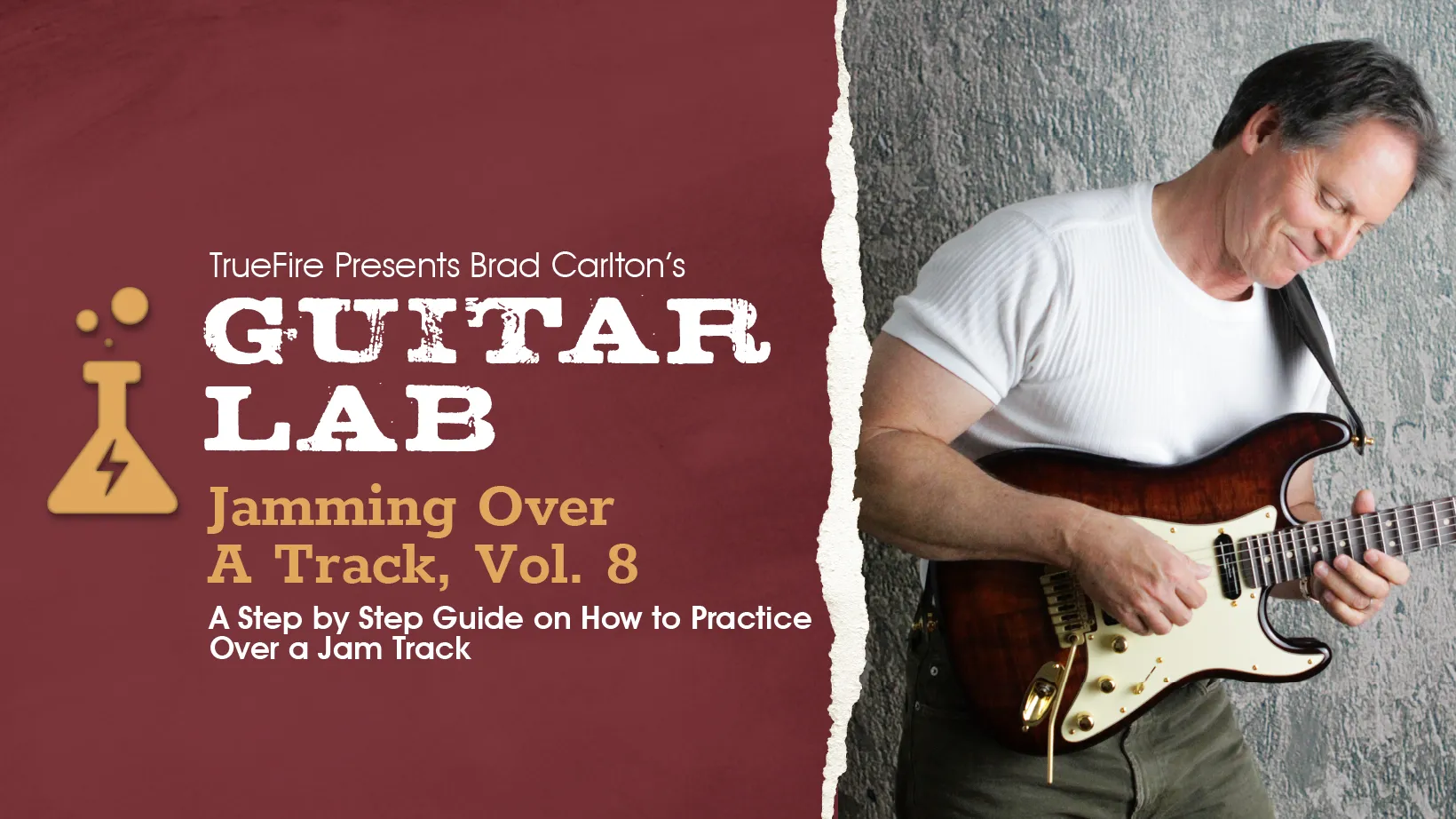

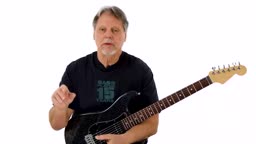
Guitar Lab: Jamming Over A Track, Vol. 8

Jamming Over a Track, Volume 8: Unlock the Ionian Mode and Supercharge Your E-Bass Jams!

Marty FriedmanTommy EmmanuelSteve VaiEric GalesEric Johnson

Get this course and 1,000+ more with All Access

Try 14 days free. Cancel any time.

Purchase Individual Course for $5.00
Guitar Lab: Jamming Over A Track, Vol. 8

About this course

Guitar Lab: Jamming Over a Track Vol. 8 elevates your improvisation and jamming prowess to unprecedented heights. In this edition, Brad Carlton delves deep into playing over tracks anchored by an E bass, utilizing the powerful Ionian mode—the foundation of the major scale. You'll explore a myriad of harmonic and melodic possibilities, unlocking new avenues for creative expression.

Throughout this volume, you'll engage with sophisticated melodic techniques and intricate harmonic structures that expand your musical vocabulary. Brad will guide you through dynamic soloing strategies and versatile phrasing methods, empowering you to craft solos that are both technically impressive and emotionally resonant. Whether you're aiming to enhance your understanding of major scale applications or seeking innovative ways to navigate an E bass foundation, this course provides the essential tools to transform your playing.

From mastering modal variations and seamless transitions to incorporating expressive motifs and advanced improvisational concepts, Jamming Over a Track Vol. 8 is designed to push your creative boundaries. Perfect for guitarists eager to refine their skills and explore new musical territories, this course will inspire you to elevate your artistry and achieve a new level of mastery in your jamming sessions.

Grab your guitar, dive into the Ionian mode, and let Brad Carlton guide you through an enriching journey of harmonic and melodic exploration. Guitar Lab: Jamming Over a Track Vol. 8 is your gateway to becoming a more versatile and expressive musician.

What you'll learn

  • Solo using only chord tones (arpeggio approach)
  • Create melodic phrases that resolve to strong tones
  • Apply the Ionian mode over a backing track with E bass
  • Understand and apply tonal gravity when improvising
  • Develop multiple harmonic approaches to improvisation
Release date: 02/01/2025 • 1h 40m runtime
Start Course
Sample lessons
Soloing with Ionian | Heptatonic Scale
Lesson & Demonstration

What's included

6 lessons • 1 charts • 1 Jam Tracks

Jamming Over A Track Vol. 8
Hi, I'm Brad Carlton with Jamming Over a Track, Volume 8. We'll be talking about playing over a track that has an E bass, and we'll be using the Ionian mode—which is the major scale. I'm going to demonstrate and explain how to get lots of options, both harmonically and melodically. So grab your guitar, and let's jam over a track!
Soloing with Ionian | Heptatonic Scale
In this lesson series, we’re going to revisit that familiar “Do, Re, Mi” major scale—also known as the Ionian mode—and apply it in the key of E to create more musical lines and avoid falling back on the same tired licks. We’ll explore how a heptatonic scale (seven notes) generates four color tones alongside the triad (1, 3, 5), which are your “strong notes” carrying the most tonal gravity. You’ll see how focusing on chord tones and arpeggios helps you finish musical “sentences” more convincingly and lock in with the groove. We’ll talk about memorizing intervals, relating them to chords you already know (like an E bar chord), and expanding your fretboard fluency by practicing various rhythmic subdivisions—whole notes, half notes, quarter notes, and eighth notes—while paying attention to damping techniques and vibrato. We’ll also discuss scale form logic and the benefits (and pitfalls) of learning position-based fingerings, stressing the importance of ear training, singing your intervals, and truly knowing what each note will sound like before you play it. Ultimately, the goal is to develop the freedom to craft compelling melodies all over the neck, experimenting with different “spices” (notes) and learning how they interact, just like a good chef would in the kitchen.
Soloing with Ionian | Hexatonic Scales
In this lesson series, we’re going to revisit that familiar “Do, Re, Mi” major scale—also known as the Ionian mode—and apply it in the key of E to create more musical lines and avoid falling back on the same tired licks. We’ll explore how a heptatonic scale (seven notes) generates four color tones alongside the triad (1, 3, 5), which are your “strong notes” carrying the most tonal gravity. You’ll see how focusing on chord tones and arpeggios helps you finish musical “sentences” more convincingly and lock in with the groove. We’ll talk about memorizing intervals, relating them to chords you already know (like an E bar chord), and expanding your fretboard fluency by practicing various rhythmic subdivisions—whole notes, half notes, quarter notes, and eighth notes—while paying attention to damping techniques and vibrato. We’ll also discuss scale form logic and the benefits (and pitfalls) of learning position-based fingerings, stressing the importance of ear training, singing your intervals, and truly knowing what each note will sound like before you play it. Ultimately, the goal is to develop the freedom to craft compelling melodies all over the neck, experimenting with different “spices” (notes) and learning how they interact, just like a good chef would in the kitchen.
Soloing with Ionian | Pentatonic Scales
In this lesson, we’re going to dig into pentatonic scales—those familiar five-note patterns that most guitar players learn early on because they fit rock, blues, and 12-bar progressions so effortlessly. They’re also ergonomic, with two notes per string that fall comfortably under your fingers. But knowing a scale means more than just running it up and down from the bottom—try starting on different notes, mixing up intervals, and creating bigger leaps instead of always going stepwise. We’ll also talk about how these pentatonic “subscales” fit into the larger E major scale (1, 2, 3, 5, 6), why you should practice chord voicings and slash chords (like A over E, or B over E), and how familiarity with the CAGED system can help you visualize everything more clearly. It’s all about understanding harmony, building melodic ideas, and truly knowing what each interval will sound like before you play it.
Soloing with Ionian | Add9 Arpeggio
In this lesson, I’ll show you how to work with 1 and 5 chords as slash chords while exploring pentatonic ideas—focusing on the fact that you can always add the 9 to your 1, 4, and 2 chords (remember, the only diatonic triad you typically don’t add a 9 to is the 3 chord). We’ll look at E add9, B add9, and A add9 arpeggios (using the 1, 2, 3, 5 shape) to see how these four-note entities connect smoothly when resolving back to E. If you hit a wrong note along the way, don’t sweat it—just correct it and keep the beat going, much like stumbling in a 5K race but continuing forward without starting over. The key is to know exactly where you are in the timeline, fix the mistake, and do enough reps to lock in the proper version. Ultimately, it’s all about learning to flow through the changes, staying relaxed, and staying musical.
Soloing with Ionian | Ionian Arpeggios
In this lesson, I want to give you another Ionian mode concept that involves taking the seven diatonic triads of E major (E, F♯m, G♯m, A, B, C♯m, and D♯dim) and layering them over a static E bass to reveal richer harmonies—like hearing G♯m over E as an E major 7 or C♯m over E as an E6. By exploring these slash chords, practicing second-inversion triads, and moving linearly along a single string (rather than always “in position”), you can create more fluid, vocal lines and avoid sounding like a typewriter. Visualizing chord shapes via the CAGED system is key: when you recognize those forms, it’s easier to glide around the neck, improvise with new intervals, and experiment with extended chords or arpeggios (think 7♯9 or add11) that fuel your ear for fresh ideas. If you hit a wrong note, don’t stop—keep the beat going, fix the note, and log these concepts so you can revisit them whenever your playing feels stagnant. You’ll find that constantly pushing beyond your comfort zone—learning new voicings, listening to different styles, and letting mistakes become stepping stones—will keep you growing and prevent you from running out of ways to express yourself.

Reviews

2 results

ChristianPRS

07/24/25

discipline

Dear Brad Carlto, I'm a 56-year-old man. I started playing guitar 11 years ago. I love it. I wish I'd started much sooner. I've read and seen a lot online. I still find it difficult because I always want to go further. Exercises and exercises. I've taken all your jamming lessons. I think I understood 80% of them, but you explained it very well. I think what you're doing is great and I'll continue to follow you. That's what I wanted to say. Thank you!!ps i am from Holland Europa


Joey

02/06/25

Guitar Lab: Jamming Over A Track Vol. 8

Another great addition to the Jamming Over a Track series. Keep 'em coming, I'm having a blast ! Thanks Brad :)

Stop searching. Start improving with All Access.

Try 14 days free. Cancel any time.