




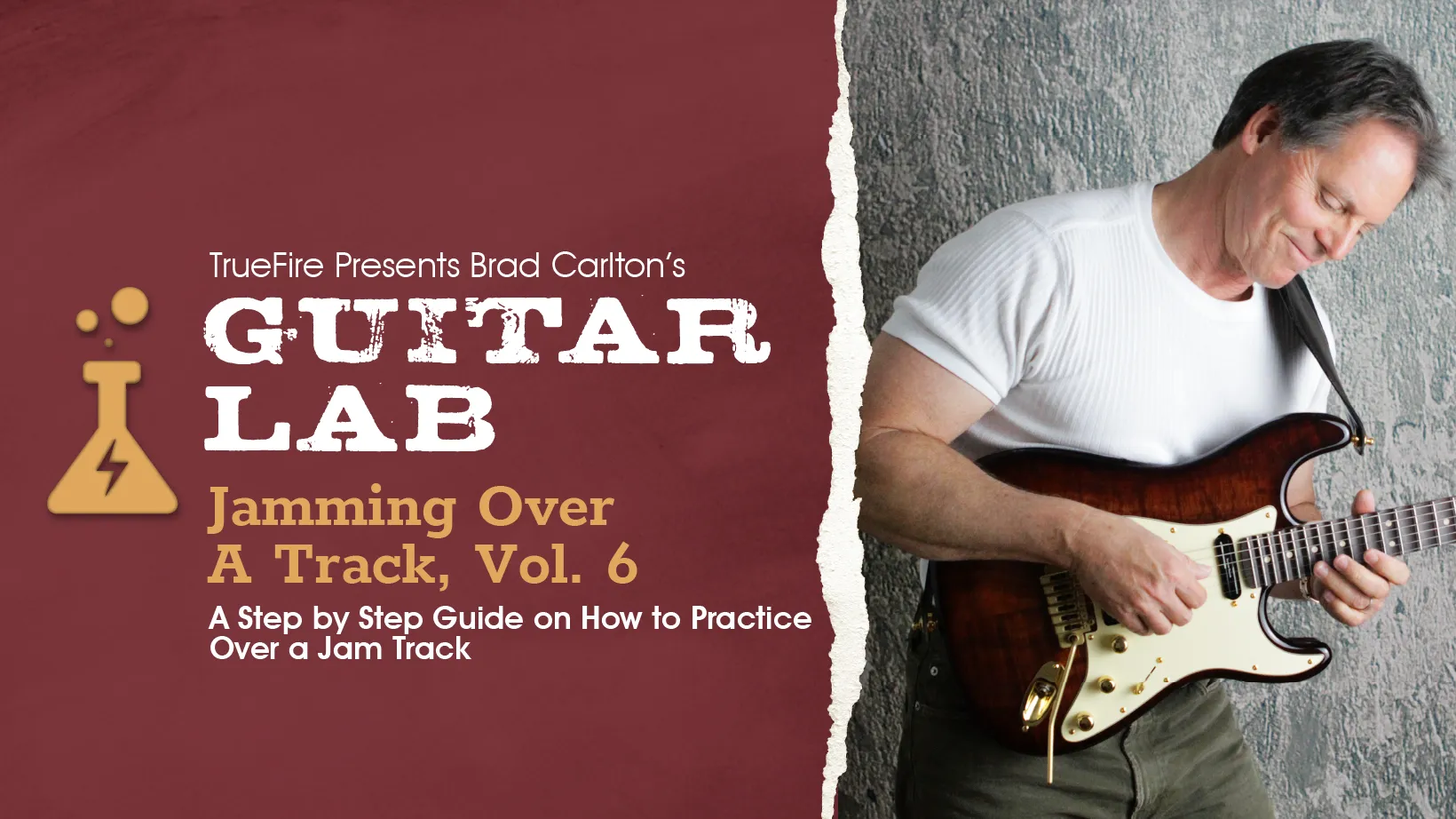
Guitar Lab: Jamming Over A Track, Vol. 6

Master the Flow: Advanced Techniques for Jamming Over Tracks

Marty FriedmanTommy EmmanuelSteve VaiEric GalesEric Johnson

Get this course and 1,000+ more with All Access

Try 14 days free. Cancel any time.

Purchase Individual Course for $5.00
Guitar Lab: Jamming Over A Track, Vol. 6

About this course

Guitar Lab: Jamming Over a Track Vol. 6 takes your improvisation and jamming skills to extraordinary new heights. In this volume, you'll explore deeper harmonic concepts, advanced phrasing techniques, and innovative uses of chromaticism to add tension, release, and sophistication to your playing.

From seamlessly blending multiple scale systems to navigating intricate rhythmic frameworks and unconventional chord progressions, this course equips you to create compelling, dynamic solos and grooves. Whether refining your command of advanced theory or diving into experimental approaches, Guitar Lab: Jamming Over a Track Vol. 6 will challenge and inspire you to transform your practice and performance.

What you'll learn

  • Play chord scales with one voice (scales), two voices (intervals), and three voices (triads)
  • Navigate diatonic triads across the fretboard in different inversions
  • Apply Mixolydian mode over funk grooves
  • Create tension and release in solos
  • Understand and apply chord scale theory to generate melodic and harmonic ideas
Release date: 12/01/2024 • 1h 41m runtime
Start Course
Sample lessons
Chord Scales
Chord Scales
Demonstration

What's included

12 lessons • 1 charts • 1 Jam Tracks

Jamming Over A Track Vol. 6
Hi, I'm Brad Carlton, and welcome to Jamming Over a Track, Volume 6. In this session, we'll be playing over a cool funk groove, diving into the Mixolydian mode and its various elements. I'll cover how to use it effectively, including cross-thinking, modal thinking, intervals, triads, and quartal structures. Then, I'll take it a step further and show you how to play "outside" the mode.

We'll also explore tension and release, plus a few handy tricks with the pentatonic scale. So grab your guitar, and let's jam!
Chord Scales
In this lesson, we explore the concept of chord scales, focusing on their application for rhythm and melodic playing in various musical contexts. Chord scales involve moving notes within a scale systematically, such as ascending or descending intervals, to develop harmonic and melodic ideas. Using the G Mixolydian mode as an example, we practice chord scales in octaves, thirds, and sixths, emphasizing muting techniques, rhythmic precision, and fretboard visualization. This method extends to creating melodic patterns, connecting lines through chromaticism, and understanding modes as derivatives of a parent scale. The interplay of theoretical understanding and practical application is key, as demonstrated through diatonic triads, interval stacking, and rhythmic exercises. By mastering chord scales, including different intervals and inversions, musicians can craft cohesive harmonic frameworks, enrich solos, and refine rhythmic accuracy, making chord scales an essential lifelong study.
Sprinkling In The Blues | 7 add b3
In this lesson series, we explore how adding a flat third to the Mixolydian mode infuses a bluesy "hot sauce" into its naturally bright, island-like sound, making it funkier and more expressive. This technique involves incorporating the flat three into both rhythm and lead playing, either as part of chord voicings or melodic lines. For rhythm, simplifying chord structures and omitting unnecessary voices, like the root, enhances the groove while leaving space for the bassline. In melodic playing, combining the flat three with the major third through bends or subtle quarter-step shifts creates a dynamic bluesy feel, particularly when blending Mixolydian with minor pentatonic scales. To master this, you will focus on ear training—scat singing and listening to your lines help internalize and anticipate the sound of these tonal colors, enriching your musical expression moving forward.
Sprinkling In The Blues | 76 add b3
In this lesson, we explore how to expand your soloing vocabulary by systematically adding new notes and colors to your playing. Starting with a basic arpeggio (1, flat 3, 3, 5, flat 7), we enhance its flavor by incorporating a 6th, creating a sweeter, more nuanced sound. This approach helps move beyond the common rut of relying solely on the minor pentatonic scale, a trap many players fall into early on. By experimenting with variations and adding melodic lines, you develop a richer, more dynamic soloing style, breaking free from repetitive habits and achieving fresh, creative results.
Sprinkling In The Blues | 9 add b3
In this lesson, we will explore how to build and modify musical vocabulary by starting with familiar elements and making intentional changes to create more dynamic and jazzy sounds. By adding notes like the flat 3 and 9 to a dominant 9th arpeggio, we can transform a simple major pentatonic scale into something richer and more nuanced. We'll discuss how to incorporate rhythmic variations and chromaticism to connect notes creatively, while resolving tensions to avoid unresolved or weak tones. The key is to modify what you already know—replace the 6 with a flat 7 for a dominant 9th, then add the flat 3 to expand the texture. This approach allows for innovation without starting from scratch, blending funk, jazz, and blues influences seamlessly into your playing.
Sprinkling In The Blues | 13 add b3
In this lesson, we explore the 13 chord and its connection to the modified Mixolydian scale, omitting the fourth to avoid the sus4 sound. By adding the flat 3 to create a "13 add b3" arpeggio, we introduce bluesy tones while steering clear of the tension the fourth might create. This approach allows for a versatile mix of flavors, combining bluesy, island-inspired sounds with harmonic clarity. Like cooking, crafting music involves experimenting, tasting (listening), and refining. The key is to practice, listen critically, and remain open-minded, evaluating what works in different musical contexts and developing your ear over time.
Adding Tension | 7 #9
In this lesson, we delve into adding tension notes to a G7 chord, focusing on the sharp 9 (or flat 3/sharp 2) to create textures like the iconic Hendrix chord or a 7 add flat 3. By understanding the relationship between harmony and arpeggios, we use the 7#9 arpeggio (1, 3, 5, flat 7, sharp 9) as a framework for melodic development. The approach—whether moving flat 3 to 3 or vice versa—alters the sound, from jazzy angular lines to smoother phrases. By combining Mixolydian scales, chromaticism, and creative note choices, we add variety and excitement to static chord progressions. Mastery comes with practice, theory, and exploration, turning static jams into dynamic musical journeys.

+ 5 more lessons

Start Course

Reviews

2 results

Ohio5665

Verified buyer

12/29/24

Guitar Lab: Jamming Over A Track, Vol. 6

This series of lessons by Brad Carlton are like all of his other courses. They are full of valuable concepts and information and you always walk away learning something! fantastic teacher!


Joey

12/04/24

Brad Carlton's Guitar Lab: Jamming Over A Track, Vol. 6

Thanks Brad. I really enjoy the guitar lab courses.

Stop searching. Start improving with All Access.

Try 14 days free. Cancel any time.