Guitar Lab: Jamming Over A Track, Vol. 3
Elevate Your Skills: The Ultimate Guide to Jamming Over Tracks





Get this course and 1,000+ more with All Access
Try 7 days free. Cancel any time.
Brad Carlton
Educator
Genres
About this course
Guitar Lab: Jamming Over a Track Vol.3 is your ultimate guide to mastering the art of jamming. This course dives deep into the fundamentals of playing over a static chord track, breaking down rhythms, scales, and chords to elevate your solos.
Whether you're starting with the basics or tackling advanced concepts, you'll learn to dissect bass lines and drum patterns, unlocking the keys to effortless jamming. Enhance your practice sessions and unleash your creativity with Guitar Lab: Jamming Over a Track Vol.3.
Whether you're starting with the basics or tackling advanced concepts, you'll learn to dissect bass lines and drum patterns, unlocking the keys to effortless jamming. Enhance your practice sessions and unleash your creativity with Guitar Lab: Jamming Over a Track Vol.3.
What you'll learn
- Create complete question and answer phrases
- Target the root note consistently in melodic phrases
- Improvise effectively over A Dorian vamp
- Build chord structures within solos
- Develop flexibility with chord scales
Release date: 09/01/2024 • 1h 37m runtime
Sample lessons
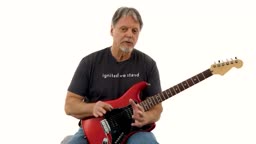
4 Voice Structures | Playing Off The 1
Demonstration
What's included
9 lessons • 1 charts • 1 Jam Tracks
I'm Brad Carlton, and in this edition of Guitar Lab we're going to be jamming over a track. In Vol. 3, I'll continue our study of A Dorian over a fixed jam track. We'll dive into principles like playing off the root, playing off the flat third, and building chord structures. I'll also discuss how to construct your solos to develop question-and-answer phrases based on the scale degree you want to emphasize.
It’s just like speaking: you finish your sentence with a period instead of trailing off or hesitating. You want your ideas and phrases to be complete and meaningful. I'll show you how to use musical 'commas' and 'periods'—all kinds of techniques to craft both short and long phrases. Plus, you’ll develop technique and flexibility with chord scales.
We'll even explore some fugue-like ideas on the guitar. So grab your guitar, and let's jam with a track!
It’s just like speaking: you finish your sentence with a period instead of trailing off or hesitating. You want your ideas and phrases to be complete and meaningful. I'll show you how to use musical 'commas' and 'periods'—all kinds of techniques to craft both short and long phrases. Plus, you’ll develop technique and flexibility with chord scales.
We'll even explore some fugue-like ideas on the guitar. So grab your guitar, and let's jam with a track!
In this lesson, you'll learn how to explore four-voice structures by focusing on the "one" as the primary voice to build a melody. You'll start with a stable A note and add descending voices within the chords, utilizing the A Dorian scale to create various A minor 7 chord voicings. By experimenting with inversions, such as a C triad, you'll keep the A as the top voice while allowing the bass to handle the lower notes. The key takeaway is to emphasize the root in your phrases, similar to ending a sentence with a specific word, which will help you align your playing with the chord. This practice will also train your ear to recognize the root note, enhancing your ability to play effectively from the "one."
In this lesson, you'll learn how to play off the flatted third in a minor tonality, which offers a distinct feel compared to playing from the root. You'll explore how to use a note like C as the top voice to experiment with various chord structures and voicings, leading to richer harmonies by ensuring each voice plays a different scale or chord tone. The lesson will guide you in visualizing the fretboard, recognizing notes along the string axis, and trying out different fingerings. By practicing these techniques, you'll gain a deeper understanding of how to harmonize off the flatted third, resulting in more dynamic phrasing in your solos and rhythms.
In this lesson, you'll learn how to play off the fifth, specifically the note E in the key of A minor. Whether you're working with three or four voices, E will be your primary focus. This approach will help you harmonize melodies using both simple chords, like minor triads, and more complex structures, such as A minor six and A minor add nine. By concentrating on roots, flat thirds, and fifths, you'll be able to build rich, melodic chord progressions.
In this lesson, you'll focus on the flat 7 (G) in an A minor 7 chord to create A minor 7 voicings by placing an A minor triad underneath. You'll experiment with different fingerings, exploring all possible combinations, including crossed or crumpled fingers, to discover what works best for you. This approach allows you to keep certain fingers free for adding extra notes and enhances your intonation, especially when using techniques like cross-fingering to minimize string distortion. Playing clean and in tune is essential, so you'll practice various fingerings, including jazz double stops, to develop flexibility and control in your playing.
In this lesson, you'll focus on the nine, or the two, starting with a B note to introduce a jazzier sound by incorporating extended nines, elevens, and thirteens. The nine adds a layer of color to your playing but requires careful placement, much like a spice in cooking. You'll learn how to sustain the B and resolve it by moving to the root or fifth for a stronger impact. As you improvise, you'll develop the ability to see chords beyond their basic shapes, gaining a deeper understanding of triads, intervals, and their relationship to scales. This knowledge will help you add more interesting chord voicings and melodic lines to your playing.
In this lesson, you'll explore the 11th, or the four, as a powerful note that disrupts tonality while remaining stable. You'll experiment with it in various voicings, such as Asus4, Am7, and Am11. By adding chromaticism, you can achieve a jazzier feel, especially when you understand the strong tones within the chord. You'll learn to build chords by focusing on the D as your focal point, then layering a flat third, root, fifth, and sixth to create a rich, extended sound. Understanding chords as slash chords, like Gsus4 over an A bass to form an Am7 11, will open up new possibilities in your playing. While this approach is common for pianists, guitarists can greatly benefit from it too.
+ 2 more lessons
Reviews
No reviews yet
Complete this course and be the first to share your experience.
Stop searching. Start improving with All Access.
Try 14 days free. Cancel any time.