




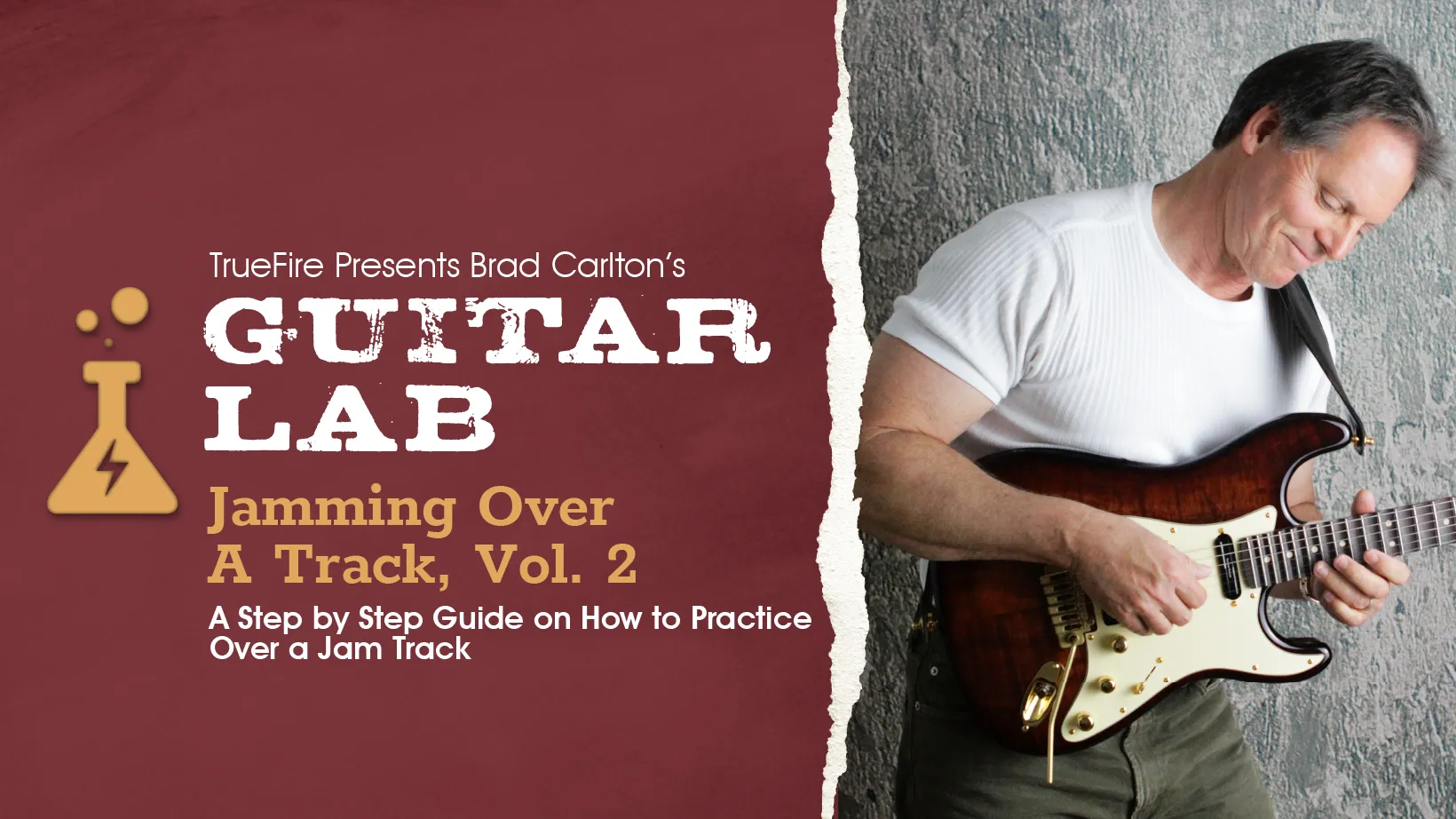
Guitar Lab: Jamming Over A Track, Vol. 2

Transform Your Practice: Your Guide to Jamming Over Tracks

Marty FriedmanTommy EmmanuelSteve VaiEric GalesEric Johnson

Get this course and 1,000+ more with All Access

Try 14 days free. Cancel any time.

Purchase Individual Course for $5.00
Guitar Lab: Jamming Over A Track, Vol. 2

About this course

Guitar Lab: Jamming Over a Track Vol.2 is your gateway to mastering the art of jamming. This course breaks down the essentials of playing over a static chord track, helping you understand rhythms, scales, and chords to enhance your solos.

From basic techniques to advanced concepts, you'll learn to analyze bass lines and drum patterns, unlocking the secrets to seamless jamming. Elevate your practice sessions and unleash your creativity with Guitar Lab: Jamming Over a Track Vol.2.

What you'll learn

  • Play diatonic scales using thirds intervals
  • Master triadic bridge concepts for melodic navigation
  • Learn to generate chords from parent scales
  • Identify and play the three interval pairs within any triad (root-third, third-fifth, fifth-root)
  • Develop keyboard-style visualization of the fretboard
Release date: 08/01/2024 • 1h 32m runtime
Start Course
Sample lessons

What's included

17 lessons • 1 charts • 1 Jam Tracks

Jamming Over A Track Vol. 2
I'm Brad Carlton. Welcome to Volume 2 of Jamming Over a Track.

I'm going to be explaining how to view the mode that you're going to play over this jam track and all the implications from a harmonic standpoint. You're going to study the parent scale and the chords that are generated from the parent scale.

I'll be teaching you a lot of triadic bridges and different options in terms of strong and weak.

You'll also learn how to view the guitar more like a keyboard.

So grab your guitar, and let's jam over a track.
Modal Choice | Dorian Voicings
In this lesson, we'll dive into jamming over a track by exploring how to choose and play modes, starting with understanding the role of the bass line and rhythm guitar parts. We'll use the Dorian mode as a foundation and see how it ties into familiar concepts like the minor pentatonic scale. You'll learn to add notes to the pentatonic to create a more jazzy or funky sound. We'll also cover the parent scale concept, showing how understanding the major scale all over the neck can help you master modes.
Dorian Voicings | Am Triads
I'm excited to take you through this lesson where we jam over a Dorian mode. We'll start by making sure you know your A minor chords all over the neck using the CAGED system. I'll show you how to visualize and play A minor triads, understanding their voicings and how they move up the neck. We’ll focus on different fingerings and inversions to add depth and variety to your playing. By the end, you'll be able to seamlessly incorporate these concepts into your solos and rhythm parts, enhancing your overall musicality.
Dorian Voicings | C Triads
Alright, let's dive into heptatonic arpeggios. Heptatonic means a seven-note group, so think about it like this: when your fingers are together, that's stepwise motion, and when they're spread apart, you're looking at triads, or what I call leapfrog. Imagine taking the A Dorian mode and instead of playing it step-by-step, you skip notes: A to C to E to G and so on. This gives us a different way to perceive scales and understand how chords are extended via thirds. For instance, if you take an A minor chord and play a C chord with an A in the bass, you get a minor seven. This leapfrogging concept helps you see triads and chord extensions across the neck, like playing C chords in different positions to get that A minor 7 sound. By the end of this lesson, you'll think like a pianist, using slash chords and visualizing chords all over the neck. Let's start with some practical examples and walk through it together.
Dorian Voicings | Em Triads
Alright, now let's talk about going up the neck with these heptatonic arpeggios. We're still in leapfrog mode, playing triads a third higher each time. So, we started with an A minor triad (A, C, E), then moved to a C major triad (C, E, G). If you know your A minor triad, that's your starting point. From there, you'll ascend to C major and then E minor, since A minor is the 2 chord in G, C is the 4 chord, and E minor is the 6 chord. We're only dealing with major and minor triads on six notes here.Knowing the notes on your guitar is crucial. You might think you can skip this step, but trust me, it makes all the difference in your growth. Spend some time with your guitar, learning the notes. You can use tools like octaves and unisons, or master one string at a time. Knowing your guitar inside out lets you play those E minor chords over an A minor tonality, creating the Dorian heptatonic arpeggio.When you play every other note of the A Dorian mode, you get an A minor 9 chord, which is like a minor version of "I Feel Good" by James Brown. You can see it as an E minor triad on top of an A minor triad or a C major 7 over an A bass. All this boils down to visualizing the key of G and applying it to A Dorian. This E minor triad gives you a unique sound, and I'll demonstrate it for you, providing commentary as I play so you can hear the difference.
Dorian Voicings | G Triads
Alright, in this lesson, we're diving into the Dorian heptatonic arpeggio. We’ll explore how to move up the neck by playing triads a third higher each time, starting with A minor, then C major, and E minor. We'll discuss the unique sounds that emerge from these combinations and how they form complex chords like A minor 9 and G triads over A. You'll learn to create different musical textures and navigate through neighboring triads, visualizing the major scale as your roadmap. By understanding these relationships and applying them practically, you'll be able to add depth and variety to your playing, blending elements of classical guitar and modern music techniques.
Dorian Voicings | Bm Triads
In this lesson, we’re moving up the Dorian heptatonic arpeggio to the B minor triad. Starting with G, you'll see how interlocking triads a third apart create rich extensions. We’ll explore how to move these triads up and down the neck, visualizing and hearing the A minor, B minor, and C triads. This approach will help you experiment with textures and open up new possibilities for your playing. Remember, always keep your home base in sight and get ready to explore further up and down the neck.

+ 10 more lessons

Start Course

Reviews

3 results

Osokin

Verified buyer

10/15/24

Dorian In Detail!

In this second volume of lessons on how to jam over a track, Brad Carlton really digs in to the myriad ways in which the dorian mode can be expressed harmonically on a one chord vamp. Some really great material is examined, with emphasis placed on how to play the guitar more like a keyboard player. Excellent stuff!
Boskov

Verified buyer

09/20/24

Great stuff

Very usefulle

Ohio5665

Verified buyer

08/28/24

Guitar Lab: Jamming Over A Track, Vol. 2

Another great course from Brad Carlton! i always learn something from his lessons.Fantastic teacher, he makes you think!

Stop searching. Start improving with All Access.

Try 14 days free. Cancel any time.