Sounds cool, but what the heck is "vertical soloing" and why would anybody want to learn how to do it? The most commonly accepted definition of vertical soloing is where a musician is focused on playing over individual chords in a progression or tune, rather than playing a scale that is common to all of the chords in the progression (horizontal soloing). Usually the musician is working with the chords' arpeggios, changing from one arpeggio to the next as the chords change, a very common approach for bebop.
Vertical soloing, for guitar players in particular, offers other very desirable benefits. When playing tunes that don't necessarily fit a standard progression like most blues or rock tunes, intermediate and even early advanced players tend to solo by following the chords up and down the neck, primarily because they cannot "see" all of the chords and underlying harmonic structure in a single position. Get your vertical soloing chops together and you'll be able to solo over any changes, in any key, in a single position on the fretboard. Sweet, huh?! It gets better.
Guitarists are notorious for getting stuck in the proverbial rut. This is primarily because they keep playing the same things, the same way in the same positions. Vertical soloing forces you out of your comfort zone and places you smack dab in the unknown zone, AKA the creative zone!
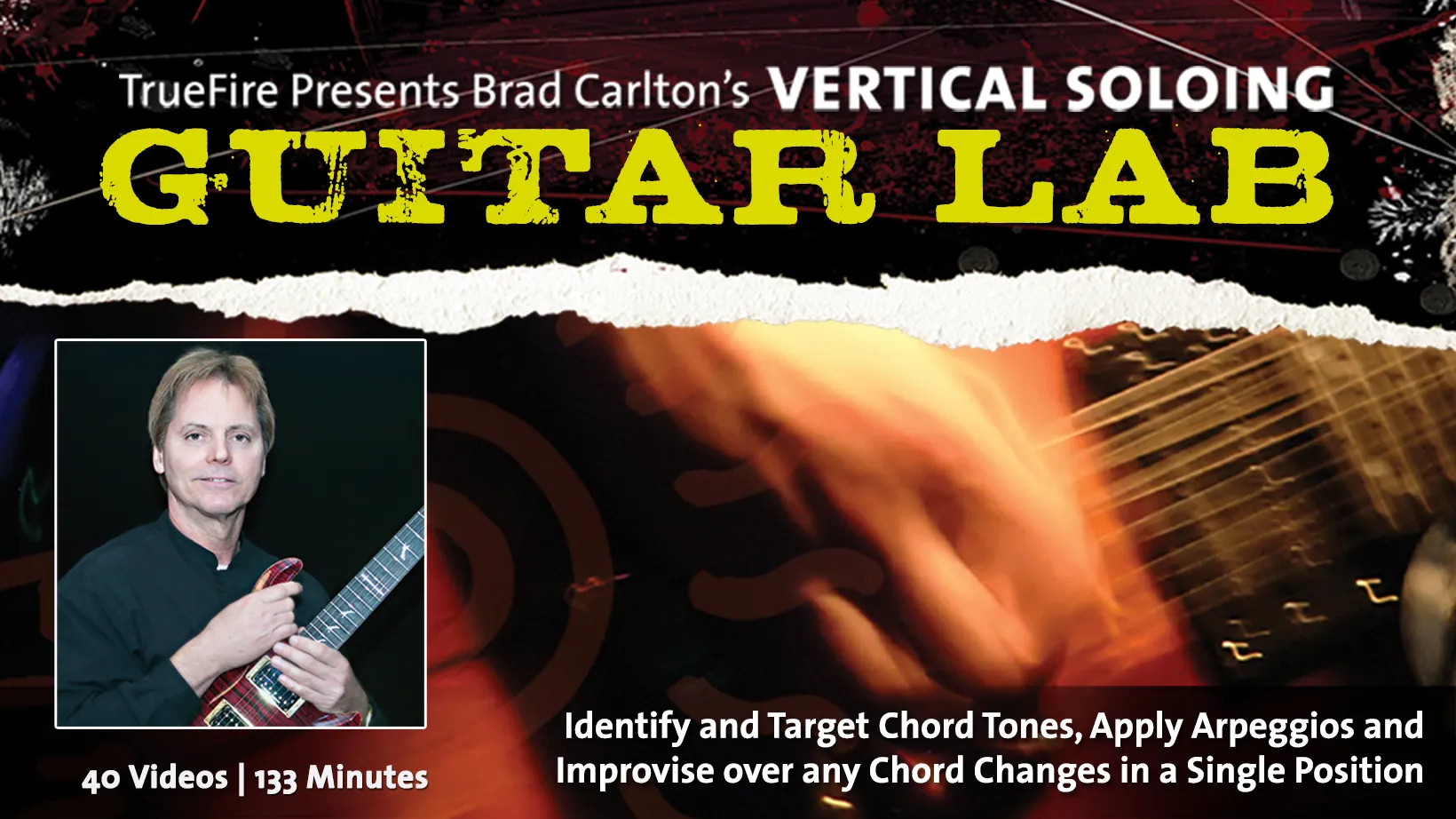
Guitar Lab: Vertical Soloing is another Brad Carlton intensive study program. True to form, Carlton not only introduces you to vertical soloing, he takes you deep into these waters. You'll learn how to quickly "see" all of the chord tones, for any prevailing chord, in a single "vertical" position. You'll learn how to play more melodically by creatively applying arpeggios, pentatonic scales and modes and connecting them from one chord to the next. Brad even shows you how to create more intersecting rhythm and bubble parts using these principles.
As you play your way through the course, you'll develop a solid grip on common tones, root targeting, sensitive and avoid tones, modes, sequences, connecting arpeggios and scales, extended arpeggios, rhythmic devices, pedal tones, street and theoretical keys, diagonal pentatonics, punctuation voicings and much more.
Guitar Lab: Vertical Soloing will dramatically improve how you think about improvisation, how you visualize the fretboard and how you sound when playing over changes. Get vertical!
This group of lessons will focus on soloing over an eight bar progression that is in the key of C Major. You will learn how to play more melodically by using the arpeggios for each chord as well as the pentatonic scales and modes. I will also give you some insight into how to apply theory to increase your skills in rhythm guitar.
The progression is a IV, V, VI, IV, ii V vi in the key of C. C Major is the theoretical key but A minor is the street key. I will demonstrate using just the A minor pentatonic scale as a means of soloing over this progression and I will explain the strengths as well as the limitations of this approach. Next I'll show you the pitfalls of just playing the modes over the changes. The issue of "weak tones" becomes apparent so next up is the application of arpeggios. The modes would be as follows: F Lydian over the F chord, G mixolydian over the G chord, A aeolian over the Am chord and D dorian over the Dm chord. As you will hear, there are weak tones in certain modes that don't sound strong so this directs us to the study of arpeggios which will be the subject of lesson 2.
This lesson deals with targeting the root of each of the four different chords that comprise the IV V vi IV ii V vi progression that we are presented with. These roots are F, G, A and D (the IV, V, vi and ii chords in the key of C). By playing the root of each chord, we are assured of a strong melodic foundation upon which we can build lines. This also reinforces the thought process of thinking of the chord changes ie "vertical soloing."
Let's start by examining why notes are available in our old standby. The A minor pentatonic scale. A minor pentatonic is spelled A, C, D, E and G. As you can see, three of the chord roots the we need are available in this scale; the A, D and G. I'll demonstrate playing these notes as the chords progress and I'll simply rest when the F chord is occuring. Next I'll flesh out the solo with the A minor pentatonic scale, always targetting the chord roots. I'll continue to rest during the F chord. Next I'll add the F note for the F chord. Finally I'll "connect the dots" with the entire C major scale. The last portion of this lesson breaks down the progression into pairs of chords: F to G for measures 1 and 2, G to A for measures 2 and 3 and also measures 6 and 7, Am to F for measures 3 and 4, F to Dm for measures 4 and 5, Dm to G for measures 5 and 6, and measures 7 and 8 are Am. These five chord connections can be practiced as loops individually, then assembled together as your skill allows. This way you won't feel overwhelmed with the constant flow of chord changes. Remember that any progression can be viewed as the chord you're on and the upcoming chord.
This lesson deals with the F to G chord connection which occurs in measures 1 and 2 of our 8 bar progression. The F chord is the IV chord in the key of C and the G chord is the V chord in the same key. The arpeggio for the F chord in V position is the F form of the CAGED system. The notes for the F chord are: F (1), A (3) and C (5). The arpeggio for the G chord in V position is the D form of the CAGED system. The notes for the G chord are: G (1), B (3) and D (5). I'll demonstrate soloing using just the notes in the arpeggios for each chord. Then I'll expand my note choice options by superimposing the C major scale (form VI) over these two arpeggios in V position. The C scale serves as F lydian over the F chord and G mixolydian over the G chord. A great practice scheme is to restrict your soloing to just the roots, thirds, fifths and then combinations of these. This helps you focus on being free in your playing as opposed to just running arpeggios.
Let's dig a little deeper into this IV V vamp in the key of C. The modes are F lydian for the IV chord (F) and G mixolydian for the V chord (G).I will show you these modes in V position. The scale form is form VI of the C major scale, There are two F notes and two G notes in this position. They establish the reference points for playing the F lydian and G mixolydian modes. You'll see me play the entire one octave mode against each chord, then I'll play smaller note groups. The important thing is that I'm always aware of the prevailing chord and I articulate the harmony by targeting roots, thirds and fifths as strong notes. That's why you want to be quite proficient with the arpeggios before you tackle the modes, otherwise your soloing will lose it's melodic nature and you'll sound like you're just playing a lot of meaningless notes.
Measures 2 and 3, 6 and 7 of our 8 bar progression consist of the chord connection G to Am. These two chords are the V and vi chords in the key of C. The arpeggios for these two chords are as follows: the D form of the CAGED system of the G chord and the Em form of the EDCAG system for the Am chord. Both of these arpeggios reside in V position. The chord spellings are G (1), B (3) and D (5) for the G chord; A (1), C (b3) and E (5) for the Am chord. I'll demonstrate soloing using just the arpeggios, then blending the A minor pentatonic scale in for a rock/blues vibe. Next I'll apply the modes to each of these chords. For the G, play G mixolydian (mode V of C major). For the Am, play A aeolian (mode vi of C major). I'll explain the sensitive or weak tones for each mode. The 4 (C) of the G mixolydian mode will clash with the 3 (B) in the G chord. Listen to how I use the 4 in a resolving move to the 3 or 5. The b6 (F) of the A aeolian mode is also a sensitive tone. It tends to resolve down to the 5 (E) or up to the b7 (G).
In this lesson I will demonstrate sequences as applied to the G and Am arpeggios. This is a great way to develop question and answer phrasing in your solos. The sequence can be melodic or rhythmic. For example, try a figure of a quarter note and a dotted half note for the rhythm (1, 2, 3, 4) and apply the following melodic choices for each chord: 1 3, 3 1, 1 5, 5 1, 3 5, 5 3.
Use this chart for any two chords for a thorough workout of melodic connections and sequences restricted to the arpeggios. Just use the appropriate formula for either a major or minor triad. Then start playing with the phrasing to provide an endless supply of ideas.
Measures 3 and 4 of our progression are Am to F (vi IV). This is different from the previous chord connections F to G and G to Am. Our previous chord links were adjacent diatonic triads whereas the Am to F change in bars 3 and 4 are a third apart (every other diatonic triad). What this means is there are common tones. The Am is spelled A (1) C (b3) E (5) and the F is spelled F (1) A (3) C (5). Notice how we have the A and C notes as common tones. There is a rule being applied here: any two diatonic triads a third apart will share two common tones. Since the A and C notes are common, try sustaining each of them over the chord change. Then use the remaining E to F move to lock up with the progression. The most important goal is to "pre-hear" these melodic moves that exist between the arpeggios. Always listen as you play to how the note you're playing functions against the prevailing chord. I'll also discuss the common tones between the A minor and F major pentatonic scales.
This was one of those courses that really set me on a path of true progression in my playing ability. This will absolutely motivate you to learn all triad inversions on the neck, and more importantly, how to work them into melodic soloing.
W
wholmer
01/04/21
Guitar Lab: Vertical Soloing
Brads Guitar Lab series is awesome! He takes an element of every aspect of guitar playing and dissects it, laying open so you can easily understand it. The bite size lessons and his teaching method are really very well thought out and very comprehensive. I am always pleased with the outcome.
S
SoniaMyLove
10/18/20
A lot of great useful information
Brad has a way to simplify a lot of information to make it easy to understand.
He is a master of his instrument and has the ability to relate useful information
A
Artist21
Verified buyer
06/07/20
This course helps a lot....great.
Very good teacher!!!
H
Hans k.
03/30/20
Under appreciated
I don't know why this course has not gotten more reviews, it contains tons of insight, theory and usable info. Why four stars, well nothing is perfect.