




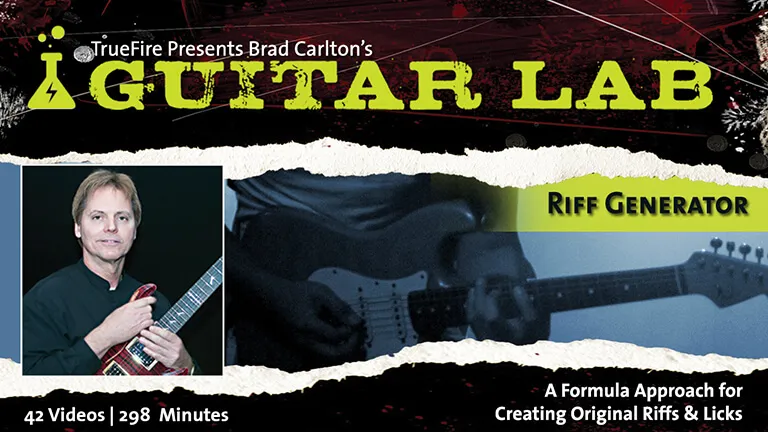

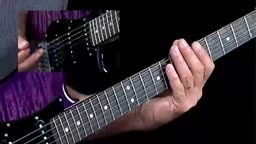
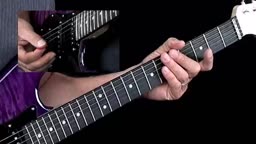
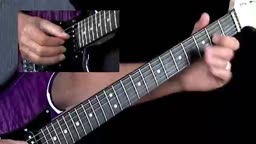
Guitar Lab: Riff Generator

A Formula Approach for Creating Original Riffs & Licks

Marty FriedmanTommy EmmanuelSteve VaiEric GalesEric Johnson

Get this course and 1,000+ more with All Access

Try 14 days free. Cancel any time.

Purchase Individual Course for $5.00
Guitar Lab: Riff Generator

About this course

Brad Carlton is back with another Guitar Lab intensive and this one will completely and unalterably change the way you see, hear and play riffs, licks and lines of any kind. In fact, his Riff Generator approach for single line construction may very well be your Helen Keller moment on guitar and we don't make that reference lightly or without extreme respect.

In the same way Brad "cracked" the CAGED and EDGAD chord system for we students of the six-string, he likewise unravels the creative formula for single line construction in an entirely illuminating and profoundly accessible way.

You will learn how to think, feel and see the entire fretboard in scale degrees. Yup, scale degrees. And once you've got those under your belt -- and that will come very easily -- he'll equip you with a series of formulas for ideation and motivic development. Right and left-brained finger stuff that pull you out of the proverbial rut so fast and so far that your head will spin with new musical ideas.

In the first section of the course Carlton shows you how to see and work with a minor pentatonic scale in terms of scale degrees and its intervals along the string axis. The first five lessons present slur exercises to develop your speed, articulation and endurance. Lessons six through ten focus on targeting tones; a fundamental skill leading to mastery over the tonal gravity of your melodies. The last two lessons get you started building riffs by utilizing formulas as the framework for your melodies.

"This concept of viewing riffs and melodies following a scale degree formula approach has many advantages. You'll learn to hear melodic lines and know where they are on the fingerboard no matter what key you're in. This first section of the course is the foundation upon which we will build more advanced melodies in different harmonic environments in the subsequent sections."

In the second section of Riff Generator, you'll explore a variety of formulas drawn from the blues composite scale. These formulas constitute the standard frameworks for lines that can be applied over dominant and blues-based harmonies. You'll work with the blues composite scale, which can be viewed as the sum of the major pentatonic scale and the blues scale. In this section, you'll learn how to "hear" the full range of tonal colors and learn where to find these sounds all over the fingerboard.

In the final and third section of Riff Generator, you'll continue adding more formulas to your kit and focus on the principle of pitch direction, which allows for variations within a given formula. Each formula will be diagrammed over the entire fingerboard thus allowing various layouts for those specific notes and degrees. Get a grip on this section's examples and series of formulas and you're well on your way to mastering how to apply pitch direction, layout and phrasing to generate an endless range of fresh, melodic and innovative single note lines.
Moves & Formulas Covered in Riff Generator:

• Targeting Root
• Targeting 5th
• Targeting b7
• Targeting b3
• Targeting 4th
• b7 1 Move & Formula
• b3 1 Move & Formula
• b3 2 1 Move & Formula
• 1 2 b3 3 Move & Formula
• 3 4 #4 5 Move & Formula
• 6 5 Move & Formula
• b7 6 5 Move & Formula
• b5 4 b3 Move & Formula
• b3 3 5 6 1 Move & Formula
• b3 3 1 Move & Formula
• b3 3 b7 Move & Formula
• b3 3 5 Move & Formula
• b3 3 6 Move & Formula
• 1 b3 3 4 #4 5 Move & Formula
• 1 b3 3 5 6 b7 Move & Formula
• 1 6 b7 Move & Formula
• 4 b3 3 1 Move & Formula
• 5 1 Move & Formula
• 4 1 Move & Formula
• b7 b3 1 Move & Formula
• b3 b7 1 Move & Formula
• b7 5 1 Move & Formula
• 5 b7 1 Move & Formula
• 5 b3 1 Move & Formula
• b3 5 1 Move & Formula
• 4 b3 1 Move & Formula
• b3 4 1 Move & Formula
• 4 5 1 Move & Formula
• 5 4 1 Move & Formula
• Targeting Minor Chord Tones
• Targeting Major Chord Tones

True-to-form with most Brad Carlton courses, there's enough grey matter and solid guidance in Riff Generator to draw from for the rest of your guitar playing days, yet it will take less than five minutes to absorb enough to put these principles to good work in your own solos and improvisations. Open your eyes and get to work!

What you'll learn

  • Apply the lick effectively at bar 12 of a 12-bar blues to target the V chord
  • Apply b7-5-1 structure in both rhythm and lead playing
  • Create melodic patterns using the b7-5-1 intervallic relationship
  • Improvise using the b7-5-1 structure within pentatonic frameworks
  • Construct and play b7-5-1 chord voicings across the fretboard
Release date: 11/18/2010 • 4h 58m runtime
Start Course
Sample lessons
Targeting b7
Targeting b7
Riff Formula
3 4 #4 5 Move
3 4 #4 5 Move
Riff Formula
b5 4 b3 Move
b5 4 b3 Move
Riff Formula
1 b3 3 5 6 b7 Move
1 b3 3 5 6 b7 Move
Riff Formula

What's included

42 lessons • 41 charts • 4 Jam Tracks

Riff Generator
Welcome to Riff Generator. In this course you will learn to see the entire fingerboard in terms of scale degrees. We will begin with the A minor pentatonic scale viewing it in a linear sense along the string axis. This will enable you to clearly see the intervals that occur in this scale. The first five lessons will present slur exercises to develop your speed, articulation, and endurance. Lessons six through ten will focus on choosing a specific note out of the minor pentatonic scale as a target. This is critical for having mastery over the tonal gravity of your melodies. The last two lessons is where we start building riffs by utilizing formulas as a framework for our melodies. We will explore various technical approaches to playing a specific formula as well as our options as guitarists to how we lay out the information on the fingerboard.

This concept of viewing riffs and melodies according to a scale degree formula approach has many advantages. You will learn to hear melodic lines and know where they are on the fingerboard no matter what key you are in. This is a foundational group of lessons upon which we will build more advanced melodies in different harmonic environments in subsequent courses. Probably the most appealing aspect of this approach is that you won't get into the rut of playing the same old tired licks.

In the second half of Riff Generator, we will explore various formulas drawn from the blues composite scale. These formulas constitute standard frameworks for riffs applicable over dominant and blues-based harmonies. The blues composite scale can be viewed as the sum of the major pentatonic scale and the blues scale. The formula for the major pentatonic scale is: 1 2 3 5 6, and for the blues scale it is: 1 b3 4 5 b7. As you can see, both scales share your two strongest tones, the root and the fifth. In these lessons you will learn how to hear various colors to enhance your blues-based playing and where to find these sounds on the fingerboard.

As we rap up Riff Generator we continue with the melodic formula concept which is the foundation of the riff generator series. In these lessons we’ll focus on the principle of pitch direction which allows for variations within a given formula. If a formula contains two different notes, there will be two possible pitch directions for the second note, either up or down. If the formula contains three different notes, there will be four possible pitch directions for the second and third notes. Each formula will be diagrammed over the entire fingerboard thus allowing various layouts of the notes. You may then take a given formula and apply pitch direction, layout, phrasing, and all the various guitar techniques that we have available to truly generate a huge variety of licks. Each formula is based on strong tones which will increase your confidence when soloing.
A Minor Pentatonic
This lesson focuses on the A minor pentatonic scale as viewed on the fifth string. We will begin with trills involving the open A as a pedal tone. You will use all four fingers of your left hand thus balancing your hammer on and pull off technique. As you practice you will think letter name, scale degree, location on the fingerboard and pitch of each note you play. Your goal is to see the entire scale along the string axis and have the ability to play any of those notes in any combination.

We will also cover descending triplets with specific emphasis on the sequential components of the hammer on and pull off combinations used to execute these figures. Each lesson in this course is accompanied with specific color-coded diagrams to aid you in visualizing the information on the fingerboard.
A Minor Pentatonic
This lesson focuses on the A minor pentatonic scale as viewed on the first and sixth strings. We will apply the techniques from the previous lesson namely trills involving the open string as a pedal tone. In this case the open string will be the fifth, the second strongest toner in terms of tonal gravity. In addition to the descending triplets that were presented in lesson one, you will play ascending triplets with slurs. Instruction concerning the sequential components of the hammer on and pull off combinations used to execute these figures will be addressed.

Each lesson in this course is accompanied with specific color-coded diagrams to aid you in visualizing the information on the fingerboard.
A Minor Pentatonic
This lesson focuses on the A minor pentatonic scale as viewed on the fourth string. All the techniques presented in lessons one and two are applied to the fourth string as well as 16th note figures and right-hand tapping.

As you advance through these lessons and practice the drills that are presented, your endurance and speed will improve as well as your ability to visualize the A minor pentatonic scale any linear sense along the string axis. The minor pentatonic scale is always built with the following intervallic pattern: minor third, major second, major second, minor third, and major second. One of your goals is to see this on different strings. At this point, this wide-angle viewing of the scale along the string axis should be coming into focus from practicing on various strings.

Each lesson in this course is accompanied with specific color-coded diagrams to aid you in visualizing the information on the fingerboard.
A Minor Pentatonic
This lesson focuses on the A minor pentatonic scale as viewed on the third string. All the techniques presented in lessons one through three are applied to this string. We also now introduce legato slides as a new tool to create a liquid flowing sound to our melodic lines. In this lesson you will learn how to get the guitar to sing with just your fretting hand by utilizing hammer ons, pull offs, and legato slides to keep the string vibrating.

It is important to visualize the entire scale along the string axis and not get in the rut of tunnel vision where you just see a few frets of the fingerboard as your area of activity. Force yourself to play all over the fingerboard using all the techniques at your disposal.

Each lesson in this course is accompanied with specific color-coded diagrams to aid you in visualizing the information on the fingerboard.
A Minor Pentatonic
This lesson focuses on the A minor pentatonic scale as viewed on the second string. All the techniques presented in lessons one through four are applied to this string. One difference will be that we will not have an open string available as a pedal tone because the lowest available note on the second string is the flat three which occurs in the first fret.

Your fretting hand will be challenged by the three note groups that are presented in this lesson. They will be as follows: b3 4 5, 4 5 b7, 5 b7 1,b7 1 b3, and 1 b3 4. You will be forced to stretch as you use a one finger per note approach to play these figures. I'll also demonstrate bends and releases as another way of playing these three note groups.

Each lesson in this course is accompanied with specific color-coded diagrams to aid you in visualizing the information on the fingerboard.
Targeting Root
This lesson focuses on targeting the root of the A minor pentatonic scale all over the entire fingerboard. The root is the strongest tone and therefore is very useful as a close for melodic lines. I will demonstrate by playing over the jam tracks string by string, and then integrate the entire fingerboard by utilizing all six strings. Your goal is not only to visualize this information on the fingerboard, but to hear it.

I'll also give you a preview of the concept of lower neighbors to a target note. This will be covered in depth in lessons 11 and 12.

All the techniques you've learned in lessons one through five will be applied to this lesson as you target the root.

Each lesson in this course is accompanied with specific color-coded diagrams to aid you in visualizing the information on the fingerboard.

+ 35 more lessons

Start Course

Reviews

11 results

mxdaxeman

Verified buyer

01/16/25

Learn from the master they call Brad Carlton!

Brad Carlton IS THE BOMB!!! Just a brief history of my journey learning the guitar, my late father told me in 2017, "Marcus, you MUST know theory. You've gotten so frustrated over the years playing and learning but you've never mastered the major and minor scales. " Thank you Dad. You were right. I decided to purchase Riff Generator because of my lack of comprehension and skill in being able to perform them. This is a skill to necessarily be had and Mr. Carlton blew me away in his 'Riff Generator' course because I've NEVER attacked them in this fashion. Being able to take the minor scale ON EACH STRING was totally mind blowing because when I wanted to learn how to do them from the guys I hung around, they always treated riffs as a best kept secret. Now that I have the POWER on my desktop and now within my hands, I can only thank Brad Carlton for that! HE is the reason today that I now have my "AHHH-HAAA" moment. I've constructed a schedule for my self taught music lessons for the rest of the year. This year, 2025, will be the year I can truly say that I AM a musician. Knowing a skill like performing riffs takes anyone's guitar playing to a totally different level. Thank you all at TrueFire and Brad, YOU ARE THE MASTER. Keep rockin'!!! Marcus DeRamus
brosblues

Verified buyer

10/28/24

This course contains lots of useful pentatonic tips!

smarago

Verified buyer

11/25/23

cool fretboard orientation , but not a silver bullet

No doubt, Brad Carlton is a good guitarist and teacher and the title Riff Generator sounds appealing, who does not want to play Riffs automatically? And indeed, the course gives a good orientation, how to orientate on the fretboard finding the right notes for scales and chords. But this does not mean that you generate good riffs only by finding right sounding tones. So if you want to learn how to find the root, b3, 4, 5 etc. then this is the right course for you. If you think that you can play cool riffs after this course you might be disappointed.

Perseusz2305

Verified buyer

09/05/23

solid course

I like Brad's courses because it forces you to work on your own and search for your sound within the lesson you are covering. I like his universal approach and practical tips. Riff Generator has opened my eyes and ears to cool new riff ideas. The course requires a lot of work, but it is enjoyable and produces good results.

rryder67

Verified buyer

04/23/23

Riff Generator

Brad's lessons always provide me with new insights and tools to understand music improve my guitar theory and skills.

Stop searching. Start improving with All Access.

Try 14 days free. Cancel any time.