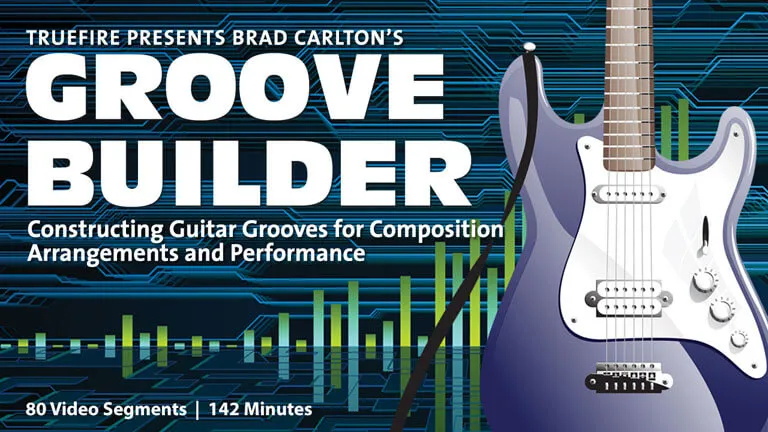
Groove Builder

Constructing guitar grooves for composition, arrangements and performances.

Marty FriedmanTommy EmmanuelSteve VaiEric GalesEric Johnson

Get this course and 1,000+ more with All Access

Try 14 days free. Cancel any time.

Purchase Individual Course for $5.00
Groove Builder

About this course

Groove Builder thoroughly examines the art and science of "groove" by working through a variety of arrangements designed to illustrate the interplay between bass, drums, and various rhythm and lead guitar parts. Students work through an intensive curriculum focused on training their "ears" and improving their rhythm, arrangement, and composition chops to achieve and maintain the all-important groove.

TrueFire's resident educational guru, Brad Carlton, authored Groove Builder as a follow-up to his highly popular Rhythmic Grooves curriculum; however, the material is an ideal stand-alone course for students with a relatively solid grasp of rhythmic figures.

Starting from the bottom up, Carlton demonstrates how to establish the foundation of a groove with bass and drum parts. These sections of the course teach guitar students how to "hear" and analyze what's going on rhythmically. This essential skill must be developed to create rhythm guitar parts that lock solidly into the groove; an ability that most intermediate players have not yet fully mastered.

Students work through a variety of grooves including 8th note, 16th note, shuffle, straight, swing, R&B, rock, funk, ballad, fusion, and blues. With each groove, the bass and drum parts are analyzed, and the rhythm guitar parts are discussed and created accordingly. This is a particularly "ear-opening" series of lessons for players of all levels.

Now the fun begins. Once all of the grooves are established, the arrangements are fleshed out and orchestrated with additional rhythm guitar parts, bubble parts, and then melody and lead parts. This construction process reveals all of the fundamentals and finesse required for composing or arranging tunes as well as learning how to "play nice with others" (read: avoid train wrecks!) in any band or jam setting.

If you compose, arrange, record, play in a band, or just jam with friends, Groove Builder is a must for your practice regimen and reference library. As with most Carlton study programs, this one's no breeze, and students need to be prepared to invest the time to work through all of the material at their own pace.

What you'll learn

  • Play movable sus2 voicings across the fretboard
  • Create arpeggiated fingerstyle patterns over chord progressions
  • Create supportive rhythm guitar parts that build over time
  • Understand and apply chord inversions systematically
  • Build extended chord voicings (maj9, m7-11) with multiple fingering options
Release date: 01/18/2007 • 3h 36m runtime
Start Course
Sample lessons
Straight 8th Bass & Drums
Performance
Straight 8th Guitar
Straight 8th Guitar
Introduction
Straight 8th Rhythm Guitar
Performance
E Funk
E Funk
Introduction

What's included

80 lessons • 40 charts • 20 Jam Tracks

Straight 8th
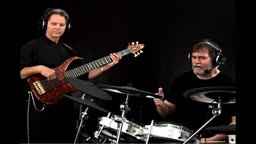
Welcome to Groove Builder! While this series of lessons and performances stand on their own, the intention is to punctuate and expand on the key learning in Rhythmic Grooves. Mike Davis helps me illustrate many of the rhythmic examples that I present. For the first half, I will be playing bass so that I can demonstrate the building blocks of a groove and how essential the rhythm section is to the overall vibe of that groove.

In the second half, I'll play rhythm guitar over the grooves that Mike and I lay down so that you can clearly see how the guitar interacts with bass and drums to keep things in the pocket. All of the bass and drum tracks are included for your use as practice tracks. First, focus on mimicking what I am doing on guitar. Then start applying the unlimited range of patterns that we covered in Rhythmic Grooves.

This first track is oriented around a straight eighth feel with sixteenths interspersed throughout for a funky feel. Section A is based off of the A minor pentatonic scale and the power chords built out of it: A5, C5, D5, G5. Section B moves from G to D/F# and then back to A5. An E5 is used to close this section which provides a V I cadence when returning to section A.
Straight 8th Bass & Drums
Welcome to Groove Builder! While this series of lessons and performances stand on their own, the intention is to punctuate and expand on the key learning in Rhythmic Grooves. Mike Davis help me illustrate many of the rhythmic examples that I present. For the first half, I will be playing bass so that I can demonstrate the building blocks of a groove and how essential the rhythm section is to the overall vibe of that groove.

In the second half, I'll play rhythm guitar over the grooves that Mike and I lay down so that you can clearly see how the guitar interacts with bass and drums to keep things in the pocket. All of the bass and drum tracks are included for your use as practice tracks. First, focus on mimicking what I am doing on guitar. Then start applying the unlimited range of patterns that we covered in Rhythmic Grooves.

This first track is oriented around a straight eighth feel with sixteenths interspersed throughout for a funky feel. Section A is based off of the A minor pentatonic scale and the power chords built out of it: A5, C5, D5, G5. Section B moves from G to D/F# and then back to A5. An E5 is used to close this section which provides a V I cadence when returning to section A.
16th Notes
This groove is based on the constant sixteenth note rhythm popularized by the great funk group "Tower of Power". Section A is simply an E7, section B is a C7. Later in the tune you'll hear us "open it up". This is where the rhythm section gets to solo.

Even if funk isn't your bag, there's no better learning ground for developing solid rhythm chops. You'll also find that the sixteenth note patterns so common to funk are also very evident in a wide variety of styles.
16th Notes Bass & Drums
This groove is based on the constant sixteenth note rhythm popularized by the great funk group "Tower of Power". Section A is simply an E7, section B is a C7. Later in the tune you'll hear us "open it up". This is where the rhythm section gets to solo.

Even if funk isn't your bag, there's no better learning ground for developing solid rhythm chops. You'll also find that the sixteenth note patterns so common to funk are also very evident in a wide variety of styles.
Blues Shuffle
Now we examine a blues shuffle. I'll show how articulation of the bass line within the shuffle figure can make a difference. Section A is a I7 IV7 vamp in C. Section B moves through the V7 and IV7 chords with a walking style bass line before closing with a quarter note triplet figure.

A solid understanding of the shuffle rhythm, gives you the ability to create an endless variety of shuffle grooves to keep things fresh and spicy.
Blues Shuffle Bass & Drums
Now we examine a blues shuffle. I'll show how articulation of the bass line within the shuffle figure can make a difference. Section A is a I7 IV7 vamp in C. Section B moves through the V7 and IV7 chords with a walking style bass line before closing with a quarter note triplet figure.

A solid understanding of the shuffle rhythm, gives you the ability to create an endless variety of shuffle grooves to keep things fresh and spicy.
R&B
This track is based on a typical R&B sixteenth note style groove. The secret is in what you don't play. Section A is a I, iii, IV, iv progression in C. Section B uses other diatonic chords in the key of C.

You've heard me say many times that "less is more" when it comes to soloing and rhythm playing. This groove is a perfect example of that principle.

+ 73 more lessons

Start Course

Reviews

8 results

guitarguy234

Verified buyer

02/05/26

Enjoying the curve

A good insight on what to think!
obbig

Verified buyer

01/05/25

Great for guitar, but handy for bassists too!

For a start it's Brad Carlton teachiing a rhythm course. But if you look outside the box you'll see that there's a large emphasis on the bass & drum grooves in different styles. These are good to jam along to as he & Mike demonstrate & talk about different approaches, and for early intermediate bassists it's more good stuff to work on. Part of the work/practice is that the bass parts aren't notated (it's a guitar course), so you'll use your eyes & ears to play along or write your own tab. Sometimes courses provide more than what you think they do!

angusold

Verified buyer

04/10/21

Good Course to set more focus on the groove. Good Idea to start with bass and drums!

rick56

Verified buyer

03/23/21

Groovin

Pretty easy to follow. Fun to play and challenging as well. Very well presented. Recommended Grooving to this!

Gerry U.

12/03/19

Love this guy!

Superb teacher. Anything by Brad Carlton is worth a look

Stop searching. Start improving with All Access.

Try 14 days free. Cancel any time.