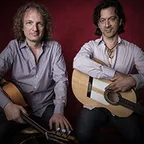
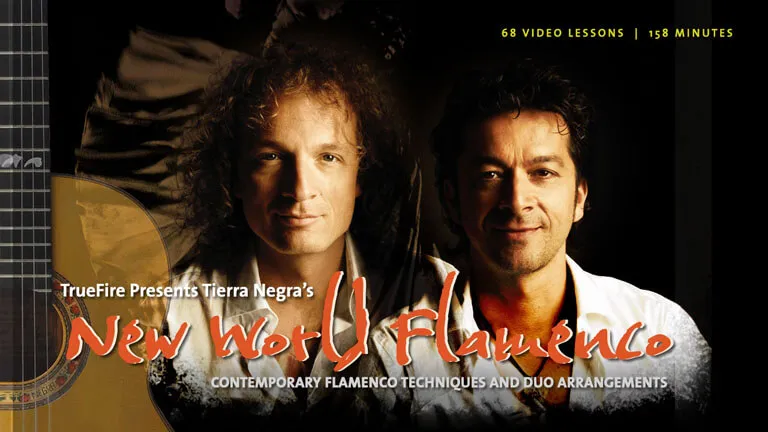
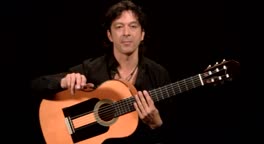
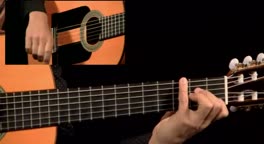
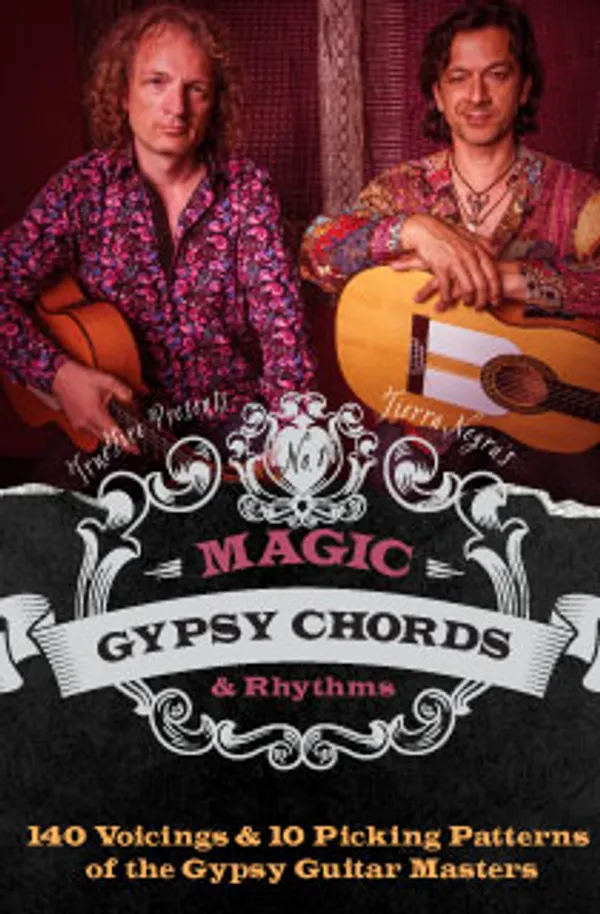
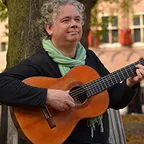
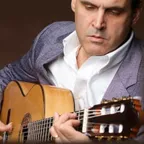
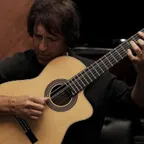
Performing as the guitar duo Tierra Negra, Raughi Ebert and Leo Henrichs have double-handedly sparked a "New World Flamenco" craze amongst guitar players and enthusiasts the world over. Clear symptoms of this particular craze are involuntary tapping of feet, entranced urge to dance, ear-to-ear grins, and an irresistible pull to their merch table in search of CDs and guitar lessons covering this new and exciting modern take on Flamenco. Sadly, no instruction was readily available. Until now.
Over two years in development, this hands-on interactive New World Flamenco video course gets you up and running more quickly, more effectively, and in a far more entertaining manner than anything we've seen before. You will play your way through the course without having to struggle through boring exercises or tedious theory; and you can do so on any guitar you own, although a nylon stringed acoustic instrument would certainly be ideal.
New World Flamenco serves two types of students; it's an ideal study program for any student who wants to delve into the world of Flamenco or world music by learning some of the traditional techniques and developing a strong repertoire of tunes that they can perform. But, it's also very appealing for blues, rock, jazz, pop and acoustic players who are more interested in flavoring their own sound with this very compelling, melodic and rhythmic world vibe.
Raughi and Leo first step you through 21 key techniques; 7 Rumba strum patterns, 3 Arpeggio patterns, 3 Melody approaches, 3 Golpe techniques (percussive sounds made with the index finger), and 5 Rasquado techniques. (strumming with flicks of the fingers). They explain and then demonstrate the technique in a very accessible manner and often include a play along segment for you to practice with.
Various combinations of these 21 techniques will be applied in the second half of the course where Raughi and Leo teach you the rhythm and melody parts for eight New World Flamenco-style arrangements; Boreal, Hommage a Manitas, Thanks for the Memory, Junto al Mar, La Camargue, El Acuario, Scirocco and Place du Forum.
Each tune is taught across 6 segments (4 for the slower tunes); rhythm overview, rhythm & play along at slow tempo, rhythm play along at tempo, melody overview, melody and play along at slow tempo, and finally the melody play along at tempo.
The play alongs are fantastic because you can play along with the video to learn the part itself and then play along with the corresponding part to comprise the full duo performance (ex. play the melody part along with the rhythm play along video or audio or vice versa).
New World Flamenco is majorly fun to work with and extremely gratifying. In fact, you will find it hard to put down once you've dived in. This is one of those courses that everybody here at the 'Fire had to have an advance copy of and a few of us here even 'electrified' a bunch of the material with great success. We guarantee that you will have a blast as well!
What you'll learn
Apply rumba rhythm patterns 3 and 5 to a complete song
Transition between different rumba rhythm patterns within a song
Coordinate rhythm playing with melody part
Observe performance technique for 'Junto al Mar 2'
We are Raughi Ebert and Leo Henrichs. Together we form the guitar duo Tierra Negra, which plays nuevo flamenco, or "new flamenco."
New World flamenco is a modern take on flamenco - the fiery traditional guitar music from Andalusia, a vast region on the southern tip of Spain. Our souls were captivated by the exotic rhythms of flamenco and rumba, which we have studied with the Gypsies in depth. We love the drama and passion of flamenco and look forward to sharing it with you here.
In this course, we take you step-by-step through building a powerful and exciting New World Flamenco vocabulary of your own. You may use a classical guitar, or a flamenco guitar, which is very similar to the classical guitar but has a wider fretboard. Historically, these instruments were strung with gut strings. Today nylon strings are used to produce a rich, mellow tone. Have the string action of your guitar set to medium height to help prevent strings from buzzing against the frets during the vigorous strumming that is essential to flamenco.
As you progress through this course, you will learn to play duets, alternating between rhythm and melody parts. Don’t worry, we demonstrate every piece at a slow tempo, as well as at its normal tempo, and provide accompaniment so you can practice both sides of each duet.
Sometimes we use the capo to achieve a traditional sound. We achieve a colorful sound in a guitar duo when only one guitar plays with the capo. Apart from that, the guitar sounds brighter and the chords are easier to play, because the scale is becoming smaller and the string action is getting lower.
We conclude with an exclusive performance for you from Tierra Negra. Olé!
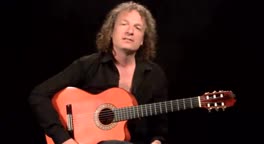
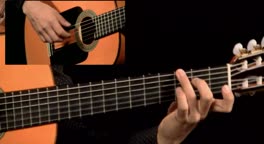
The rumba strum is a basic building block of flamenco. To play this rumba rhythm pattern, I’m going to use my thumb, index, middle and ring fingers, which are referred to in both flamenco and classical guitar by the letters of their Spanish names:
(P) = pulgar = thumb (I) = indice = index finger (M) = medio = middle finger (A) = anular = ring finger
Notice how I rest my upper right arm on the guitar, and allow all the movement to come from my forearm, which swings freely. We will use the thumb and fingers of the right hand to strum the strings.
First I’ll show you the strum while muting the strings. To do so, I press down on them gently with my left hand. This muting technique is called a palo seco, which means "dry stick" in Spanish. It’s named after the stick that was beaten on the floor to accompany flamenco dancers and singers.
Next, we’ll add percussive sounds to the rumba strum by tapping the guitar body with the thumb and thumbnail. As you can see, my flamenco guitar is outfitted with black scratch plates called golpeador that protect the soft wooden body of the guitar from being damaged by my nails. Flamenco guitars come with these attached, but you can also have a luthier attach protective plates to your classical guitar, if you like.
Hit the chart button on the player for the strumming pattern diagram.
I play the rumba strum a little differently than Raughi, but all rumba strums emphasize the same accents - on the "and" of 2 and on the 4.
In this lesson, we will play my rumba strum over the most popular chord progression in flamenco: Am G F E. As you can see, these are all played in the first position on the guitar.
Let’s move this progression up a whole step to Bm A G F# Phyrgian. Note that I am not fretting the high B and E strings. I’m letting them ring, and it’s these open B and E notes that add some character to the progression and turn the F# into F# Phyrgian.
Hit the chart button on the player for the strumming pattern diagram.
Note how my hand is positioned when I hit the guitar - I’m spreading my thumb away from my fingers in order to avoid hitting the sound hole. The palm hits the guitar on beat 3 for a very satisfying "thunk." Sometimes I hit the top of the guitar above the sound hole with my thumb nail on beat 4.
Let’s try it over this Gypsy chord progression: Em D7 (in third position, let the high E string ring open) C7 B7. Make sure to mute the low E string when you play D7 C7 and B7. To mute the low E string, simply let the tip of your ring finger rest against it as you play the chords.
Hit the chart button on the player for the strumming pattern diagram.
So far, you’ve learned to mute the strings with the left hand. For this rumba strum, we mute the strings with the right hand on beat 3, by pressing the side of the thumb against the strings after strumming them with the index finger.
Notice how relaxed my thumb is. By keeping it loose and relaxed, I am able to use the full length of the thumb to gently mute the strings.
Hit the chart button on the player for the strumming pattern diagram.
This is the new chord progression:
Abm F# (with open B and E strings) E Eb/G.
For this strum pattern, I’ve simply moved the right thumb mute to beat 4. Note that as I strum the guitar with the index finger of my right hand, I’m using my fingernail to stroke along each string.
Let’s try this pattern with an Em6 chord shape. Use your ring finger to add the 6th to the Em chord, by pressing it onto the 5th string at the 3rd fret.
Hit the chart button on the player for the strumming pattern diagram.
Nuevo flamenco incorporates creative new techniques into traditional flamenco guitar, like my own percussive technique I demonstrate here, which mimics the sound of a bongo player.
You will need a pickguard on your guitar body to protect it from all the tapping. If you don’t have one, temporary pickguards are available online or at music stores, and are easy to install and remove.
Hit the chart button on the player for the strumming pattern diagram.
As a guitarist who discovered Nuevo Flamenco in the late 1990s I have really enjoyed this course and it’s been very inspirational and nostalgic. If you’re into rhumba flamenco and Spanish guitar music this is the real deal.
P
pmorey
Verified buyer
01/07/24
New World Flamenco
Catchy rhythms and chord progressions. Really dynamic presentation. Well done!
D
DrHMark
Verified buyer
02/05/23
Great course lessons. Be prepared to take it slow to practice the fingering techniques. Like anything, practice makes perfect. When in doubt of the techniques, slow down the video or stop it to identify where and how the fingering techniques are being used. Learning Flamenco guitar, in my experience is much more difficult compared to electric or acoustic guitar playing, but once you achieve the results, holy smokes, it's incredibly beautiful music! Good luck and adios!