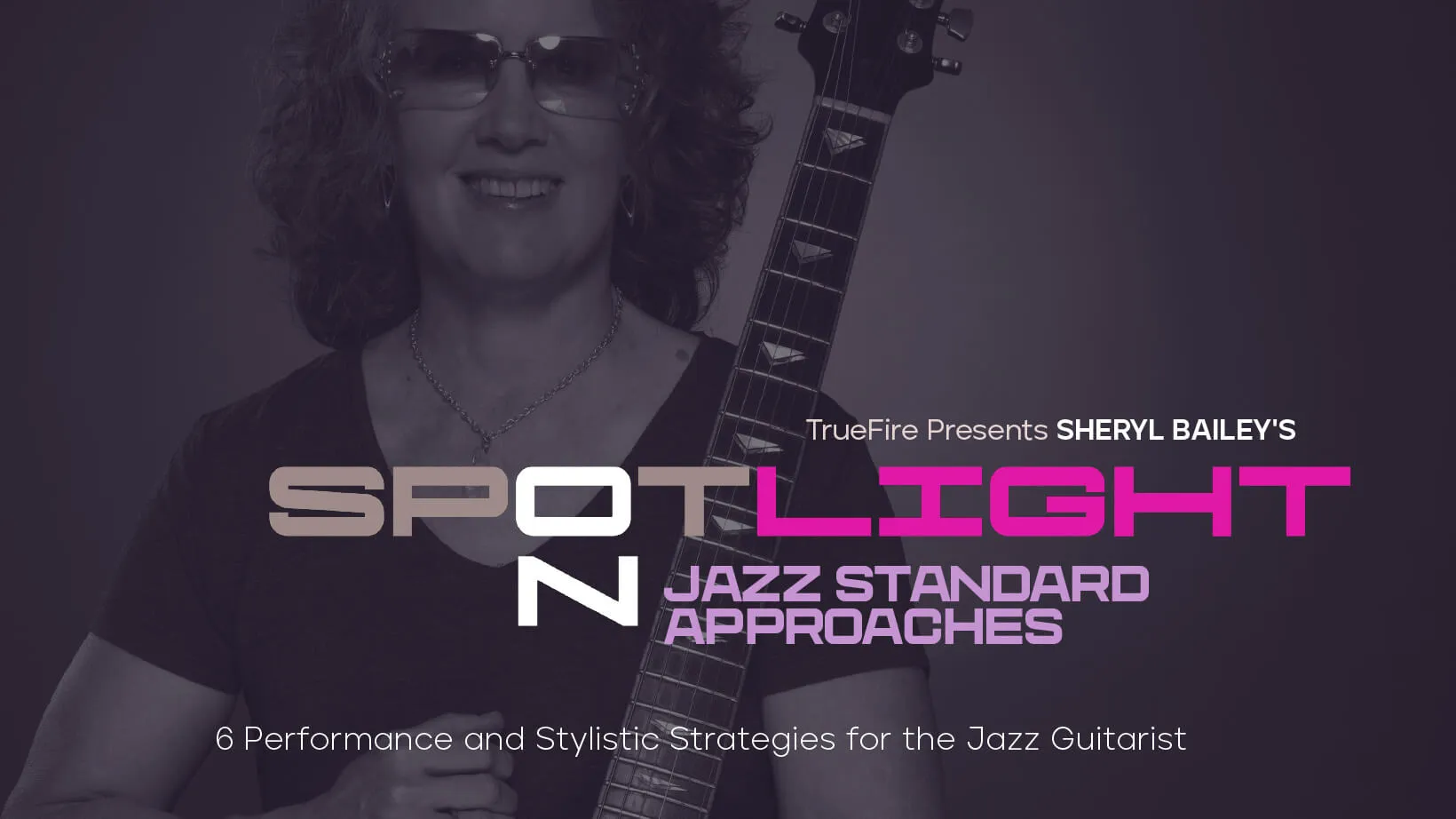
Spotlight On: Jazz Standard Approaches

6 Performance and Stylistic Strategies for the Jazz Guitarist

Marty FriedmanTommy EmmanuelSteve VaiEric GalesEric Johnson

Get this course and 1,000+ more with All Access

Try 14 days free. Cancel any time.

Purchase Individual Course for $9.99
Spotlight On: Jazz Standard Approaches

About this course

The complete jazz guitarist should feel comfortable playing duo, trio, quartet, or larger ensemble performance settings. Also, the musicians you encounter, on the stage or in the session, may have a more traditional approach, or bebop approach, or may lean towards a more modern approach using contemporary harmonic techniques.

All of these settings require a variety of performance strategies to best fill your role as the guitarist. Sheryl Bailey’s Jazz Standard Approaches will pass on six optimal strategies and approaches for the most commonly encountered settings and stylistic feels.

”We’ll work through six studies, each of which addresses a different approach to duo and trio playing textures, as well as different stylistic aesthetics from bebop to modern, and ways to practice motivic ideas that will develop chops and continuity in your lines.

Each study begins with a unique situational arrangement approach, and then we’ll put that approach to work in a performance study over a jam track, which I’ll break down for you highlighting all the key concepts and techniques you need to know along the way.

Each performance study is centered around the changes to the popular jazz standard “Solar” so that the harmonic, melodic, and rhythmic DNA remains consistent, while further highlighting the unique performance and arrangement approaches at play.“


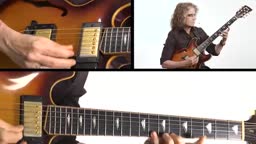
For each of the approaches, Sheryl will first explain the how, why and when to use it. She will then play an example, over a backing track, for musical context followed by a detailed breakdown. You can practice by playing along with her and then playing over the backing track by yourself.

You’ll get standard notation and tabs for all of the playing examples and performance studies. Plus, you’ll be able to use TrueFire’s learning tools to sync the tab and notation to the video lesson.

You can also loop or slow down any of the videos to work with the lessons at your own pace. All of the backing tracks are also included as well.

Grab your guitar, and let's dig in with Sheryl Bailey!

What you'll learn

  • Understand the difference between scale-based and chord-based (vertical) playing
  • Adapt playing style to traditional bebop or modern contemporary approaches
  • Learn how to adapt horn player articulation to guitar
  • Understand the core elements that define authentic bebop style
  • Develop awareness of rhythm and articulation as primary style elements
Release date: 06/02/2022 • 2h 18m runtime
Start Course
Sample lessons
Lunar Subs
Lunar Subs
Performance
Melodic Development
Melodic Development
Learn & Practice
Lunar Fragments
Lunar Fragments
Overview
Lunar Fragments
Lunar Fragments
Performance

What's included

26 lessons • 9 charts • 2 Jam Tracks

Spotlight On: Jazz Standard Approaches
Guitarists work in a variety of settings: Duo, Trio, Quartet. This course takes the harmonic progression of a popular jazz tune, "Solar," and explores approaches to each of these scenarios. We need to be aware of how we choose to "use the space" provided by us by different rhythm section combinations. As well, we may be working with folks that come from a more traditional swing/bebop sensibility, or a more modern/contemporary point of reference. In this course, I've addressed all of these possibilities and shared with you my personal best practices and concepts.
Trio Style
The guitar trio setting is the most challenging, yet the most satisfying, when you have the tools to learn how to navigate the harmonic and rhythmic space that playing with bass and drums provide. Jim Hall's "Live on Bourbon Street" has been considered to be the touchstone for how it's done. This etude shares concepts of how to provide harmonic support to your melodic lines by using the guide tones (3rds and 7ths) as comping rhythms underneath your melodic phrases. Listen to great piano players for ideas of how to use them for the most powerful textures.
Lunar Tones
This etude uses the 3rds and 7ths of the chords, voiced on strings 4/5, to "comp" beneath the melody line. Listen to the great Lenny Breau for inspiration, as well as Ed Bickert and Lorne Lofsky
Lunar Tones
This etude has a jam track with bassist Greg Ryan and drummer Austin McMahon.
Lunar Tones
Learning where the 3rds and 7ths are essential to creating the "piano style" of comping for yourself in trio. As well, they are your pathway to expanding your voicing prowess and lead to deeper connections to melodic soloing. If you've done your homework on "shell" voicings, you're 2/3rds of your way to mastering your guidetones. Remove the root from the shell, and you're left with the 3rds and 7ths. The bass player's job is to cover the roots, so leave it to them to do their job, and we can have fun with the colors on top. I organize my melodies around the 3rds and 7ths. Also note the way I use the comping in relation to the rhythm section: it don't mean a thing if ain't got that .........
Chord Soula
This chord solo is perfect for duo, trio, or quartet. This explores some complex ways to "color" a melody. Harmony is the emotional element of music, so finding the right mood with your voicings is really what this artform is about. This is based on sounds I've learned from masters like Barney Kessell and Jim Hall. Think about being a painter not a guitarist, per se.
Lunar Subs
This chord solo shares some of my favorite voicings and chord substitutions. I hope they will intrigue to steal them and use them, and learn a little about the wheres and what's about them. Also, odes to some of my favorite guitarists!

+ 19 more lessons

Start Course

Reviews

4 results

Sindibad

Verified buyer

12/24/25

Sheryl Bailey's Spotlight On: Jazz Standard Approaches

This lesson serves as an effective musical guide.

ouvert

Verified buyer

01/07/25

Sheryl Bailey is a top notch player and a superb teacher. Her explanations are extremely helpful - Berkeley standard at its best. I particularly appreciate her blend of bebop and modern post-bop improvisational approaches. Learning her lines have opened a whole new sphere in my playing.

RikJansen

Verified buyer

11/07/22

very interesting

It's very interesting to hear how Sheryl plays through the same chord progression in different styles. There's much to learn and to inspire you.

boogie50

Verified buyer

06/20/22

What's not to like!!

Great set of lessons. Sheryl does her usual great job of walking you thru the various lessons and explaining things in an easy to understand way. Very helpful for guitarists learning to play in diferent styles (modern vs traditional) and in differnet size groups. Highly recommend!

Stop searching. Start improving with All Access.

Try 14 days free. Cancel any time.