
Guitar Interactives

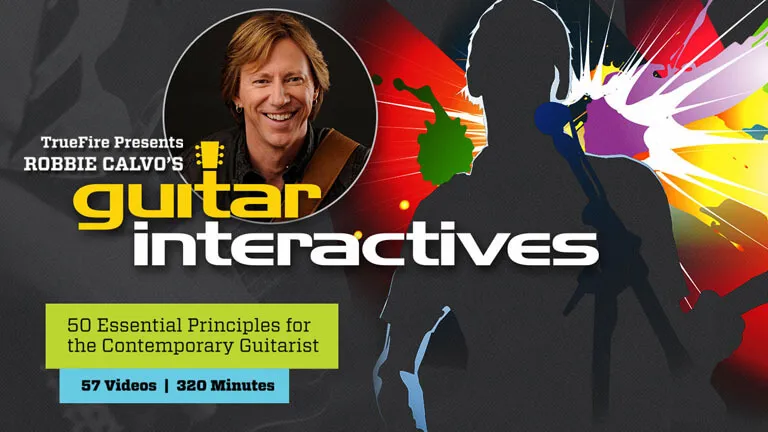
51 essential principles for the contemporary guitarist

Marty FriedmanTommy EmmanuelSteve VaiEric GalesEric Johnson

Get this course and 1,000+ more with All Access

Try 14 days free. Cancel any time.

Purchase Individual Course for $14.99
Guitar Interactives

About this course

Some guitarists are obsessed with learning all of the whats and whys of music while others focus mostly on the whats without obsessing too much about the whys. Then there’s those who could care less about either. The first group seeks out a more formal music education, the second group leans more towards private instruction or self-study programs, and the third group enters a shed only to pull out their weed whackers.

The first and second groups have equal opportunity to achieve success as a musician. You don’t need a formal music education to achieve a masterful level of play as long as you have a solid grip on the key principles and techniques that serve as the foundation for whatever style of contemporary guitar you embrace.

Robbie Calvo’s Guitar Interactives presents key principles and techniques for rock, pop, blues, R&B and country guitar with an intuitive, hands-on curriculum free of tedious theory and repetitious exercises -- you will play your way through the course applying what you learn immediately in an engaging musical context.

Robbie has organized the course into five sections; Harmony & Theory, Chord Vocabulary, Scales & Arpeggios, Rhythm Guitar and Lead Guitar. Across those five sections, fifty key principles and techniques are presented and demonstrated in a logical progression of study.

SECTION 1: HARMONY & THEORY
Featured principles include The Major Scale, Diads & Power Chords, Triads, 7th, Extensions, Slash Chords, Arpeggios & Sweet Notes, Major & Minor Pentatonics, The Blues Scale, Tonal Centers and Chord Progressions.

SECTION 2: CHORD VOCABULARY
Featured principles include Diads & Power Chords, Triads, 7th Chords, 9ths, 11ths, 13ths, Other Essential Chords, Slash Chords and Interpreting Chord Charts.

SECTION 3: SCALES & ARPEGGIOS
Featured principles include Major Scale Shapes, Major Pentatonic Shapes, Minor Pentatonic Shapes, Blues Scale Shapes, Major & Minor Triad Arpeggios and 7th Chord Arpeggios.

SECTION 4: RHYTHM GUITAR
Featured principles and techniques include Rhythmic Feel, 2nd Guitar Parts, The Pocket, Single-Note Rhythm Lines, Riffs, Rock Style Comping, Pop Style Comping, Funk Style Comping, Blues Style Comping, Country Style Comping, Jazz Style Comping and Sonic Qualities.

SECTION 5: LEAD GUITAR
Featured principles and techniques include Phrasing, Melodic Hooks & Motifs, Musical Expressions, Lead Fills, Crafting a Solo, Sweet Notes, Modal Tonality, Rock Style Soloing, Pop Style Soloing, Funk Style Soloing, Blues Style Soloing, Country Style Soloing, Jazz Style Soloing and Developing Your Sound.

All of the musical examples within the sections are connected deliberately for continuity purposes. The scales that are harmonized to create chords in Section 1 are referenced again in Section 2 to build a chord vocabulary, which chord vocabulary is used to craft the rhythm guitar styles and grooves in Section 4, which grooves are then called upon to solo and improvise over in Section 5.

Robbie's section-to-section continuity approach provides a clear understanding for how all of the key principles interact to provide a solid working foundation for rock, pop, blues, country and R&B contemporary guitar.

Guitar Interactives is an extraordinary learning experience including over 5 hours of video lessons, professional backing tracks, tab, notation, interactive tab and fingerboard diagrams.

What you'll learn

  • Use triads and arpeggios as foundations for melodic lines
  • Create memorable melodic hooks using pedal tones and repetition
  • Apply call and response phrasing to melodic ideas
  • Build solos that increase in intensity by moving up the fretboard
  • Develop syncopated scratch rhythm technique with palm muting
Release date: 07/17/2013 • 5h 19m runtime
Start Course
Sample lessons
Slash Chords
Slash Chords
Principle 6
Tonal Centers
Tonal Centers
Principle 10
The Pocket
The Pocket
Principle 27
Pop Style Comping
Pop Style Comping
Principle 31

What's included

57 lessons • 53 charts • 35 Jam Tracks

Guitar Interactives
Welcome to The Guitar Interactives program.

This comprehensive guitar course is the culmination of my 22 years real world experience as a professional musician after graduating from the Guitar Institute Of Technology, In Hollywood, California.

I have distilled my years of study, teaching, studio work, live performance and seminars into 50 key principles of practical and musical areas of study that focus on taking your rhythm & lead playing to an exciting new level of performance and musical expression.

All 5 sections have been meticulously thought out to be the logical progression of study for your complete development on the guitar. Students may find certain key principles familiar territory and can then use those musical anchors as reference points to the surrounding principles that may be less familiar. This gives all students a place of reference and a way of filling in any gaps of knowledge along the way regardless of level and playing ability.

You’ll notice that the scales we harmonize to create chords in section 1 are then used to create the rhythm guitar styles and progressions found in the section 4 key principles. Those rhythm tracks are then used for the grooves in Section 5 for our solo’s and improvisational studies. The scales and arpeggio’s studied in Section 3 are then used to improvise over Section 4 rhythm tracks.

This gives you a clear and concise look at how all of the key principles work together to create modern music and the contemporary guitar styles we all know and love.

The Guitar Interactives course is packed with Video presentations, demonstrations, professional backing tracks, tab, notation, power tab and fingerboard diagrams.

I hope you enjoy playing through the Guitar Interactives program as much as I did creating it...Thank you...Robbie
Harmony & Theory
In this section you will find 11 key principles of Harmony & Theory. You will learn how the major scale is constructed and how that determines the chords that are built from harmonizing that scale. From there we’ll build chords from each tone of the major scale, all the way from diads ( 2 note chords) up to complex 6 note 13th chord extensions . At this point you will have a full understanding of how to build and name each chord and what types of chords are built from each scale degree.You’ll learn to understand that a chord can be built from each note in the scale. Adding a 5th to the root note creates a diad. Adding a 3rd to the diad creates a triad. Adding a 7th to a triad creates a 7th chord etc...logical learning paths for the optimun growth in your guitar playing knowledge!You’ll also learn that triad and seventh arpeggio’s are derived from the major scale and so do our beloved Major and Minor Pentatonic scales!You’ll be very excited to know that you only have to understand these 11 key principles in one key, as all of the information we’ll study transposes seamlessly into every other key, shape and pattern on your guitar!
The Major Scale
PRINCIPLE 1 - THE MAJOR SCALEWhy is the major scale so important to us as guitarists and musicians? Well, because our triads, 7th chords and extensions, slash chords, arpeggio’s, modes and major / minor pentatonics are all derived from this 7 note scale...pretty important stuff to know!First Form Scale Shape: Play a scale shape at 3rd fret. Practice the scale shape over the drum groove track and drum and G bass note track.Formula: The Major scale in every key is built by adhering to a specific scale formula. That formula is this; whole - whole - half - whole - whole - whole - half. Whole refers to a whole tone, or 2 frets distance on your guitar and Half refers to a half step or one fret on your guitar.Intervals: The distance in pitch between two tones is called an interval. Here’s a list of the intervals from the tonic (root) to each note of the major scale.Major 2ndMajor 3rdPerfect 4thPerfect 5thMajor 6thMajor 7thPerfect 8th or Octave. Harmonizing the Major Scale: Harmonizing the major scale means that we are using the seven notes of the major scale to build chords. These chords we’ll then use to create chord progressions.We are going to harmonize the major scale in 5 phases so that you can see how adding additional notes or voices to a chord can change it’s quality and function. We are going to start with 2 note chords - Diads.
Diads & Power Chords
PRINCIPLE 2 - DIADS (2 note chords) / Power Chords A diad (di, meaning 2) is a 2 note chord that consists of a root and a perfect fifth. Diad chords are built by taking the root note and the note a fifth above it. For example the chord G5 is built by using the notes G - A - B - C - D - E - F# - G. The resulting chord is a G5 chord. 5 chords or power chords as they are known are neither major or minor in quality and can be played over either to add punch and power.Let’s build the second diad in the key of G:G - A - B - C - D - E - F# - G. The resulting chord is an A5 chord.As we build the 7 diads through the scale of G we’ll see that the first 6 diads all have a root and a perfect 5th above them. These chords are consonant and are commonly used as power chords in rock music because of their uncomplex sound and sonic stability when played using overdrive or distortion. The other reason they are used so much in rock music is that we can use 6 of them in one key regardless of whether the chords in musical progressions are major or minor in quality. This will become clearer as we progress through the 5 harmonizing phases.The 7th diad consists of a root and a b5th interval. This interval is also called a diminished interval. The diminished fifth diad can also be used in rock music but has a dissonant sound that will be tense and need resolution. It does not have the same sonic stability and strength as the other 6 diads with perfect 5th intervals.You can practice your 7 power chords over the tracks I’ve provided.
Triads
PRINCIPLE 3 - TRIADS (3 note chords) We are going to create 3 note chords now. These chords are called triads. (tri, meaning 3).Triad chords are built by stacking 3rds. For example the chord G major is built by using the notes G - A - B - C - D - E - F# - G (W- W - H - W- W - W - H). The resulting chord is a G Major chord. The second chord built from the G major scale is Aminor...here’s how we build that chord ... G - A - B - C - D - E - F# - G (W- W - H -W- W - W - H).Adding the 3rd to our chords determines whether the chord is major, minor or diminished in quality. Major chords have 2 whole tones between the Root and the 3rd (Major 3rd interval) and minor and diminished chords have a whole tone and half tone distance between the root and the 3rd interval. (Minor 3rd) Look at the diagrams above to see how this works.We’ll continue through the scale harmonizing each scale degree.The resulting chords are:I - G MAJOR = G - B - DII - A MINOR = A - C - EIII - B MINOR = B - D - F#IV - C MAJOR = C - E - GV - D MAJOR = D - F# - AVI - E MINOR = E - G - BVII - F# DIMINISHED = F# - A - CPractice the resulting chords against the various backing tracks I’ve provided for you.
7ths
PRINCIPLE 4 - SEVENTHS (Triads with the 7th added) Seventh chords are created by adding the seventh above the triads we’ve already created. This is done by stacking an additional 3rd above the previous note in our triad chord. This will change the quality of the chords even further.G - A - B - C - D - E - F# - G Adding the seventh note to our G major chord creates a G major 7th chord.G - A - B - C - D - E - F# - GAdding the seventh degree to our A minor triad creates an A minor 7th.Let’s continue adding the seventh degree to the next five existing triads.The result is:The resulting chords are:I - G MAJOR 7TH = G - B - D - F#II - A MINOR 7TH = A - C - E - GIII - B MINOR 7TH = B - D - F# - AIV - C MAJOR 7TH = C - E - G - BV - D7 (DOMINANT) = D - F# - A - CVI - E MINOR 7TH = E - G - B - DVII - F# MINOR 7 (b5) = F# - A - C - EUSE THE DIAGRAMS PROVIDED AND PLAY IN POSITION AT 3RD FRET AND ACROSS THE FRETBOARD WITH A 6TH STRING ROOT NOTE.
Extensions
PRINCIPLE 5 - EXTENSIONSWe can extend our 7th chords further by adding 9th’s, 11th’s and 13ths. Let me just qualify that a 9th is just a second scale degree an octave above the tonic, an 11th is just a fourth scale degree an octave above the tonic and a 13th is just a sixth scale degree an octave above the tonic.Let’s add the 9th to our diatonic seventh chords.The resulting chords are:I - G MAJOR 9TH = G - B - D - F# - AII - A MINOR 9TH = A - C - E - G - BIII - B MINOR 7 (b9) = B - D - F# - A - CIV - C MAJOR 9TH = C - E - G - B - DV - D9 (DOMINANT) = D - F# - A - C - EVI - E MINOR 9TH = E - G - B - D - F#VII - F# MINOR 7 (b5, b9) = F# - A - C - E - GAs we progress through adding chord extensions you’ll find that we may have to modify our chords and omit certain notes in order for the chords to be fingered on the fretboard. Please note that chords built in theory are not always possible to build easily on the guitar. The first note that is usually omitted is the 5th. The 5th of the chord doesn’t define it’s quality and can therefore be omited. The exception to this would be the Diminished or Minor 7 (b5) chord.9th chords should contain the 7th in order to be called a 9th chord. Add 9 chords or more correctly, Add 2 chords do not contain the 7th.Note that some of the 9th chords are b9th’s. This is because the scale formula gives us a b9 not a major 9th. This is very important to remember on the 3rd chord of our scale. The B minor 7th chord will have a b9 interval and is quite dissonant in tonality.Let’s add the 11th now to our 9th chords.The resulting chords are:I - G MAJOR 7 (#11) = G - B - D - F# - A - CII - A MINOR 11TH = A - C - E - G - B - D III - B MINOR 11 (b9) = B - D - F# - A - C - EIV - C MAJOR 9 (#11) = C - E - G - B - D - F#V - D 11 (DOMINANT) = D - F# - A - C - E - GVI - E MINOR 11 = E - G - B - D - F# - AVII - F# MINOR 11 (b5, b9) = F# - A - C - E - G - BIt should be noted that chords with a major 3rd will sound dissonant with the 11th added. This is due to the fact that the 4th (11th) and the 3rd in the same chord will add a lot of tension due to the minor 2nd interval between the 2 notes. In real world musical applications it is typical to raise the 11th to be a #11 to reduce this tension. The IV chord has a naturally occuring #11. Check out how this chord sounds in comparison to a natural 11th.Let’s add the 13th to our 11th chords. The resulting chords are:I - G MAJOR 13 = G - B - D - F# - A - C - EII - A MINOR 13 = A - C - E - G - B - D - F#III - B MINOR b13 (b9) = B - D - F# - A - C - E - GIV - C MAJOR 13 (#11) = C - E - G - B - D - F# - AV - D13 (DOMINANT) = D - F# - A - C - E - G - BVI - E MINOR b13 = E - G - B - D - F# - A - CVII - F# MINOR b13 (b5, b9) = F# - A - C - E - G - B - DYou’ll notice that we now have 7 note chords, impossible to play on a six string guitar and would also sound harmonically complex within a musical progression. In theory we add the extension to the previous extension and this is how we would write them for an examination or theory test. In reality and practice however, these extended chords may contain the root, 3rd, 7th and the extension. Obviously this varies greatly given different voicings exist in our vocabulary.

+ 50 more lessons

Start Course

Reviews

30 results

morningfield

Verified buyer

05/15/25

Thanks
patmandu

Verified buyer

03/05/25

Excellent approach to mastering the guitar

Robbie is an excellent educator and musician! The course goes at a good pace and the backing tracks are really top notch. So far I have gained a greater understanding of chords, how they are structure and the ability to phrase my solos in a way that compliments the song.

jwcar

Verified buyer

06/02/23

Great Course for a Life-long Foundation

I have purchased several of Robbie Calvo's courses and I have a great appreciation for his talent and teaching style. This course contains a wealth of knowledge presented in an easy to follow manner. I would highly recommend, first and foremost, Robbie Calvo as a teacher, and second, the content of this course. It provides a great foundation that is well worth the time and effort to gain the skills it provides.

Abner45

Verified buyer

12/13/22

Top Notch!!!

Robbie Clavo is one of my favorite instructors. He is always so calm, and his playing is outstanding. I always refer to him as the Bob Ross of guitar because he makes it look so easy and he talks so mellow, I own a lot of his course and they are all great courses. I'm trying to collect them all. I'm still trying to figure out how to get his sound on guitar. Like other courses they have the tabs and the learning tools. I will eventually figure it out and get that sound. He gives so much information in his courses that it is a lot to learn. His examples are top notch, just keep at it. His material covers a lot of ideas, and it is a lot to take in. Just keep at it. I highly recommend this course.

ironjens

Verified buyer

01/25/22

Pretty good material to work on

Stop searching. Start improving with All Access.

Try 14 days free. Cancel any time.