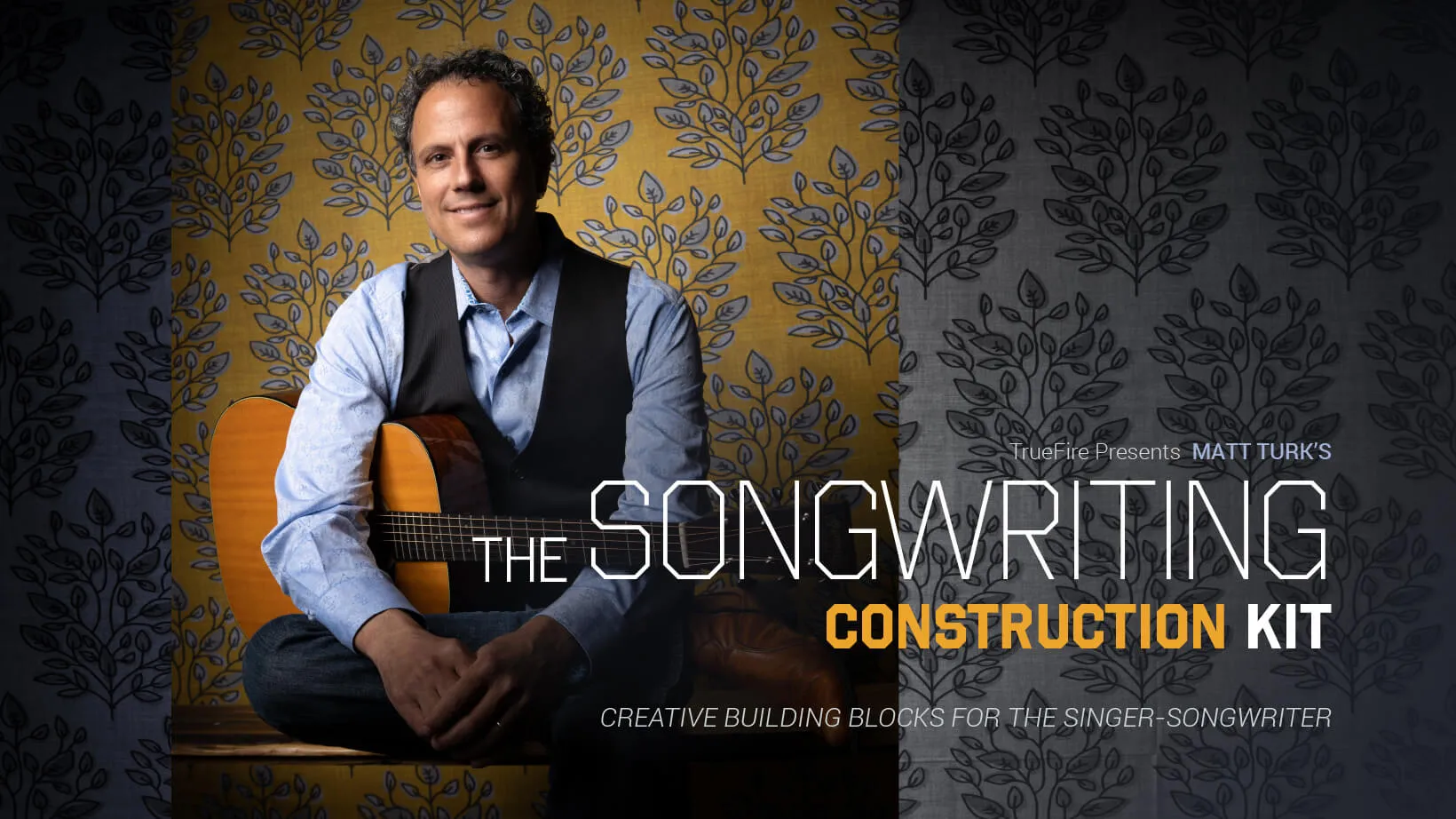
The Songwriting Construction Kit

Creative Building Blocks for the Singer-Songwriter

Marty FriedmanTommy EmmanuelSteve VaiEric GalesEric Johnson

Get this course and 1,000+ more with All Access

Try 14 days free. Cancel any time.

Purchase Individual Course for $5.00
The Songwriting Construction Kit

About this course

Finding inspiration, writing lyrics, composing melody, arranging the song’s form, crafting rhythm and groove -- these are all essential building blocks of songwriting. If you’re a singer-songwriter, you’ll also have to craft your own accompaniment along with your personal approach for singing and performing the song.

Matt Turk’s Songwriting Construction Kit will convey a clear understanding of the songwriting process and a “building blocks” approach for writing and performing your own original songs.

”In the first section of this Songwriter’s Construction Kit, I’ll guide you through a variety of approaches for tackling each of these building blocks, along with demonstrations and recommended assignments -- all designed to help you write and perform your own original songs.

In the second section, I’ll show you how I put all of the building blocks to work across 6 of my own songs. After each performance, we’ll examine and breakdown all of the building blocks that I used to construct and perform the song.

My hope is you can leave your self-doubt at the door, approach your songwriting with a child-like adventure, and use some or all of these building blocks to construct your own songs.”


A seasoned recording artist and multi-instrumentalist, Matt Turk is a veteran singer-songwriter who has engaged audiences around the world, both as a bandleader and as an acoustic folk troubadour. He has shared the stage with Pete Seeger, opened for Judy Collins, The Doobie Brothers, Fiona Apple, The Grateful Dead's Mickey Hart, John Entwistle, David Bromberg, and many more top artists. We’re thrilled to welcome Matt to the family with his first TrueFire course, The Songwriting Construction Kit.

You’ll get standard notation and tabs for all of the performance studies. Plus, you’ll be able to use TrueFire’s learning tools to sync the tab and notation to the video lesson. You can also loop or slow down the videos so that you can work with the lessons at your own pace.

Grab your instrument, pen and paper and lets write a song with Matt Turk!

What you'll learn

  • Create effective verse-chorus contrast through melodic movement
  • Understand how to arrange complete songs for solo guitar performance
  • Learn to use space and silence as melodic elements
  • Understand how consonants provide rhythmic definition in singing
  • Develop awareness of vowel selection and placement in vocal melodies
Release date: 06/03/2021 • 3h 38m runtime
Start Course
Sample lessons
Melody & Time
Melody & Time
Building Block 3: Demo
Melody & Time
Melody & Time
Your Assignment
Exploring Grooves and Feels
Building Block 6: Demo
Bette Says
Bette Says
Overview & Inspiration

What's included

48 lessons • 12 charts

The Songwriting Construction Kit
Hi, I'm Matt Turk. Welcome to The Songwriting Construction Kit.

Finding inspiration, writing lyrics, composing melody, arranging the song's form, crafting rhythm and groove -- these are all essential building blocks of songwriting. And if you're a singer-songwriter, you'll also have to craft your own accompaniment along with your personal approach for singing the song.

In the first section of this Songwriter's Construction Kit, I'll guide you through a variety of approaches for tackling each of these building blocks, along with demonstrations and recommended assignments -- all designed to help you write and perform your own original songs.

In the second section, I'll show you how I put all of the building blocks to work across 6 of my own songs. After each performance, we'll examine and breakdown all of the building blocks that I used to construct and perform the song.

My hope is you can leave your self-doubt at the door, approach your songwriting with a child-like adventure, and use some or all of these building blocks to construct your own songs.

So, grab your instrument, pen and paper and let's write a song!
The Building Blocks of Songwriting
In this first section, I'll discuss the seven important building blocks of writing a well crafted song: Finding Your Inspiration, Crafting Lyrical Content, Melody & Time, Singing & Vocalization, Self Accompaniment & Arranging, Exploring Grooves and Feels, and Song Forms. There will be assignments, so get ready!
Finding Inspiration
What is calling you to write a song? Can you identify your inspiration? What is your intention in writing a song? Can we honor what inspires us?

Lead with what inspires you. Let your feelings be expressed. Feelings reveal sources of inspiration. Experimenting with instruments and music can be inspiring, like when you come up with a riff or chord progression.

In this video I'll play a riff from "When a Boy" off my record Cold Revival and demonstrate the simple chords that inspired it. They are E shape, with a moving bass, sort of like The Allman Brothers "Sweet Melissa".

I'll also play a riff off "Broadway" from my record What Gives. The riff and a relationship inspired the tune.

"King Blood," also off What Gives, was inspired by this riff.

"Fifth & Faith" off Turktunes was inspired by this D shape acoustic guitar introduction that fell into these verse chords. Then I identified my lyric about Fifth & Faith - searching for a Fifth of Faith? Waiting on Fifth and Faith? It worked out very well.

For me growing up, the guitar was a solid emotionally secure place, a vessel, where I could be vulnerable and express my feelings I may have otherwise suppressed. This is common for many and perhaps for you. I discovered early that feelings can be inspirational, and I found a home with the guitar and my voice. Inspiration must be personally authentic. The writer must connect to what inspires and choose what to write about. What inspires doesn't have to be deep. It doesn't have to be complicated, though it can be. The inspiration just needs to be real. You can only write about something you know, which includes knowing feelings and the source of these feelings. We know from our experience.

A song can be written and inspired from a title or from a phrase. For example, the song "In Her Smile" from my album Cold Revival, which will be performed and deconstructed later in these lessons, was inspired by something someone said to me: "The beauty of life is in her smile." I found this so moving that it became the central lyric and created a mood that really fit the song.

Solid songs need authentic emotion, mood, feeling, and personal connection from the writer. Inspiration is where it all begins.
Finding Inspiration
Make a list of 10 different subjects that you find personally inspiring. For lyrics, look to any time in your life. Look to others you know of or have heard about. If it's real for you, it can be real for someone else, which makes this an authentic inspiration.

Here are three examples of potential subject matters:

The redeeming power of love as seen in a relationship with a partner.
The empty feeling of not having said goodbye to a friend you lost touch with, or who passed unexpectedly.
The highly unusual, uncomfortable feeling I had with myself when confronted by an experience which should have been normal. Meaning = perhaps I don't know myself as well as I think I do.

For music, come up with some chord progressions, riffs, melodies, and grooves - and identify 10. They can be short. Use these as the starting point for composing a song. Lyrics will follow…

Here are examples: "King Blood" riff, "Broadway" groove and riff, (off What Gives and off Turktunes) and "Favorite Tune," a G descending chord progression with a quasi Reggae/folk rock groove.
Crafting Lyrical Content
On occasion, lyrics come out perfectly formed. This is rare. Most often, lyrics need to be written, re-written, edited and honed. There are 3 ways to develop lyrics: Find Your Inspiration, Free Writing, and Free Singing.

Once you have identified your inspiration, lyrics can follow. Lyrics need to be meaningful, both personally and universally. The writer, you, need relate to them specifically and the lyrics need to appeal to the listener on a universal level. There are two simultaneous perspectives: Micro and Macro. Lyrics need to connect with the lyricist and singer on a very specific level, and be broad enough for a listener, not familiar with the specifics, to connect.

If you are not clear on what your inspiration is, lyrics can develop from free writing and free singing.

Free writing is taking pen to paper and writing freely every day or so. Upon review, there are phrases and words that stick out with quality, edge, and meaning, and lead to more intentional lyric writing and subject matter. As a songwriter, one needs to write on a theme freely - journal style - and build up content. The building up of content will allow substance to appear for a lyric to provide adequate material for a song.

Free singing is just that: La La La-ing and making up melodies. I came up with this while I was walking around: "It's a Beautiful Day." This is something I haven't done anything with as of yet, and it was a free singing creation of a melody. You can try free singing while jamming with your band. Vocalize vowels, form melodies, and then create words. After a jam, listen back to the recording you made and ask, "what did I say?"...and create the lyrics out of that. U2's Bono is known for doing this.

These are my recommended resources for writing lyrics:

Roget's Thesaurus. This is used for finding word substitutions because you can't keep using the same words.
The Complete Rhyming Dictionary, edited by Clement Wood is also super helpful. There are a ton of rhyming dictionaries out there and everyone uses them.
I-Ching is a Chinese book of wisdom which is spirituality related to the Tao Te Ching. It is a random stick throwing guide to life. I often open it to any page and read it for what it may instruct.
Craft of Lyric Writing by Sheila Davis has been super helpful and is very specific.
The Elements of Style by William Strunk Jr. and E.B. White is a grammatical book and a great reference to utilize when uncertain about how to say something correctly or incorrectly with intention.
How to Not Say What You Mean, A Dictionary of Euphemisms by R.W Holder, gives an alternative approach that is inspiring.

As creating songs is all craft and process, these books inform, guide and instruct. They are always by my side and have been for a while.

Utilize all writing and poetic techniques: alliteration, lists, metaphor, slang, and more. Listen to what other people say and bring it into your world. Eavesdrop. Pick up on news and link news that is unrelated. The art movement Dada did this and made sense out of nonsense.

Use real rhymes. Verbs and lists are lyric drivers. For example, lyrics from my tune "Fifth and Faith" off of Turktunes go:

"Woke up this morning, thought I give my life another try.
Stumbled, fumbled, rumbled with everyone and everything in sight.
Alone in anger, a stranger meets danger."

"Stumbled, fumbled, rumbled" is an example of a good list and rhyme. "Stranger meets danger" is an example of a good rhyme.

Remember, In terms of craft, it doesn't matter if lyric or melody come first or at the same time. Every order works in the process of crafting songs.

Crafting Lyrical Content
1) Keep a journal and title each sketch according to your item of inspiration. Spend 6-10 minutes a day writing stream of consciousness at least a page for at least 5 items at a time. For this you are putting in 30-50 minutes a day. I find quiet mornings or late evenings best. Still, write whenever it hits you. Write every day for a week so that at the end of 7 days you have about 3-4 pages of notes on your 10 inspired subjects.

Then, take the best parts of the sketch and carry over (maybe you'll get a half a page) and repeat as you fill out your lyric. From my experience, within a month or two, you will have most of your lyric finished. Workshopping (not part of the Copyright) can help refine the final stages of a lyric if needed. A trusted producer or trusted fellow songwriter can be very helpful in this regard.

2) If you don't have an item of inspiration, write freely, then upon examination, choose a "working title/concept" and lyrics that apply, carry over, repeat.

3) Take a 12 bar blues, a blues on the 1 chord and Bm/D/G/Em, Bm/F#m/D/A C/Am/G/F and freely talk and vocalize over them. Write down what you say and/or record your jam. Upon listening, extract anything good - melodically or lyrically.
Melody & Time
The goal is to construct a melody with motion, rhythm, tonality, and feeling. What's best is to follow your heart, ear, and mind and see where it leads. Recording a cappella melodies on a smart phone recorder, starting with a groove (and feel) or strumming (or playing) a chord work great. One can follow a scale to construct a simple melody consisting of a few notes. This is a more analytical approach, but it can be very successful. Pitch, variation of pitch, and duration of pitch make melody. Duration is how long the note is held as well as the space between the notes.

In this video, I'll play "In Her Smile" with the lyrics: "i just wanna keep flying with you, I'm the one who always tries for two" to show the quality of melody and movement.

**What is most important is how it feels in your heart and how it feels in the heart of our listener.**

If you are not finding a melody naturally, chords and the notes in these chords can help form a melody. Melodies need to be honed rhythmically (ultimately rooted in lyrics, speak singing or vocalizing) and melodically.

Harmony is a musical combination of tones or chords. Thinking about harmony is important in composing, and can help in the creation of a melody, and the support of a melody. Sometimes stumbling on a harmony can lead to an improved or new melody.

Sing along with your melody and/or play the melody and harmony on your instrument. Here are examples on guitar, with simple ascending and descending 3rds, 5ths, these are modal/scale/chord pairs:

2/3, 1/3 > 2/3, 1/2 > 2/1, 1/0
3/2, 2/3 > 2/8, 1/7 > 2/7, 1/5
2/5, 1/3 > 3/4, 2/5 ascending in Am.

Counterpoint is an independent treatment of parts, the art of polyphonic composition. This is important in arrangement. Call and response is a type of counterpoint that can be useful. Check out the chorus of "Favorite Tune" with trumpet to hear a good example of counterpoint.

There are also more complex things like polyphany: two or more independently treated melodies like "All For the Best" from Godspell.

+ 41 more lessons

Start Course

Reviews

4 results

julseg22

Verified buyer

05/14/26

great

banjopiper

Verified buyer

06/28/25

A great start

I can see true value if you dedicate yourself

bhayley

Verified buyer

01/04/23

The Songwriting Construction Kit

A lot of good info.

tjparkinson

Verified buyer

08/11/21

Course Covers all the Important Areas

Everyone who is or wants to be a songwriter can get something from this course. Even without picking up a guitar, you can begin thinking about writing an original song, follow some of his pointers and get started creating songs today. The author covers really constructive actions everyone can take in getting started and finishing a song (which always seems to be the hard part) and he covers most styles of music. (Mostly of the singer/songwriter styles, but he covers heavier and bluesy styles too. If I saw him perform someplace, I would be impressed with his guitar playing, because he includes quality guitar techniques to his original songs (it’s not just about his singing like so many performers make it). I watched the Truefire course demos first and felt he was coming from the right place, music-wise, to help me improve. As I said before, just watching this course will get you closer to getting your songs started, but actually doing the lessons (regularly) will improve your songwriting immediately.

Stop searching. Start improving with All Access.

Try 14 days free. Cancel any time.