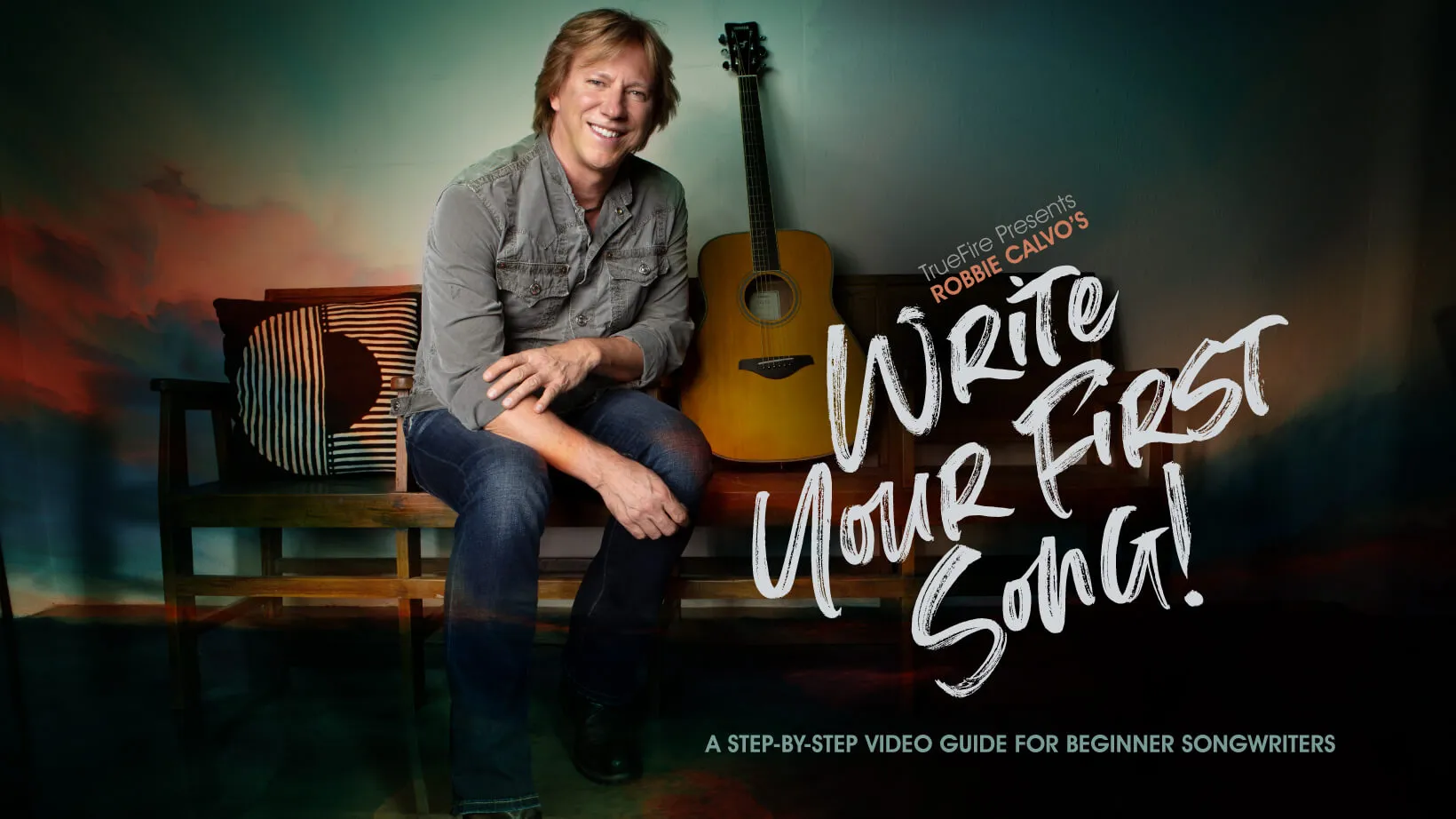
Anyone can write a song! And that’s exactly what you will do with Write Your First Song, an extraordinarily intuitive step-by-step guide from singer-songwriter, Nashville producer, and top TrueFire educator Robbie Calvo.
In this step-by-step guide to songwriting, you're going to learn how to develop all of the skills needed to create original music, including guitar Instrumentals and complete songs with lyrics. I've kept the theory to an absolute minimum, showing you only the information you need to know to get you up and running quickly.
You will play and compose your way through the course, writing your own original song as Robbie writes one of his own, alongside you, to illustrate the various steps in the process.
”We'll start the songwriting process by building chord progressions for each of the song sections: Intros, verse and chorus ideas and how to transition between each of those sections. We'll build a complete song framework using our chord progression ideas and then take a look at how to develop melodic ideas over each section.
We'll explore options for the rhythm, groove, and tempo of a song… because the rhythmic aspect of music is just as important as the chords, melody, and lyrics. I'll also be giving you solid advice on how to develop a song title into a complete song lyric and how to write your verses towards the chorus title and hook lines.
At the end of this course, you’ll have completed your song and I’ll play mine for you so that you can hear how it all comes together in a finished song. Let's get started!”
Robbie organized the course into a series of sections, each focused on a key aspect of songwriting. In the first section, Robbie presents a series of lessons focused on key understanding you should be aware of: What Is Rhythm?, What Is Harmony?, What Is Melody? What Are Lyrics?, What Is an Instrumental?, and What Is a Song?
Understanding the basics of major scale harmony and major scale triads is an essential tool for any songwriter. Robbie presents a series of lessons to get you up and running quickly and easily: Major Scale Harmony, Seven Melody Notes, Major Scale Triads, and Seventh Chords.
Next, you’ll dive into chord progressions — the framework for all songs: Chord Progressions, Popular Chord Progressions, Change Progression Order, and Reversing Progressions.
The section on Song Form and Song Sections reveals the importance and best practices for the key sections of a song: The Intro Section, Verse Sections, The Chorus, The Bridge Section, and The Outro Section
You’ll start writing the harmony of your song in the following section: Writing Your Harmony, Build Your Intro Progression, Exploring Options, Build Your Verse Progression, Build Your Chorus Progression, Build Your Bridge Progression, and Build Your Outro Progression Every song needs its own distinctive feel and groove. Robbie guides your songwriting accordingly: Find Your Feel, Choosing a Groove, and Choosing a Tempo.
Whether you're writing an instrumental or a song with lyrics, the melody is critical and that’s the focus of the next section: Developing Melody, Instrumental Music, Sweet Notes, Simple Motifs, Phrasing, and Melody & Lyrics.
The final section drills down on lyric writing: Crafting Lyrics, Song Titles, First And Second Verse Lyric, The Chorus Lyric & Hook, The Bridge Lyric
As you work through each of the sections, Robbie demonstrates an appropriate part from his own song to demonstrate the key learnings from the section. Robbie also includes an assignment in each of the sections to help you craft and finish your own song.
Robbie will explain and demonstrate all of the key concepts and approaches along the way. The backing tracks are included so you can work with them on your own. In addition, you’ll be able to loop or slow down any of the videos so that you can work with the lessons at your own pace.
Grab your guitar and let’s write our first song with Robbie Calvo!
What you'll learn
Recognize that lyrics combine words with rhythm and melody
Recognize that instrumentals follow similar song structures to vocal music
Appreciate that instrumental melodies can be more complex than vocal melodies
Understand the freedom instrumental melodies have compared to vocal constraints
Understand the importance of relatability in popular songs
Hi, I'm Robbie Calvo. Welcome to Write Your First Song!
Anyone can write a song! In this step by step guide to songwriting, you're going to learn how to develop all of the skills needed to create original music, including guitar Instrumentals and complete songs with lyrics.
I've kept the theory to an absolute minimum, showing you only the information you need to know to get you up and running quickly. We'll start the songwriting process by building chord progressions for each of the song sections: Intros, verse and chorus ideas and how to transition between each of those sections. We'll build a complete song framework using our chord progression ideas and then take a look at how to develop melodic ideas over each section. We'll explore options for the rhythm, groove and tempo of a song...because the rhythmic aspect of music is just as important as the chords, melody and lyrics. I'll also be giving you a solid advice on how to develop a song title into a complete song lyric and how to write your verses towards the chorus title and hook lines.
At the end of this course, I'll be playing the song that we studied throughout the course so that you can hear how it all comes together in a finished song.
Rhythm is the regular and repeated use of beats to form a groove. Rhythm consists of strong accented beats and a series of softer beats organized in bars or measures. The kick drum accents are low end pulses, like the heartbeat of a song. The snare drum typically accents beats 2 and 4 and the hi-hat plays softer subdivisions of those stronger downbeat pulses.
Rhythms are organized into time signatures and these time signatures help us define the feel of a rhythm: 4/4 means that there are 4 quarter note beats in a bar of rhythm, 3/4 means that there are 3 strong quarter note beats in a bar of rhythm, 12/8 denotes that we have 3 subdivisions per beat, etc.
Once the feel, tempo and groove of your rhythm is established, small variations in the accents and subdivisions can occur to add musical interest...these are called syncopations.
Harmony is the combination of tones and pitches played together to form chords. Quite simply, think of harmony as the chords that you play on the guitar. The simplest chord harmony in music is the dyad (2 notes), and the most complex can consist of many tones. The amount of tones possible in any given chord will depend on the instrument playing them. A guitarist can play a maximum of 6 notes per chord due to the limitation of strings available (unless you have a 7 or 8 string guitar. Pianists, however have the ability to play larger chords with 10 digits and also be able to separate the pitch across a number of octaves as well.
Let me give you a really brief outline of the common harmonic terms and names of the chord types:
Dyad: A two note chord like a power chord or double-stop.
Triad: Chords that consist of 3 notes and can be major, minor, diminished or augmented in quality.
7th Chord: Consists of 4 notes and are made up of a triad plus the major or minor 7th.
Chord Extensions: 7th note chords can also add extensions to embellish and add flavor to their sound. Consonant extensions are that of the 9th, 11th and 13th. Dissonant extensions are that of the b9, #9, b5, #5.
Melody is the combination of rhythm and pitch. A melody is the arrangement of single tones, organized in a series of rhythmical phrases to produce a memorable musical sequence.
Melodies are derived and created by using the notes found in the scales we play. Melodies can also be created by arpeggiating chords (using the notes of a chord as separate tones).
Later in the course, you'll see that chords are built from scales and the scale tones are then used to play single note lines over those chords...it really makes sense when you think about it.
Lyrics are words that are combined with rhythm and melody to deliver and express the message and story of a song. Each of those elements will be crucial in captivating your audience. Song lyrics paint a picture and make the music relatable to us within our written language...
Strong messages can be delivered in a softer way by combining words with music. Lyrics can be written about any topic...and have been throughout time. Popular or "hit" songs usually contain lyrics we can all relate to though, so keep that in mind as you start to write your own ideas.
Lyrics are arranged in sections that we call a verse, chorus, bridge, etc. The combination of those sections adds up the complete song lyrics.
An instrumental is music without lyric and vocals. Instrumentals typically follow the same musical form as a song with lyrics, except the melody is played by another instrument, like the guitar, piano or saxophone.
An instrumental melody can also be more complex than vocal melodies because they aren't restricted by a vocalist's pitch range and that lyrics also need to be phrased in "singable" passages so that the words can be understood easily by the listener.
A song is music combined with vocals and lyrics. A song usually consists of a verse, chorus and bridge sections. Songs can be written in any style and genre of music; however, the lyrics usually reflect subject matter and topics relatable to those genres of music. I was going to list some topics from certain genres of music, but I think you all understand what I mean. You probably aren't going to write a metal song about puppies or a country song about a Prius...but hey, anything goes!
An excellent way to kickstart your songwriting journey.
Although I’m only part way through the course, I have already had several lightbulb moments amongst all the other very useful information that it contains. Robbie is a natural teacher and has obviously accumulated a wealth of songwriting experience.
Recommended for those like me who have been struggling to find songwriting inspiration.
W
wholmer
12/23/20
Really Great Process!
Thanks Robbie! this is a really great process for song writing. I have tried a bit in the past but always was very disappointed in the outcome. Now I know what I missed! I went through the course and went right back and re-examined what I did wrong and now I'm a happy camper! Very thorough and laid out intuitively. Thanks Robbie!
A
Alan B.
07/06/20
Great course
Just finished watching all the videos and think its a great course. Lots of great ideas and easy to follow. I wrote and recorded 12 songs in the past 12 months and think they could have been better if I had used some of the ideas in the course first. And thanks Robbie for getting me past my recent songwriters block. Now I'm enthused again to get cracking and write some more.
J
John F.
03/22/20
Great Course!
I'm about 3/4s through this course and I'm really enjoying it. I had already made attempts to write songs but this course gets you to understand and identify what makes a great song and gives the process some structure. Recommended!