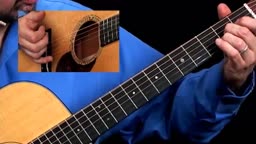
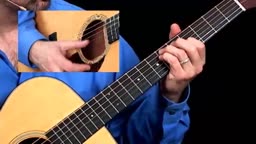
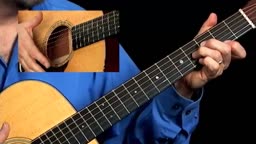
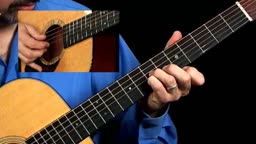
Whatever your level of play, whatever your preferred style, and whatever you know or don't know about theory — we guarantee at least two dozen monumental aha moments herein for acoustic and electric guitar players alike. Fretboard Epiphanies is an eclectic mix of theory, harmony, chord tricks, tricky licks and even a few "amazing" full-length arrangements (one of them worth the price of admission alone). What ties it all together? Everything you learn will spark dozens of fresh, creative ideas. Fretboard Epiphanies is the ultimate rut buster.
A bona fide master of Nashville-style guitar and monster session player, Joe Dalton is the guitarist's guitarist. He's also a much sought-after instructor and has been teaching pros for the last two decades. As you can imagine, his guitaristic trick bag overfloweth and that's what Fretboard Epiphanies draws so effectively upon.
Dalton's "epiphanies" show you how to take full advantage of the guitar's unique harmonic and physical characteristics to create an extremely versatile palette of sounds, textures, motifs, moods, melodies and grooves. You'll find that most of the grips in Fretboard Epiphanies are familiar and super accessible — but the application of those moves is what will have you grinning ear-to-ear.
Joe kicks off the course with a bit of basic theory that you might even already know - but this simple theory unlocks key principals. This fires up a series of epiphanies based around the E Major scale with Diatonic Triads on the 1st, 2nd, 3rd, 4th and 5th strings. Joe continues with cool moves utilizing drones and bass notes, and then reveals similar "epiphanies" in the key of A Major. Melodic development in both of these keys cap this set of lessons.
Fretted notes with drones followed by D Diatonic tricks of the trade and some Drop-D tuning moves continue the adventure with similar wow impact. Dalton then shows you a bit of magic with the good ole E, D, and A chords. Non-harmonic tones, upper and lower neighbors, simple but highly effective embellishments, and a few ideas for creating songs will likewise captivate your imagination and fretboard skills.
Then the coup de grace -- five arrangements, each worthy of nailing just for your own repertoire, but each also chock-full of epiphanies you can apply in thousands of tunes, across virtually any style. These arrangements for Laura's Song, Song for Ally & Julie, Silent Night, Wayfaring Stranger and Amazing Grace will blow you away. Amazing Grace however, is a course of study on its own as Dalton applies a new set of embellishments with each new chorus.
Whether you flat pick or go fingerstyle, unplugged or electrified, Fretboard Epiphanies is a candy store for we of the six-string. If you've got a sweet tooth for creative indulgence, there's enough here to feed you for a very, very long time.
What you'll learn
Navigate the harmonized D scale using these new voicings
Visualize chord shapes across different string sets
Understand what diatonic chords are
Understand how the C chord form relates to the D chord
Recognize that major to minor changes often involve just one note
Epiphany - a moment of sudden revelation or insight. This course is designed to open your eyes to new positions, using fingerings you already know, and to open your ears to new sounds or to discover how to play those sounds you’ve heard before but thought it was too hard to play. Along the way you will strengthen your understanding of music theory and harmony. This may be an introduction to music theory and harmony for some of you, but I’m certain we’ve simplified it enough. If you don’t understand something at first, just play it, hear it, and read about what’s going on and it will begin to sink in. Fasten your seatbelts. (You don’t need a crash helmet.)
To figure out the notes in a major scale, you need to be armed with a few facts. The major scale consists of a series of whole steps and half steps. The major scale formula is whole, whole, half, whole, whole, whole, half. From one fret to the next on the guitar is a half step. So 2 frets, 2 frets, 1 fret, 2 frets, 2 frets, 2 frets, 1 fret would give us a major scale. You can start on any fret and on any string and you will get a major scale. If you start on the first string open, you get an E major scale. If you start on the first string first fret, you end up with an F major scale. The first string second fret which is an F# (sharp) yields of course an F# major scale. I think you get the idea. There’s some other information that‘s good to know. From A to A# is a half step, from A# to B is a half step, but from B to C is a half step. To simplify this let’s say from B to C is a half step and from E to F is a half step. Here’s a chart to help. These are all half steps:
A to A# A# to B B to C C to C# C# to D D to D# D# to E E to F F to F# F# to G G to G# G# to A
On the piano, I’m sure you noticed that there are 2 white keys close together 2 times in each octave. (You’ve noticed the pair of black keys and then the trio of black keys.) These white keys are the B and C just below the pair of black keys and E and F just below the trio of black keys.
Sharps and Flats A sharp raises the pitch one half step. A flat lowers the pitch one half step. Go back to your guitar. The first string first fret is F. The first string second fret is F#. (F sharp) The first string third fret is G. The first string second fret is Gb (G flat).
The E Major Scale The notes in the E scale are E-F#-G#-A-B-C#-D#-E.
Playing the picking exercises will obviously strengthen your picking but will also drive home the whole and half step relationships within the scale.
Diatonic- consisting of half steps and whole steps. The notes of a major scale without any other notes. There are two phrases to describe the use of the word “diatonic” as it pertains to our studies. The chords that result from any major scale are:
Major Minor Minor Major Major Minor
Diminished
The first triad (3 note chord) uses the 1st, 3rd, and fifth notes of the scale. This chord is major. The second triad uses the 2nd, 4th, and 6th notes of the scale. This chord is minor. A major triad has two steps between the first two notes and a step and a half between the next two notes. A minor triad has a step and a half between the first two notes and two steps between the next two notes.
The 1st note is known as the root of the triad. Every triad has a root third and fifth. If the triad is built on the 2nd, 3rd, 4th etc. scale degree, we still refer to the first note as the root. Another way to look at the construction of chords is by intervals.
An Interval is the distance between the notes. Always count the note you are starting with. The distance between A and C is a third.
A major third is 2 steps. A minor third is 1½ steps. A major triad is a major 3rd with a minor 3rd on top. A minor triad is a minor 3rd with a major 3rd on top. A diminished triad is a minor 3rd with a minor 3rd on top.
This makes the length of the triad shorter (only 3 steps), hence the name diminished. (made smaller) The remaining triad does not occur in a major scale. The augmented triad is a major 3rd with a major 3rd on top. So this triad is longer. Augmented - made bigger.
Here are the triads in E major. Notice how they follow the formula. (major, minor, minor, major, major, minor, and diminished) The root of each triad is on top. The highest note will be perceived as the melody. When the 3rd is the lowest note, it is said that the triad is in 1st inversion. Make certain to use the proper right hand fingers as you learn and drill these patterns.
This time the triads are in root position. Now the 5th is the melody note. Again, be certain to use the proper right hand fingers as you learn and drill this new pattern. To be proficient at finger-style playing is knowing all of the patterns and being comfortable with them. You can use a pick with these patterns, but why not broaden your horizons and learn something new.
These triads are in 2nd inversion. Don’t let the 6/8 time signature throw you. When you are playing this, think 2 groups of three notes. 1-2-3, 1-2-3 or 1-2-3, 4-5-6. The bold numbers are accented. Accenting a note means to bring it out. Letting it stand out could mean playing it louder than the other notes. Very often, I’m playing the other notes quieter. This way I’m not playing every note too heavily.
Letting the second string ring open will add some other notes to our chords. This will change the name of the chord, but more importantly will add color to our sounds. The second string open is a B and belongs to the E major scale. So we are adding a note that belongs to our tonality.
Great refresher course for anyone how hasn't picked up a guitar in a while, but also great if you want to fill gaps in your theory and fretboard knowledge.
Highly recommended.
D
dwa79
Verified buyer
07/30/23
Interesting Approach
I appreciate the lessons and new terms/definitions/demonstrations for me.
B
Blue72
01/31/22
Harmonic booster shot
Incorporating open-string drones into diatonic triads as chord tones or color tones will extend the tonal range of any intermediate-level player. Joe starts with running diatonic chord scales up and down the fretboard, then sets them against open strings to make unusual colors. You get basic theory, creative chord extensions and exercises to show the new chords up with a variety of finger-pacing patterns, ending with a couple of beautiful arrangements of songs you thought you knew. Excellent course!