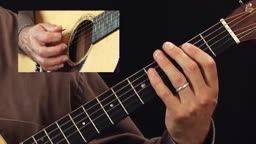
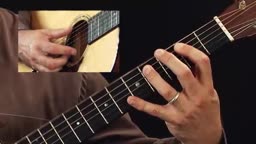
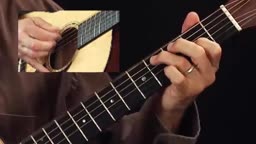
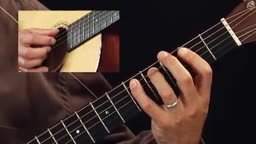
Every guitar player experiences a major turning point early on in their education. After the requisite, and often times, frustrating period of getting comfortable holding the instrument, learning a few chords and single note lines, players suddenly find themselves making real music. And it's at that exact moment in time that we fall head over heels in love with the guitar. More often than not, that magical moment is triggered by another, more advanced player passing on a few tricks, licks and fingerpicks that are ridiculously easy to learn yet sound like a million bucks. These "guitaristic" qualities are what makes the instrument so popular but you need a good guide to get you there quickly and correctly. If you dig acoustic blues, your guide is Joe Dalton's Acoustic Blues Handbook.
Performing artist, composer and eminent instructor Joe Dalton, has developed a series of guitar lessons designed to give the late beginner and early intermediate student a complete range of rhythms, turnarounds, solos, scales, and "guitaristic" tricks to plug in to any 12 bar blues progression.
"The Acoustic Blues Handbook equips the student with all of the tools necessary to create and play their own solo blues tunes. This guitar lesson approach is modular in nature. Students learn a series of "plug-ins" including rhythm patterns, turnarounds, stop-time solos, constant bass solos, walking bass lines, fills, intros, endings and more. After getting a grip of these bite-size parts, they learn how to put them together to form entire blues arrangements."
Dalton covers a variety of melodic rhythm patterns which not only build on one another, but can also be mixed and matched. Joe also demonstrates many different turnarounds with several ways to play and present them including the use of contrary motion phrases.
Students learn chord substitutions, stop-time solos, the all important major and minor pentatonic scales (and how to mix the two by borrowing notes), walking bass lines to move from one chord to the next, fills, call-and-answer phrasing, intros and endings based off of turnarounds.
If you've been biting at the bit to take your new guitar skills to the next level and learn how to play solo acoustic blues guitar, your roadmap is a click away. Pick up Joe Dalton's Acoustic Blues Handbook, grab your guitar and lock yourself in the shed. Selling soul at the "crossroads" not required.
What you'll learn
Play a steady bass note with the thumb while adding melody notes with fingers
Create rhythmic variations using quarter and eighth notes
Apply call and response phrasing techniques
Coordinate thumb and ring finger to play on different beats
Manage melodic register to create dynamic interest
The objective for this course is to give the student many variations of rhythms, turnarounds, solos, scales, and tricks to plug in to a 12 bar blues progression to improvise and create your own acoustic blues solo. The material you will learn here can be applied to electric playing and back-up rhythm roles as well. Be meticulous in your practicing. Work everything out slowly at first, and it will all come together flawlessly in the end.
I figured we should take the time to talk about how to hold the guitar properly. The guitar is my third instrument. I learned percussion and piano from my grandfather. He was a famous band leader and percussionist from New York City. (Joseph Minichini, son of Salvatore Minichini, for those of you who like to research...). My grandfather did show me the proper way to hold the instrument and the proper technique, but I used many bad habits learning from friends and acquaintances as you do since the guitar is a social instrument. We seem to sit down with others and show each other many things because, with the guitar, this is so convenient. Consequently, we pick up many bad habits, so this information about holding the guitar sometimes gets lost. So, here it is.
One of the challenges of writing a lesson is finding the spot of common ground. Where is that spot where most of us are comfortable and we can begin to build? In this instance, I thought this simple rhythm would be that great place to start. Most of us have played this rhythm many times.
Spend some time getting the shuffle rhythm to sound just right. If you are new to this rhythm, work on it slowly, then take it slightly faster until you just feel the rhythm. Spend some time listening to some shuffles, electric or acoustic.
This new rhythm pattern gives the whole chorus a laid back feel. By splitting the notes, we take away some of the drive and leave us just rolling along. The pick-up note rhythm comes from the previous measure. So, after we count 4 beats, we play the pick-up note before then first beat of the measure. (or in other words between the 4 and the 1) After you get the shuffle feel and the new pattern, you can add the flatted 7th to the pattern.
The turnaround does just that. It turns us around back to the beginning. There are many variations to learn. As we add them, try to note the similarities from one to the next. They are all related. The turnaround is one of those elements of the blues progression that you can mix and match. You can plug these things in as if they were modular. Use your ear and discretion to find the turnaround that is most appealing or tasteful for the given situation.
Of course, it’s one thing being able to play the turnarounds, and another being able to transition in and out. Practice to make these changes seamless. If you are new to the blues progression, you want to be able to feel the spot for the turnaround. Counting it out, in the beginning, is a good way to find the spot, but you need to feel the blues. Blues is an emotion, so play these with feeling. Listen to everything from Muddy Waters to Eric Clapton to the Allman Brothers to Led Zeppelin and don’t stop there.
To perform these harmonized patterns, I think of each of these harmonized notes as chord forms. So each beat is a chord change. The first chord is an E7 chord. The second chord may be a new form, but there are only two fingers for the double passing tone A chord. Remember to practice slowly. If you work on it slowly, you will save practice time. Practicing it the wrong way, whether it be a wrong fingering or a hitch in the rhythm (not playing smoothly), will result in getting better at doing it the wrong way. In other words, repetition at something done the wrong way, no matter how you may be thinking of doing it the right way, means you are rehearsing the wrong thing. Be meticulous in your practice and it will pay off sooner than you think.
Great series to help a beginner get into fingerstyle blues, incorporating chords and picking out notes from the scale. Well paced and very easy to follow. Joe Dalton is a great teacher.
B
Bob375
Verified buyer
08/07/24
Joe Dalton's lessons are Awesome!!
I have learned so much from this.
The lessons are clear and concise.
O
Orville1
08/13/23
Love acoustic blues!
This course is packed with wonderful lessons! I'm new to guitar so I wasn't sure if I'd be able to accomplish this course. It turns out that I was able to ably perform most of the lessons. Joe's style is quiet and low key which agrees with me. his demonstrations are clear. I recommend this course
R
Redhouseoy
Verified buyer
11/13/22
Acoustic Blues
Interesting, innovative, educational and fun the teachers is clear and his style provides ready access to the musical materials.