




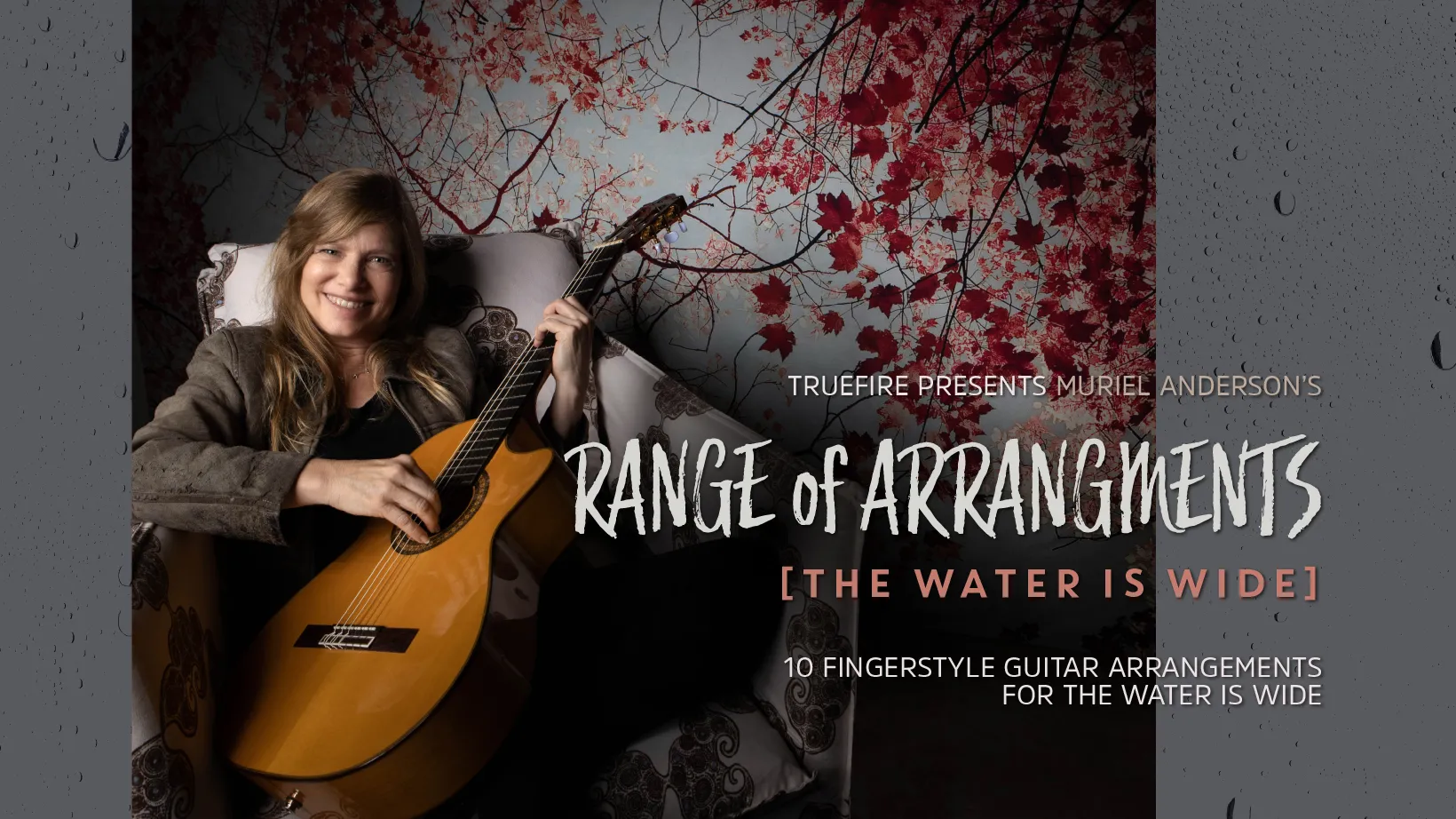




Range of Arrangements: The Water is Wide

10 Fingerstyle Guitar Arrangements for The Water is Wide

Marty FriedmanTommy EmmanuelSteve VaiEric GalesEric Johnson

Get this course and 1,000+ more with All Access

Try 14 days free. Cancel any time.

Purchase Individual Course for $9.99
Range of Arrangements: The Water is Wide

About this course

There are so many creative options for arranging tunes for fingerstyle guitar. Applying different techniques, rhythmic patterns, harmonic and melodic treatments, and different keys can provide an almost unlimited range of approaches to choose from.

In this edition of Muriel Anderson’s Range of Arrangements, you’ll be crafting and performing 10 versions of the tune, The Water Is Wide. All of the concepts and approaches that Muriel passes on as you work through the course can be used on literally any tune you’d like to arrange.

”We’ll start with a super simple, but surprisingly tasty approach for arranging the melody and chords. I’ll show you how to use simple strums between melody lines. We’ll also arrange it for another key and look at ways to add energy to a piece, add movement to the inner voices of your chords, and explore how to add more elegance to your arrangements by using arpeggios.

I’ll also show you how expanding your harmonies will naturally add to the piece, and how to add more length out of an arrangement is to move your melody up or down an octave.

We’ll work on arranging with a drop-D tuning to really bring a piece to life, we’ll look at harmonizing the melody notes in sixths, and we’ll utilize harmonics to add some sparkle to our arrangements. Finally, I’ll give you an example of how I might mix and match the different arranging approaches to form a more full-length piece.”


Muriel will explain and demonstrate all of the key concepts and approaches along the way. You’ll get standard notation and tabs for all of the performance studies. Plus, you’ll be able to use TrueFire’s learning tools to sync the tab and notation to the video lesson. You can also loop or slow down the videos so that you can work with the lessons at your own pace.

Grab your guitar and let’s start arranging with Muriel Anderson!

What you'll learn

  • Perform 'The Water is Wide' with melody in the bass voice in D
  • Execute a complete arrangement where bass carries the melody
  • Apply melody-in-bass arrangement concept to a traditional song
  • Harmonize melodies using sixth intervals
  • Maintain harmonic accompaniment while bass plays melody
Release date: 06/08/2020 • 1h 34m runtime
Start Course
Sample lessons
Arrangement 1 in G
Arrangement 1 in G
The Water is Wide: Performance
Add Strums Between Melody Lines
Approach 2: Walk Through
Arrangement 5 Arpeggios in G
The Water is Wide: Performance
Key of G, Varied Harmony
Approach 6: Walk Through

What's included

36 lessons • 15 charts

Range of Arrangements: The Water is Wide
Hi, I'm Muriel Anderson. Welcome to Range of Arrangements!

I'd like to get you thinking about making your own arrangements. We'll take "The Water is Wide" and arrange it ten different ways. Each arrangement is very simple, yet designed to open some doors and give you ideas that you can use while creating your own arrangements.

I chose "The Water is Wide" as a vehicle to take through the process of arranging not only because it is a beautiful and easy tune, it's also often played in jam sessions. I'd like you to also choose a tune to arrange on your own, using some of the these same approaches.

All of the arrangements are tabbed and notated and you'll be able to sync the tab and notation to the video using TrueFire’s learning tools. You can loop or slow down the videos so you can work with the lessons at your own pace.

Ready to get started? Get your guitar, and welcome on board!
Thoughts on Arrangement
This is a peek into my thought process of arranging, how each tune can be approached in a different way. For instance, Pete Huttlinger's arrangement of "Superstition" was the inspiration for my rendition, likewise was Tommy Emmanuel's "Day Tripper", in which I changed the octave and added other parts. Another fun challenge was capturing the koto sound of "Sakura", or the marching band feel in Sousa's "The Liberty Bell". The most important thing in many songs is to concentrate on the beauty of the melody, so "The Water is Wide" is perfect for this reason.
Find the Melody & Chords
Throughout this course, try to work by ear or with just the basic chord chart, without the transcriptions so that you can go through the process of working out how to arrange on your own. Putting together the melody and the bass notes of the chords is the first step. Find the chords and melody by ear, and check with the sheet music if you like. Try to phrase the melody the same way as if you were singing it. It helps to sing the melody out loud.
Find the Melody & Chords
We'll take this first one very slowly. Start by singing the melody along with the chords, using the way you phrase it when singing to inspire how you'll play the melody. Look for ways to play the melody notes within or close to your chord voicings. For the Bm chord you can also use Bm7 or Bm9 and likewise for the D you can play either D or D7.
Arrangement 1 in G
Work on keeping the meter consistent as you are playing the melody, and grabbing the bass notes to the accompanying chords.
Add Strums Between Melody Lines
Feel free to change the phrasing of the melody if you sing it differently from the way I do. It makes it much more musical if you pay attention to connecting the notes so they don't fall off too quickly. The next step is what you do in the space between the melody notes. Let's start with a simple strum (where there is time) between the notes.
Add Strums Between Melody Lines
This is the easiest way you can arrange a tune and have the chords, the rhythm, and the melody all at the same time. Don't try to fill in the accompaniment all the time, especially when the melody is busier. Sometimes I like to anticipate the melody so it comes before the bass to add more of a singing feel and to allow for more prominent bass notes. Starting your arrangement very simply gives you a solid feel and also someplace to go musically in subsequent variations, building in interest and complexity in the next verses.

+ 29 more lessons

Start Course

Reviews

8 results

Davidhabermel

Verified buyer

10/22/25

All that I have purchase, but especially Tommy E. ,Muriel Anderson, Garett the man from Wales, Hamburger the blues man. That’s all folks.

Lessons that I have purchased from TrueFire have enabled me to make definite improvement in my playing and expanded/deepened my understanding of guitar and music.


vincenzo1310

Verified buyer

10/25/21

The musical legacy of Chet Atkins (and other holy monsters)

Muriel Anderson is one of the greatest fingerstyle guitarist, in any genre: do you know anyone who can play Nola that way? This course is wonderful! How to arrange this gorgeous traditional.

Scotnorm

Verified buyer

10/02/20

Delightful Course

Muriel Anderson presents 10 arrangements of the beautiful tune "The Water is Wide". The arrangements cover several different approaches and are presented in a structured manner with the new arrangement generally building on the previous, but adding a new layer or approach. The good thing is that at any stage (even from the very beginning) you will have an arrangement of the tune that you play through from start to end which sounds good.

Suzanne V.

08/03/20

Range of Arrangement

Wow! This course is awesome! It takes the same song from a basic bass note - melody through a series of progressively more complex arrangements. It's allowing me the get comfortable in the skill level before adding on to the arrangement.

olddoublechin

Verified buyer

07/19/20

All the classic arrangement techniques

Muriel Anderson has lots of teaching experience a nice way of explaining, without getting lost in too many details but still covering all the essentials. She walks you through the whole range of classic arrangement techniques the easy way. One Song in 3 keys, starting with the basics, adding strums, arpeggios, inner voices, bass runs, moving the melody up or down an octave, adding flavor with more chords, harmonics, dropped-D, arranging the melody in sixths and puts it all together for a longer and more interesting complex arrangement in the end. A perfect course for those who are firm with chords and melodies already covering some fingerstyle pieces, who want to start to develop their own arrangements.

Stop searching. Start improving with All Access.

Try 14 days free. Cancel any time.