Take 5: Jazz Bass Soloing

Interactive Video Masterclass on Jazz Bass Guitar Soloing

Marty FriedmanTommy EmmanuelSteve VaiEric GalesEric Johnson

Get this course and 1,000+ more with All Access

Try 14 days free. Cancel any time.

Purchase Individual Course for $5.00
Take 5: Jazz Bass Soloing

About this course

Bassists like Christian McBride, Scott LaFaro, Jaco Pastorius, Stanley Clarke, John Patatucci, and Charles Mingus are not only giants of the instrument, but also masters of the jazz bass solo. A great jazz soloist can navigate rapidly shifting jazz harmony while maintaining the integrity of their melodic line.

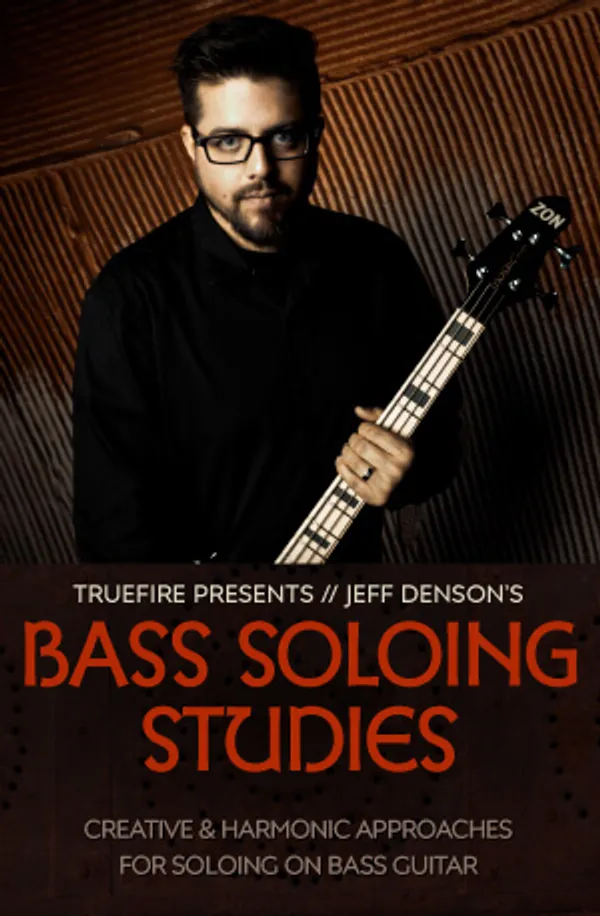
In this edition of Take 5, from monster bassist Jeff Denson, you’ll start your learning journey with a short primer covering key jazz soloing approaches and concepts like using space, melodicism, playing off the band, and more.

Jeff will then guide you through 5 Jazz Bass Soloing studies, starting from very accessible, and then graduating to more sophisticated and challenging approaches. Jeff will first play each solo over a backing track, and then he’ll break it down, pointing out all the juicy harmonic and technical information you’ll need to take your bass soloing to the next level.

Jeff will explain and demonstrate all of the key concepts and approaches along the way. You’ll get standard notation and tabs for all of the performance studies. Plus, you’ll be able to use TrueFire’s learning tools to sync the tab and notation to the video lesson. You can also loop or slow down the videos so that you can work with the lessons at your own pace. All of the backing tracks are included to work with on your own as well.

Grab your bass and let’s solo with Jeff Denson!

What you'll learn

  • Apply Lydian dominant scale over dominant 7 chords
  • Use arpeggios to define harmony in solos
  • Navigate AABA form with key changes
  • Navigate jazz turnarounds smoothly
  • Build solos that make chord changes audible without accompaniment
Release date: 08/31/2020 • 1h 19m runtime
Start Course
Sample lessons
Level 4: Jazz Bass Soloing
Overview
Level 4: Jazz Bass Soloing
Performance
Level 4: Jazz Bass Soloing
Breakdown

What's included

18 lessons • 5 charts • 5 Jam Tracks

Take 5: Jazz Bass Soloing
Hi, I'm Jeff Denson. Welcome to this Jazz Bass Soloing edition of Take 5.

Bassists like Christian McBride, Scott LaFaro, Jaco Pastorius, Stanley Clarke, John Patatucci, and Charles Mingus are not only giants of the instrument, but also masters of the jazz bass solo. A great jazz soloist can navigate rapidly shifting jazz harmony while maintaining the integrity of their melodic line.

In this edition of Take 5, we'll kick off with a short primer where we'll talk about key jazz soloing approaches and concepts like using space, melodicism, playing off the band and more.

Then I'll guide you through 5 Jazz Bass Soloing studies, starting from very accessible, graduating to more sophisticated and challenging approaches. I'll first play each solo over a backing track, and then I'll break it down, pointing out all the juicy harmonic and technical information you need to take YOUR bass soloing to the next level.

All of the performances are transcribed and you'll be able to sync the tab and notation to the video using TrueFire's learning tools. You'll get all of the jam tracks and you can loop or slow down the videos so you can work with the lessons at your own pace.

Ready to get started? Grab your bass and let's go!
Jazz Bass Soloing
Before we get started on our first solo study I'd like to go over some basic concepts we're going to look at in this course. Think about melodic content in your solos. Building a great jazz solo isn't about how fast you can move your fingers, but instead it's all about telling a good story. Of course, sometimes your story can contain fast lines, and that can really bring excitement to it, but playing fast in and of itself does not build a good story. Take your time and develop your ideas. Convey a melodic idea, pause and give yourself enough time to think about what your next musical sentence would be. Just like when you're speaking to someone, your next sentence is most of the time going to be building off of what you just finished saying, right?

What if you spoke to someone without pauses, or punctuation? What if you spoke in constant unrelated run-on sentences? Would anyone understand you? Probably not! It could be interesting or entertaining for a minute, but then the novelty of it would wear off and the people you were speaking with (or TO in that case) would grow tired of listening to you. Just like in a good conversation with a friend, you want to convey clear ideas as well as leave space for them to add to the conversation – soloing is no different!

In order to be able to really communicate to the musicians you're playing with, you really have to listen to them, even when it's your solo! Listen to the comping instrument (usually either a piano or guitar) to see what they're doing harmonically or melodically underneath you. Listen to the rhythms that the drummer is playing under you. I find that the most interesting solos occur when you are all taking information from one another in the moment.

Here are some concepts we'll discuss in this course:
  1. The use of space
  2. Highlighting chord tones
  3. Rhythmic placement of ideas
  4. Tension and release
  5. Phrasing
  6. Note duration
  7. Melodic cadencing
  8. Bass technique
Level 1: Jazz Bass Soloing
This is based on the chord changes of Miles Davis' composition "So What," from his classic album "Kind of Blue." The wonderful bassist Paul Chambers played the melody on this piece.

In this solo, I'm going to stick to the notes of the Dorian mode. Here's that scale/mode: D, E, F, G, A, B, C & back to D. (These are the notes of the C major scale starting on the second note of the scale, D. This is the second mode of the C major scale.)

I'm going to use space to clearly delineate musical phrases and set the pace of my solo/story. I'll juxtapose short and long phrases as well as individual notes both inside of my musical phrases but also at the ends of each phrase.
Level 1: Jazz Bass Soloing
Here's the performance for the Level 1 solo.
Level 1: Jazz Bass Soloing
Analysis:

A
II: i-7 – i-7 – i-7 – i-7
i-7 – i-7 – i-7 – i-7 :II
B
bii-7 – bii-7 – bii-7 – bii-7
A
i-7 – i-7 – i-7 – i-7

Analysis w/ Chord Symbols:

A
II: D-7 – D-7 – D-7 – D-7
D-7 – D-7 – D-7 – D-7 :II
B
Eb-7 – Eb-7 – Eb-7 -Eb-7
A
D-7 – D-7 – D-7 – D-7

This track is based on the chord changes to Miles Davis' "So What," and it's built on only two chords: D-7 and Eb-7. When people bring up modal jazz, this is the song that is always mentioned first.

Let's review what the Dorian mode is again:
D, E, F, G, A, B, C & back to D. (These are the notes of the C major scale starting on the second note of the scale, D. This is the second mode of the C major scale.)

Miles' idea with "So What" was to force the musicians to develop melodic solos using the Dorian mode over the stagnant minor seven harmony. On one hand, you may think this is easy to do, since you don't have to change scales or deal with a lot of changing chords, but you'll soon find that the challenge lies in keeping your lines interesting for an extended period of time and in trying to avoid too much repetition of the same ideas.

The use of space is an important element of music that should not be overlooked. When you're learning about jazz, you are inundated with many different scales, and when you start building chops on your instrument, it's only natural that you try to play as many things as you can at any given moment. The problem with doing that, is that it most likely will not lead to a melodically rich solo, or a coherent story. The great jazz pianist, Thelonious Monk said that the space is as important as the notes. He's quoted making this point in a number of different ways, here's another one of his quotes: "Don't play everything (or every time); let some things go by... What you don't play can be more important than what you do."

In keeping with these concepts, I wanted to construct my solo using only the notes of Dorian mode and to carefully use space to add musical interest and to clearly delineate my musical phrases. (For musical color and excitement, I used a note outside of the Dorian mode. Everyone on the "So What" recording did this too! :-) A third element that I should mention about my solo here is that I was responding to the comping of the piano and rhythms of the drums behind me. What do I mean by that? My pianist here in this recording was suggesting ideas in his comping throughout all of the tracks, so sometimes I would try to weave what he was playing into my solo. That's easier said than done, but if you leave space and focus on the musicians who are playing around you, you'll start to be able to do this. Even if you don't 100% hear or understand the melodic statement, rhythm or chord that is played under you at the moment, try to soak in as much of it as you can and use the part that you did get. Are you following me? The more you do this, even if it's very subtle, the more connections will start to happen within the music. You'll also find that it gives you fresh ideas!

Let's get into some of the harmonic concepts I was using in my solo: I started my solo using an A-7 arpeggio (A, C, E, G). Why would I use an A-7 arpeggio over a D-7 chord? These notes are all the extensions of the D-7 chord. If we analyze the notes of the A-7 in relation to the D-7 chord we find that the A is the 5th of the chord, C is the minor 7th, E is the 9th and G is the 11th. If you're interested in learning more about this concept, I go into this in depth in my other TrueFire courses, Bass Soloing Studies 1 & 2. Those are progressive courses, so in the second course I'm building off of what I discussed in the first course.

Here are the important concepts to get out of this solo:
  1. Use of space
    • Leave space to improve your phrasing. If you play on and on without rest, it's like speaking in run-on sentences. It makes it hard for anyone to follow you....as well, it makes it hard for you to build on your own ideas if you don't stop to develop one.
    • Leave space for the comping instruments to give musical input – doing that can allow you to get ideas from them to use in your solo – fun!
  2. Use different length of notes (duration) for expressive musical purposes.
    • Differentiate between short and long notes.
      • Long notes sustain the sound and bring yours and the listeners' ears along with them
      • Short notes are more abrupt. They could be more percussive or they could be more exclamatory or punctuated.
  3. Listen to the comping instruments!
    • This goes along with point 1.b, but I also mean while you're playing lines and not just while you're leaving space. If you are actively listening, meaning you are trying to hear what the band is playing around you, it will allow you to be more responsive and conversational. Listening is the key to making good music. In fact, listening is the most important part, it's not your flashy techniques, or your chops, it's your ability to hear what's going on around you, process it, engage with it and play accordingly.

Level 2: Jazz Bass Soloing
Here in our Level 2 solo study we're going to play over a standard jazz blues form. There are quite a few more chords than in other styles of blues, so let's look at those here:

Analysis:

I7 – IV7 – I7 – ii-7 V7/IV
IV – IV7 – I7 – iii-7 VI7 (or ii-7 V7/ii)
ii-7 – V7 – I7 VI7 – ii-7 V7

Analysis w/ Chord Symbols:

F7 – Bb7 – F7 – C-7 F7
Bb7 – Bb7 – F7 – A-7 D7b9
G-7 – C7 – F7 D7 – G-7 C7
Level 2: Jazz Bass Soloing
Here's the performance for the Level 2 solo.

+ 11 more lessons

Start Course

Reviews

2 results

DBLClick

02/20/21

Excellent Course

This course is about applying solos over various styles. Following the instructor examples are only the start for putting your own ideas into play.

mercilessemo

Verified buyer

10/01/20

Great course

Like the backing tracks, and how the instructor shows his own ways of playing over the track.

Stop searching. Start improving with All Access.

Try 14 days free. Cancel any time.