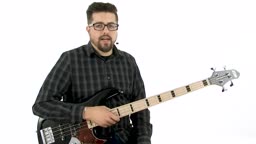
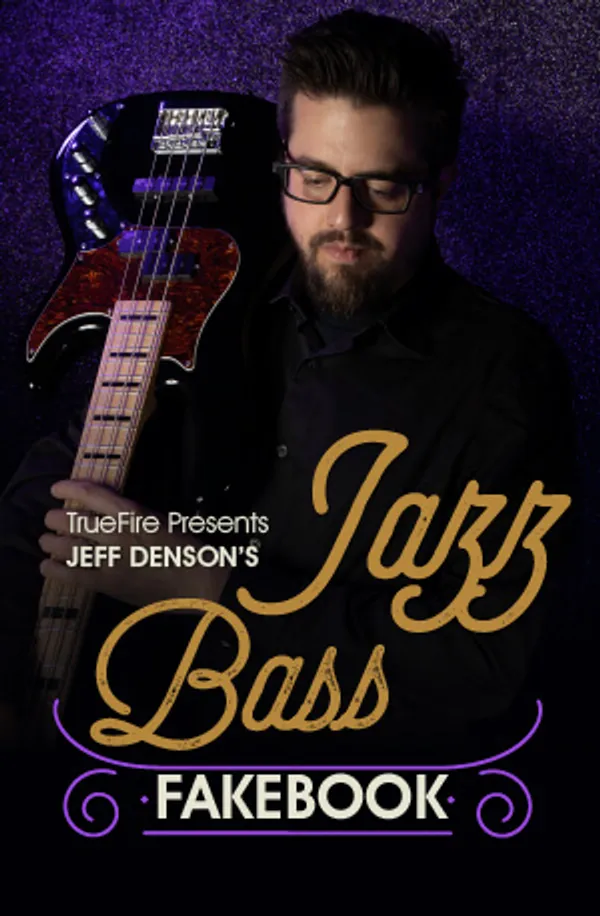
We're thrilled to welcome Jeff Denson to the family with his first TrueFire course, Bass Soloing Studies Vol. 1! You will likewise be thrilled when you dig into this comprehensive educational experience for electric bass players, which is strictly focused on soloing.
Bass Soloing Studies will lead you to a greater understanding of your fingerboard, (i.e. teaching you where the notes are), teach you the concept of relative major and minor and how to use that information, build your chops and fluidity with moving up, down and across the neck and give you strong concepts to use in soloing. Regardless of what style/s of music you play, this course will be invaluable to you as a way to get started soloing on your bass!
"In this first module of the series, we'll be examining relative major and minor pentatonic scales and applications for their use in soloing and improvisation. All of the exercises and solo studies in this course will be limited to only the notes the pentatonic scale, so we can really dig deep into it and mine it for its maximum potential."
Recording and performing artist, master bass player, and passionate educator Jeff Denson received his Bachelor’s of Music degree in Performance from Berklee College of Music, Master of Music in Jazz Studies from Florida State University and his Doctorate of Musical Arts in Contemporary Music Performance from the University of California. Jeff's "bandstand" credentials includes 12 albums as leader/co-leader and over a dozen more as a featured sideman - four with Lee Konitz (including live recordings at the Village Vanguard and Birdland). Over the past 15 years, he has shared the bandstand with an impressive array of musicians including Lee Konitz, Brian Blade, Joshua Redman, Anthony Davis, Mark Dresser, Joe Lovano, Jane Ira Bloom, Kenny Werner, Mimi Fox, Mads Tolling, Dave Douglas, Bob Moses, Giacomo Gates, Howard Alden, Walter Smith III, Warren Wolf, Romain Pilon, Dayna Stephens and many more.
"I chose to start with the pentatonic scale because chances are, this is familiar to most of you since it's widely used across many (if not all) styles of music around the world. We'll be exploring all of the pentatonic shapes up and across the neck in six positions, which will allow you to solo without being tied to a root position shape."
Jeff organized the course into 3 sections. In the first section, Jeff covers one and two octave pentatonic scales with demonstrations and practice sessions. In the second section, Jeff guides you through six positions for minor and major layouts and then illustrates each with improvisational soloing demonstrations and practice sessions.
In the third and final section of the course, Jeff performs and then breaks down 5 soloing performance studies across a variety of keys and feels.
Jeff will explain and demonstrate all of the key concepts and approaches along the way. You'll get standard notation and tabs for all of the key studies. Plus, Jeff includes all of the rhythm tracks for you to work with on your own. In addition, you'll be able to loop or slow down any of the videos so that you can work with the lessons at your own pace.
Grab your bass and let's solo with Jeff Denson!
What you'll learn
Navigate fourth position on the fretboard from D to third octave G
Improvise using third position major scale
Apply position-based improvisation concepts
Use all available notes while giving special weight to triad tones
Hi, I'm Jeff Denson and welcome to the first in a series of courses on soloing on the electric bass: Bass Soloing Studies. In this first module of the series, we'll be examining relative major and minor pentatonic scales and applications for their use in soloing and improvisation. All of the exercises and solo studies in this course will be limited to only the notes the pentatonic scale, so we can really dig deep into it and mine it for its maximum potential. When studying anything, it's always best to limit the material you are working with in order to afford yourself the best chance to absorb it.
I chose to start with the pentatonic scale because chances are, this is familiar to most of you since it's widely used across many (if not all) styles of music around the world. We'll be exploring all of the pentatonic shapes up and across the neck in six positions, which will allow you to solo without being tied to a root position shape. This is a key point: many of us learn a scale - take the minor pentatonic scale as an example - as a "shape," instead of being a collection of pitches, each with their own function in relation to a given chord. Thinking about "shapes" on the fingerboard is a common approach to learning on the electric bass and/or guitar, however that thinking can be a crutch that is very limiting to your playing, if you don't learn the individual notes, their harmonic function, and most importantly, their sound. For this reason, we will be working with the scale from lowest to highest note as it appears in each position up and across the neck, regardless of starting pitch. We will discuss the harmonic implications of each note and how they can be used in soloing.
This course will lead you to a greater understanding of your fingerboard, (i.e. teaching you where the notes are), teach you the concept of relative major and minor and how to use that information, build your chops and fluidity with moving up, down and across the neck and give you strong concepts to use in soloing. Regardless of what style(s) of music you play, this course will be invaluable to you as a way to get started soloing on your bass!
In this first section of the course, we're going to be looking at the E minor pentatonic scale in one and two octaves and its relative major, the G major pentatonic scale, also in one and two octaves. This may be a review for some of you, and if so, please stick with us and play along with the tracks. If this is new for you, you will really want to take your time here to get a strong grasp on these scales before moving on.
What does "relative major and minor" mean? Relative keys are the major and minor scales that share the exact same key signature when looking at written music. Take the key of C major for example, here the notes of the scale are: C, D, E, F, G, A & B. For each note of this scale, there is a corresponding chord: C major, D minor, E minor, F major, G major, A minor and B half diminished. Without going too deep here, you can find the relative minor of a key by going up to the sixth (count C1, D2, E3, F4, G5, A6...see what I mean?) When you're looking at a minor key, to find the relative major, you count up to the third (A1, B2, C3). You can find out a great deal of information on this, however this should give you enough so you'll understand the terminology I used in this course.
In this video, we look at one possible fingering for the E minor pentatonic scale in the lowest octave on the four-string electric bass. This may be a review for some of you, and new to others, in either case, please check it out and work with it until you feel comfortable to move to the next video.
In this video, we look at one possible fingering for the E minor pentatonic scale in two octaves, starting with the lowest octave on the four-string electric bass. This may be a review for some of you, and new to others, in either case, please check it out and work with it until you feel comfortable to move to the next video.
In this video, we look at one possible fingering for the G major pentatonic scale in the lowest octave on the four-string electric bass. This may be a review for some of you, and new to others, in either case, please check it out and work with it until you feel comfortable to move to the next video.
In this video, we look at one possible fingering for the G major pentatonic scale in two octaves, starting with the lowest octave on the four-string electric bass. This may be a review for some of you, and new to others, in either case, please check it out and work with it until you feel comfortable to move to the next video.
Now that we've got some basic fingerings down for one and two octave major and minor pentatonic scales, we're going to look at playing the pentatonic scale up and across the neck in six positions. As we move up from position to position, we'll be learning all the notes in the scale, as they appear across the neck, from lowest to highest pitch, regardless of starting note. This means that we won't always be starting from the root note. For example, when looking at the E minor pentatonic scale in our second position, the starting note will be an A and the highest note will be a D, neither one is our root. This will help to break our reliance on the common "minor pentatonic shape" that we're all really accustomed to. This knowledge can be very powerful, especially when you take the time to really be conscious of the note you're playing, not just the shape, but the note name and its place in the scale.
Why is this important, you ask? When soloing, or when playing a bass line that moves up or down the neck, you don't want to be forced into leaping back to your old familiar shape, instead you should be able to seamlessly move from note to note, focusing on your voice-leading (i.e. finding stepwise motion to link your lines). Also, another benefit of this exercise is that you may very well find new ideas by looking at this scale in different, or unfamiliar ways. Let's get started!
Jeff Denison’s Bass Soloing Studies Vol 1 is just what I needed to understand and internalize what bass soloing is. This course builds you up from the ground up; simplistic in its presentation with short and sweet segments. Once I got through I had the fundamental understanding I feel like I now have the tools I need to create any bass solo my creativity will allow.
Give a bassist a solo and the bassist will know how to play that solo; give the bassist the skills and tools to create their own solos and that bassist will be soloing for life.
C
cupit357
Verified buyer
12/04/22
I am a brand new bass player and I find this to be easy to follow and very informative.
K
krisfromhell
Verified buyer
06/10/22
Bass Soloing Studies 1
With the course you simply learn how to play solos to a song. The menu is very clear and well structured. it is so easy fun to play
S
SleepyJ
Verified buyer
03/23/21
Instructions are easily comprehensible, the instructor's pace is serene enough, the learning curve not over-ambitious, but nevertheless rewarding. I shall definitely gon on to buy other programmes by this tutor, the next being Vol. 2