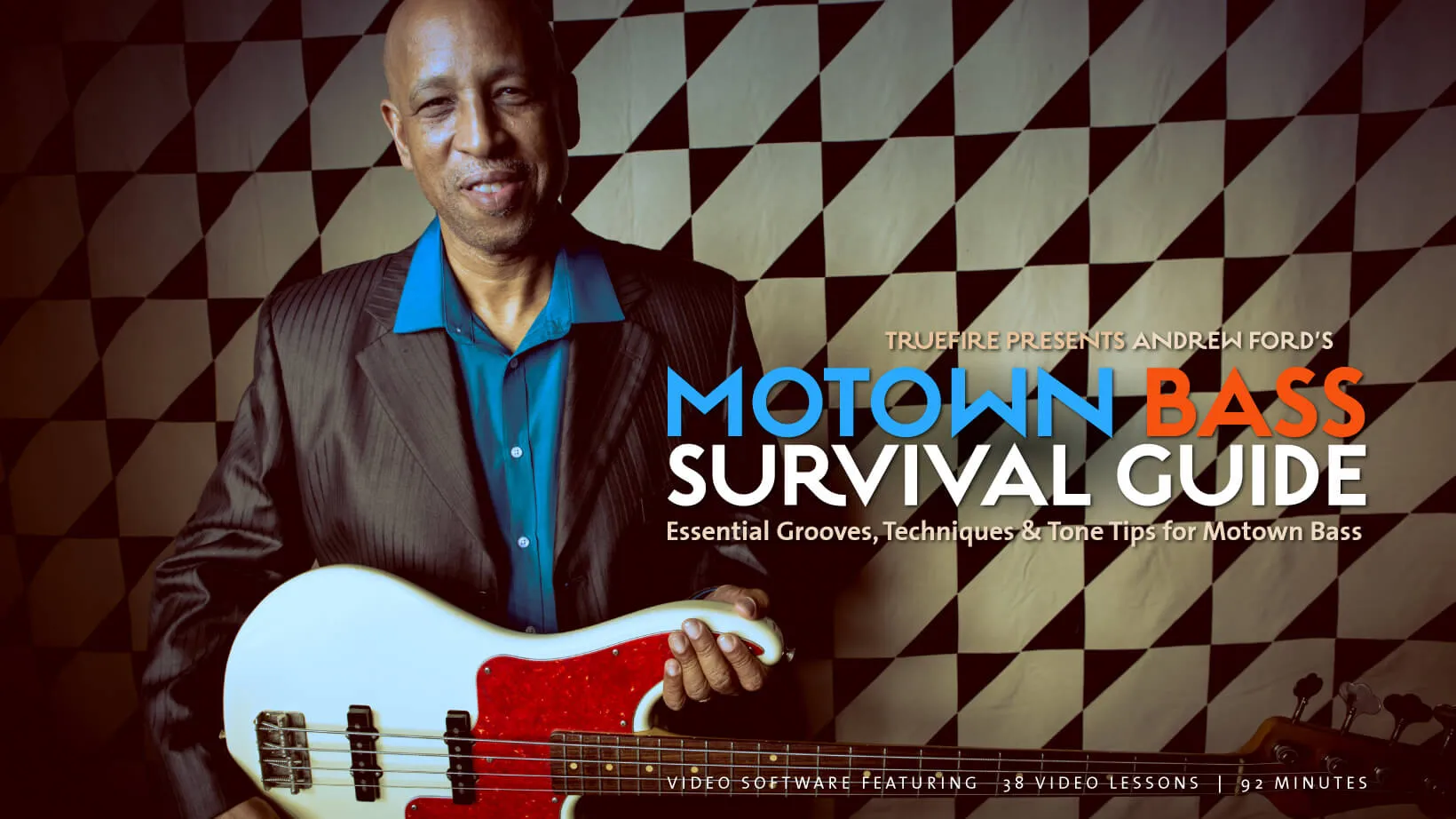
Motown Bass Survival Guide

Essential Grooves, Techniques, & Tone Tips for Motown Bass

Marty FriedmanTommy EmmanuelSteve VaiEric GalesEric Johnson

Get this course and 1,000+ more with All Access

Try 14 days free. Cancel any time.

Purchase Individual Course for $14.99
Motown Bass Survival Guide

About this course

James Jamerson is one of the most influential bass players in modern history. His work on countless Motown hits, back in the early 60's and 70's, inspired every generation of bass players to come, across virtually every style of music. If you play R&B, funk, pop, jazz, or even rock, you've likely been influenced by Jamerson and his Motown sound.

Andrew Ford’s Motown Bass Survival Guide examines all of the essential concepts and techniques you need to know to get that signature Motown sound. In the first section, you’ll explore concepts like reharmonization, embellishing passing tones, muting, ghost notes, and other essential approaches through a variety of exercises to help you integrate them into your own playing.

”I’ll show you Motown grooves and bass lines with embellished passing tones, muted non-diatonic ghost notes, root five movements, major pentatonics, question and answer phrases, reharmonized chords, open string pivots, and a signature bass run concept I like to call ‘dropping the biscuit’ — in short, all of the essential Motown techniques and grooves.”

In the second section, you'll work through a series of performance studies designed to help you apply each of the concepts and techniques from the first section in a Motown context. Andrew will first perform the groove and then break it down note-for-note explaining the underlying techniques and harmonic approach.

All of the performance studies are tabbed and notated for your practice, reference and study purposes. You’ll also get Guitar Pro files so that you can play, loop and/or slow down the tab and notation as you work through the lessons. Plus, Andrew includes all of the backing tracks for you to work with on your own.

Grab your bass and let’s get our Motown Groove on with Andrew Ford!

What you'll learn

  • Play a Motown-style bass line using non-diatonic ghost notes
  • Execute quarter-eighth triplet rhythm patterns with shuffle feel
  • Use 16th note anticipations to create rhythmic interest
  • Outline major and minor triads melodically in a bass line
  • Understand how James Jamerson approached melodic bass playing within pop song structures
Release date: 12/16/2017 • 1h 34m runtime
Start Course
Sample lessons
Embellished Passing Tone
Concept 2
Dropping the Biscuit
Concept 6
Hand in Hand
Hand in Hand
Overview
Hand in Hand
Hand in Hand
Performance

What's included

38 lessons • 17 charts • 16 Jam Tracks

Motown Bass Survival Guide
Hi, I'm Andrew Ford, and welcome to the Motown Bass Survival Guide.

James Jamerson is one of the most influential bass players in modern history. His work on countless Motown hits, back in the early 60's and 70's, inspired every generation of bass players to come, across virtually every style of music. If you play R&B, funk, pop, jazz, or even rock, you've likely been influenced by Jamerson and that Motown sound.

In the first section of this Motown Bass Survival Guide, we'll examine essential concepts and techniques you need to know to get that signature Motown sound. We'll explore concepts like reharmonization, embellishing passing tones, muting, ghost notes, and other essential approaches through a variety of exercises which will help you integrate them into your own playing.

In the second section, we'll work through a series of performance studies designed to help you apply each of the concepts and techniques from the first section in a Motown context.

I'll break down each performance note for note, you'll get tab and notation for each, AND you'll get all of the rhythm tracks to work with as well. You can also loop and slow down any of the performances so that you can work with the materials at your own pace. So, grab your bass and let's get started!
SECTION 1: Essential Concepts
In this first section of the course, we're going to talk about essential concepts that you need to know to get that classic Motown bass sound. We're going to talk about reharmonization, passing tones, ghost tones, and a whole lot more. Let's get started.
Reharmonization
Many times, a songwriter has some basic generic chords to accompany their lyric and melody. For many of them, the focus understandably is on the lyric and melody, after all that is technically what makes up a song. Many of them, as well as producers, depend on those gifted studio musicians such as Jamerson to take their song to the next level with their performance enhancements. A technique used by Jamerson was reharmonization, changing the bass notes of very simple progressions to make them sound much more sophisticated.

Let's look at this simple 2 bar progression using Gb for 1 bar and Db for 1 bar. In this first example, I'll play a more standard bass line that outlines the harmony as might be written by a songwriter. The bassline does have some rhythmic syncopation and note movement. I start on the root Gb in the first bar going down to the major 7 (F) briefly as a pivot before getting back to the root. Finally, I go to Ab as a transition to the next chord, Db. I use a similar motif as I did in bar 1 in this next bar, just changing the intervals. I start on the root Db then go down to the 5, Ab, before going back to the root, and finally and F which is the major 3rd that also leads me nicely back to Gb. This is a decent interpretation of this chord progression, but let's look at one way to harmonize this in the style of Jamerson in the next exercise.

For the second exercise, I'll keep the first bar basically the same with a slight change by inserting the major 3rd, Bb, into the motif. In the second bar, or actually the syncopation into the second bar, is when we start the reharmonization. Instead of playing a normal Db centered line in this bar, I begin with an Ab, which is the 5 of Db. I then go down to the major 3rd, F, before moving to Gb, which is the 4 and ending with and Ab that leads me back to the Gb. I actually never play the intended root Db at all. Now one thing to be aware of when doing this type of reharmonization are the voicings of the chordal instruments. If they voice too low with the written root on the bottom, it can destroy your handy work and take away any impact of these new notes. Also, be aware of what the singer or melody instrument is doing, any fancy stuff you do on bass is a waste of time if it does not make the song "better".

Embellished Passing Tone
Jamerson often demonstrated how to use passing tones even if there were none as part of the original chord progression. In these examples, I use two bar phrases, first over one bar of D and one bar of Bm. Then, I use a two bar phrase over a bar of Dm and a bar of Bb. I'll first show you a sample bass line with no passing tones, then I introduce a passing tone, and lastly, I "embellish" that passing tone. These embellishment notes are not supposed to be heard as much as felt. They are meant to be more rhythmic than melodic, more about the rhythmic placement than the melodic content although they can be quite melodic. I use a C# passing tone in the D to Bm progression since the C# is still part of the D major scale. Over the Dm to Bb progression you notice I use a C because it works better with the D minor tonality.
Root Five Movement
Another characteristic sound of Motown bass was the use of root, fifth, octave patterns. Using those 3 notes in different combinations and different syncopations creates that unique sound you attribute to James Jamerson right away. These examples will be played over a two bar phrase that goes from Ab to F minor, one bar of each. I start with just playing roots with various rhythms and then move into the different ways you can incorporate the 5th and octave, sometimes going down to the fifth and sometimes up to the 5th. Jamerson used them in various combinations and rhythms.

These root-5th-octave patterns can change directions vertically quickly and with syncopation which gives them their character. These will give you just a few ideas of what is possible with just the root and fifth.
Outline the Triad
The triad seems like such a basic and elementary concept, but in the hands of a master it can be brilliant. So many of Jamerson's baselines include the outlining of triads. Obviously, the triad gets you away from the root, foundational dominated bass concept, but he was able to use them as a harmonic tool that never vacated the role of foundation provider.

These examples are over an Ab major 7 chord so they only use those triad notes Ab, the root, C, the major 3rd, and Eb, the 5th. We mix different syncopations and octaves to create bass lines that provide harmonic foundation as well as forward motion and dynamics. Only three notes, but very powerful potential.
Question & Answer
The question and answer approach is very effective in creating dynamic bass lines in general and was used often on Motown hits. Sometimes splitting a bar or a two or four bar phrase into two parts that were married together using space and motion. One approach Jamerson used was starting with some type of dotted quarter/8th phrase and answering that with a more syncopated but relative phrase. This will be our approach in these examples.

This is a Curtis Mayfield style 2 bar groove in Dm where we have a sparser beginning of the phrase playing the root, 5, and b7 with this dotted quarter 8th pattern and then answer the question with syncopated lines that follow. Each question has a slightly different answer, but all relating to the question and musical situation.

+ 31 more lessons

Start Course

Reviews

11 results

ImNotSid

Verified buyer

11/12/25

Slowing it down

I recently purchased a P bass and put flats on it hoping to learn some Jamerson licks. I turned to True fire for help. The Motown course is very instructive in breaking the genre down to its component parts so they can be mastered separately. However his playing is very fast. I need to slow the tempo down to 50% in order to play the exercises. Thankfully the platform makes this easy to do.

Steeley54

Verified buyer

03/08/25

This course is so well thought out. As a big fan of Motown I thoroughly enjoyed this course. Thanks Andrew!

Felicer1

Verified buyer

02/03/25

Good course

I'm enjoying this course and learning new things. I was surprised that so far (4th lesson) there are no specific Motown songs used as study examples, but perhaps that's a good thing, so we're not tied to a song but to the musical concept in a more general way. I'm happy I purchased this course and think it will elevate my playing.

Jasonmccord

Verified buyer

08/28/24

Motown Bass Survival Guide

Very impressive

egonwisdom

Verified buyer

10/19/22

Great analysis of the playing Motwon styles and techniques

Good didactic and a lot of fun to practice! Excellent course to learn excellent soul music.

Stop searching. Start improving with All Access.

Try 14 days free. Cancel any time.