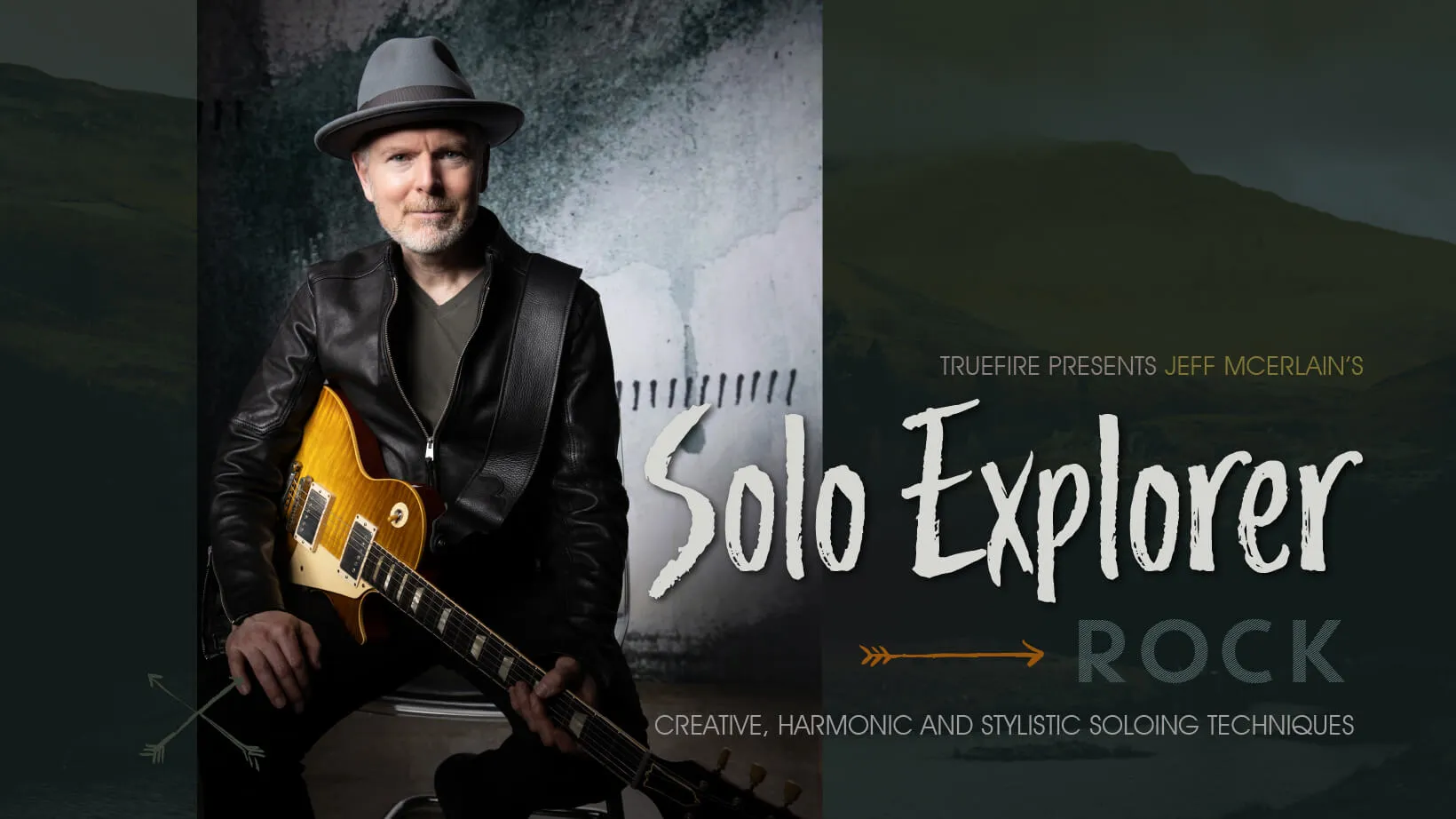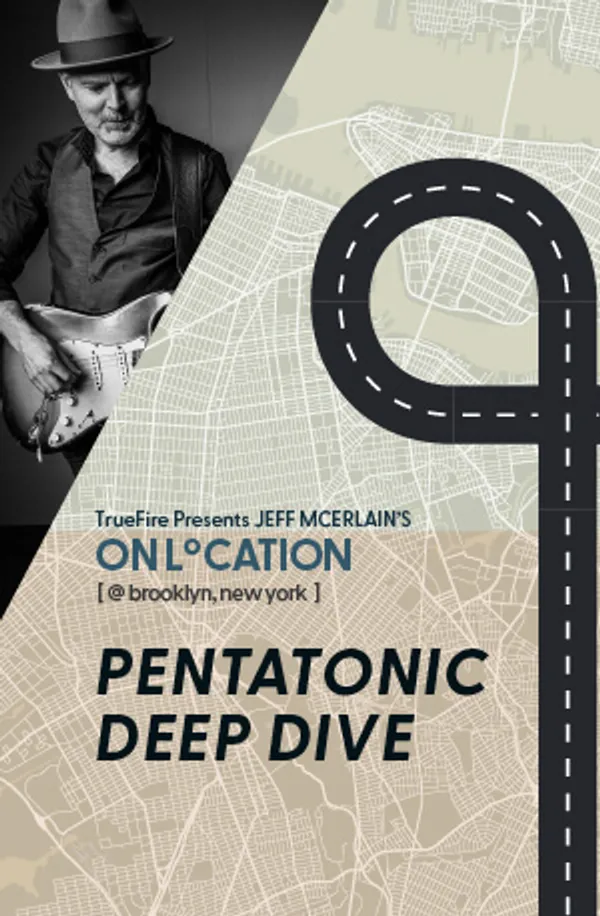
Solo Explorer: Rock

Interactive Video Masterclass for Guitar Soloing

Marty FriedmanTommy EmmanuelSteve VaiEric GalesEric Johnson

Get this course and 1,000+ more with All Access

Try 14 days free. Cancel any time.

Purchase Individual Course for $19.99
Solo Explorer: Rock

About this course

There are countless harmonic applications, creative and stylistic approaches, techniques and a wide range of embellishments that you can employ to spark inspiration for a compelling rock solo. You will explore dozens of them with Jeff McErlain guiding your journey as you play your way through this Rock edition of Solo Explorer.

”We’ll work through six diverse solo explorations each centered around popular progressions that you’ll encounter in hundreds and thousands of songs in the rock lexicon. For each, we’ll start by analyzing the changes to get a sense of what melodic options exist.

Then, we’ll explore a variety of creative applications and approaches that you can use to spark your own creativity. And you’ll apply them all in a real-life musical context!

You’ll learn to “tweak” soloing devices that you’re already familiar with such as pentatonic and blues scales, modes, guide tones, targeting chord tones, and expressive techniques like bends and vibrato.”


You’ll start your journey with a three-chord blues-rock jam. Next, a moody three-chord vamp followed by a deep exploration of a classic rock style progression that blurs the line between major and minor. There’s a Pink Floyd inspired progression, a Led Zeppelin-style chord progression that takes us through multiple keys, and finally, you’ll deep dive into a heavy metal, classically influenced jam in E minor.

Jeff will explain and demonstrate all of the key concepts and approaches along the way. You’ll get standard notation and tabs for all of the performance studies. Plus, you’ll be able to use TrueFire’s learning tools to sync the tab and notation to the video lesson. You can also loop or slow down the videos so that you can work with the lessons at your own pace. All of the backing tracks are included to work with on your own as well.

Grab your guitar and let’s start exploring the sonic landscape with Jeff McErlain!

Jeff McErlain's Preferred Gear

Below is a list of Jeff McErlain's preferred gear including guitars, amps, pedals, accessories, and more. What you see in Jeff's lessons may or may not be this actual gear, but if you are trying to capture Jeff's sound and tone, the gear listed below is recommended by Jeff and it's a great place to start!

Guitars

Amps

Pedals

Accessories & More

What you'll learn

  • Play ascending and descending chord tone lines
  • Apply harmonic minor sound without learning the full scale pattern
  • Learn to add chromatic alterations to pentatonic scales for more sophisticated soloing
  • Recognize when to switch from pentatonic thinking to chord tone thinking
  • Understand how to blend Mixolydian and Dorian modes (MixoDorian concept)
Release date: 05/21/2020 • 2h 46m runtime
Start Course
Sample lessons
Blue on Track
Blue on Track
Analyzing the Progression
Minor Pentatonic Mods
Demonstration
Major Pentatonic Mods
Demonstration
Minor Blues Scale
Minor Blues Scale
Demonstration

What's included

40 lessons • 19 charts • 6 Jam Tracks

Solo Explorer: Rock
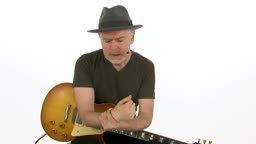
Hi, I'm Jeff McErlain and welcome to Solo Explorer: Rock!

I'm excited to share with you the way I look at rock and blues rock soloing. I largely see everything as related to a pentatonic scale and I'll add notes accordingly to navigate the chord changes or add some flavor. I've chosen some familiar progressions and how I would approach them as simply as possible.

I've found this method to be the most effective way to approach soloing and how to play more interesting ideas. Like the title says, we'll explore how you can dig deeper into any chord progression by following a few simple concepts. Let's dive into Solo Explorer!
Blue on Track
"Blue on Track" uses an extremely common chord progression and of course the title is based upon the Kenny Wayne Shepherd song "Blue on Black". Of course, this chord progression is found in countless songs like, "Sweet Home Alabama", "Badge", "Sweet Child 'O Mine", and many more.

Clearly it is a song and chord progression that requires some investigation. The progression of the basic D major, Cadd9 to G. That would be I, bVII, IV in D Mixolydian. We can look at this as being based upon the D major pentatonic scale, and we can also use D minor pentatonic. How can that be?!?!? Let's keep going!
Minor Pentatonic Mods
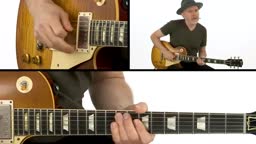
I'm so happy discuss this in such detail with you. If we think about a D minor pentatonic scale, which is our first approach on this chord progression, we can see that there maybe some problematic notes. Mainly, that the chord progression starts off with the D major chord and in we are playing in D minor pentatonic scale. D major contains an F# and D minor contains an F natural. If we were to sit on the F natural note in this chord progression it would sound pretty terrible, so the first thing you want to do is learn how to tweak that flat third. I discuss this in pretty much every one of my courses, as it's key to becoming a good guitar player! The next note tweak would be the flat, which would be the b7.
Major Pentatonic Mods
D major pent. is spelled DEF#AB, and when I use it I automatically think Southern rock like the Allman Bros. or jam bands. The minor pentatonic is a bit more "edgy" and bluesy and opposed to the brighter and happier major pentatonic scale.

Now, a major pentatonic scale is is just a major scale without the half steps. D major is DEF#GABC#D, so if we remove the 4th (G) and the 7th (C#) we get a D major pentatonic scale. But when doing that we can lose some cool sounding stuff, so we're going to add some of those notes back into the the scale but still see it as a pentatonic scale.
Minor Blues Scale
Let's take a look at the minor blues scale and see how we can mix the ideas we discussed in the last two sections. First, I HIGHLY suggest you work through the D dominant pentatonic scale. Here all we're doing is taking a minor pent. scale and replacing the natural b3rd with the natural 3rd, so it's spelled DF#GACD. In that scale, we get a D7 arpeggio. This really reinforces the Mixolydian sound of the progression, but we're just getting there through our pentatonic scales. THIS is what it's all about!!
Final Tweaks
Well, we can mix all of these ideas into a crazy scale that would be a combo of D major pentatonic and D minor blues. So, that would be DEFF#GAA#BCD, a scale with no official name, sometimes called the altered blues scale. I used to think of the scale this way, and that's not the best way to do it. I think about chord tones and resolutions mainly.

In this track, since the progression moves fairly quickly, I'm thinking D7 - DF#AC and I'm going to resolve to one of those notes. The main thing to remember is to take everything in SMALL chunks, one idea at a time!
Blue on Track
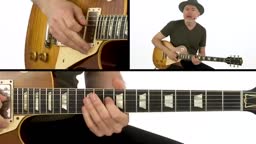
Let's put it all together into a classic blues rock sounding solo. I'm going to use D minor pent., D major pent., D dominant pent., D blues scale, and D7 arpeggio. Sounds like a lot, right? Well it is, but the quick route is to just add in the natural 3rd to the D minor blues scale!!! That covers most of that and is a very cool and familiar sound. Check it out!

+ 33 more lessons

Start Course

Reviews

24 results

fransjanboon

Verified buyer

05/15/26

Nice course to restore then your skills

Ghetto1969

Verified buyer

05/03/25

What a great teacher and likeable person. I love this course 😁

PhilFS

Verified buyer

01/06/25

Solo explorer

Good, clear tuition. Recommended.

mermermer

09/26/24

The best information on rock soloing I've encountered

I keep coming back to this course over and over to refresh and hone my skills. The information is fantastic, and is presented by probably the best guitar instructor on the internet. McErlain knows is stuff, but more importantly, he knows how to teach it. He builds upon concepts in a thoughtful manner, going over the most common chord progressions encountered in modern rock music. Stuff you find in Zeppelin, Clapton, everywhere. That said, if you can't run through some basic pentatonic scales, you are going to have a rough time here. It's not really for beginners. However, if you have some basics down, it will really catapult your playing to another level and you won't feel lost when jamming over your favorite songs or when it's your turn to take a solo in the band.

Leonsiao

04/13/24

just awesome

I really learn so much from this course, giving me so many ideas and concepts that are actually practical~~Biggist thank to Jeff!!!

Stop searching. Start improving with All Access.

Try 14 days free. Cancel any time.