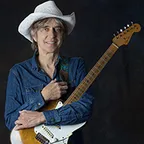
There are few genres that gospel music hasn't influenced in very positive ways; soul, rock, jazz, blues and many other forms of contemporary music all have strong roots to gospel music. Gospel's engaging melodies and beautiful harmonies present an ideal landscape for fingerstyle guitar and there's no one better qualified than Richard Kiser to guide you through the handful of gospel favorites presented here in Gospel Fingerstyle Guitar.
"Once in a while a guitar player comes along that will make people sit up and take notice. Richard's playing did that for me. He has a very smooth and creative touch!" - Doyle Dykes
Kiser is an excellent instructor and the arrangements that he prepared for this course are very accessible primarily because he keeps the student's focus squarely on the melody rather than long passages of fancy fingerwork; "keep the melody out front and keep it singing!" For each of the tunes, Richard will first perform the tune in its entirety and then breaks it down, note-by-note demonstrating the various right- and left-hand techniques he employs throughout the intros, verses, choruses and outros.
Richard has won 38 major awards including "Instrumentalist of the Decade" from the International Country Gospel Music Association and three-time "Artist of the year" with the Country Gospel Music Association. Kiser has recorded six CDs and performs at over 125 concerts a year in the States and in Europe. A favorite performer at the Chet Atkins Appreciation Society convention held annually in Nashville, Kiser has performed with everyone from Roy Clark, Charlie McCoy and Boots Randolph to Phil Driscoll, The Oak Ridge Boys and Charlton Heston.
Your Fingerstyle Gospel Guitar repertoire and learning adventure explores the following tunes:
No, Not One - "This is an old hymn found in most hymnals. It is a slightly upbeat song to be played at a moderate speed. I chose a "drop D" tuning mainly for the cool drone effect of the drop D and the sustain of the use of a lot of open strings in the melody. Each verse and chorus has a little different phrasing just to keep the song interesting and listenable. The ending has a cool set of runs to conclude the song."
Amazing Grace - "I chose this song for a couple of reasons. First, this song is very recognizable in any music genre. Second, the melody is fairly easy to play. It is also a great song to learn another method of fingerstyle playing. In this one, there is no alternating bass line, no "boom chick" rhythm; it is simply a moving melody where the thumb and fingers share a lot of the movement of the melody."
Higher Ground - "The song "Higher Ground" is an old camp meeting song written in 1898. It was originally played and sung sort of staccato but I chose to adjust the tempo to perform it in a "Chet" style. It lends itself really well to this tempo and makes for a really cool arrangement. I arranged this song to play on a CD which I recorded as a tribute to Chet Atkins titled "With All Due Respect."
I Love to Tell the Story/Tell Me the Old Old Story - "I chose these two old hymns, "I Love to Tell The Story" and "Tell Me The Old Old Story", because of the similar messages of each song, and the fact that they are musically compatible. I often will take two or three songs and make an instrumental medley out of them because it creates a pleasant three to four minutes of listening provided you chose the correct songs. These two work really well together and the key change is very simple."
His Eye is on the Sparrow - "This particular song is an old gospel favorite but it was always sung and performed very slowly. I have heard it played on the piano, organ and sung by soloists and quartets, but I have never heard it arranged as a guitar instrumental piece. That's why I decided to arrange it for the guitar and to make it my own arrangement. I was careful to not rearrange the music but to try to change the tempo and overall attitude of the song. I turned it into a fairly fast and uplifting solo and it is a lot of fun to play."
Wayfaring Stranger - "This song "Wayfaring Stranger" is a tune that I have arranged and rearranged so many times over the years. There are a lot of different tempo and style variations within this song and although it might sound a bit intimidating at first, it's really not that hard to learn. I think you will have a lot of fun learning as well as performing this tune. You will also find that many of the little riffs and runs that you learn here, can be used in a lot of other songs."
Over in the Glory Land/Jesus Hold My Hand - "This medley comes from two old camp meeting tunes; "Just Over in the Glory Land" and "Jesus Hold My Hand." They work really well together as a medley as they are both a bit up-tempo and the arrangement makes for a good Chet Atkins style song. The ending riff is another Chet style signature and consists entirely of pull-offs starting with the 1st string 3rd fret pulling off from the index to the middle finger on 2nd fret and then pulling off the middle finger to open string. It's a good one!"
Whether you play gospel music for its spiritual inspiration, or love to play its soulful, beautiful melodies, or maybe just anxious to develop some solid fingerstyle guitar chops - it's all here in Richard Kiser's Gospel Fingerstyle Guitar!
What you'll learn
Integrate walking bass lines from 5th to 6th string
Perform syncopated rolls with alternating bass
Play through the complete song arrangement
Transition smoothly between chord voicings while maintaining bass movement
Welcome to this instructional series on learning to play fingerstyle gospel tunes. I have chosen some of my favorite old hymns to demonstrate and hopefully teach you to play. The main thing to focus on is to keep the melody out front and keep it singing. You will discover that in arranging an instrumental piece, we try play the song in a way that the listener can follow the entire tune. You will notice that each song in this series will gradually get more complex. The key is practice
This is an old hymn found in most hymnals. It is a slightly upbeat song to be played at a moderate speed. Usually when i begin to arrange an instrumental tune, I experiment by playing the song in many different chords for two reasons. First, to discover which chord helps me to keep the melody out front, and second, to see how the melody fits the chord progressions with the lease amount of chord inversions and movements. In this song, I chose a "drop D" tuning mainly for the cool drone effect of the drop D and the sustain of the use of a lot of open strings in the melody. Each verse and chorus has a little different phrasing just to keep the song interesting and listenable. Be sure and focus on the lesson for the ending. It has a cool set of runs to conclude the song.
As you watch this performance clip, notice that the alternating bass lines are not muted except for the bass note on every four counts, and that some of the melody is played on open strings when possible in order to keep the sustain. That’s the key to making this song fun to play and easy to listen to. Another thing you will notice as you practice is that you can play the song at almost any speed and it still sounds good. When I recorded this song on my "Upon This Rock" CD, i actually played it faster.
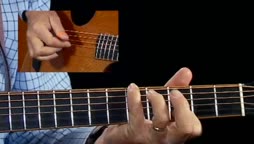
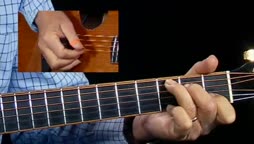
The intro will consist of alternating the bass lines in a 6-4, 5-4 string configuration while playing the second and third strings of the D chord. Be sure and let the D note on the sixth string ring out and sustain for that deep drone effect. You can see that I only mute the note lightly on every four counts. The "hammer on" effect is played on the fifth string second fret, not the sixth string as i misquoted in the video. Just remember that the intro will actually be setting the tempo as well as the attitude of the song so play it with feeling. This intro is a great exercise to get your alternating bass line smooth and tight for almost any fingerstyle tune so use this lesson to practice your alternating bass.
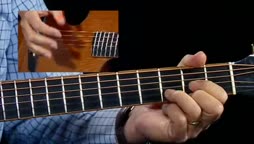
The first thing you need to learn in this song as in all the songs in this course is the melody. You want to remember that your fingers as singing the lyrics so stay tight on the melody. If you over play or paint too many extra chops and riffs in the song, you stand the chance of losing the listener because can't follow the melody. On this tune, the melody will follow the chord structure in one or more inversion of each chord. I will use two formations of the "D" chord in the lead line. When I play a two string harmony part as in the "No Not One phrase", the harmony notes are played on the 7th fret position of the "D" and then the 5th and 6th fret position of the "A", as they are played on the 2nd and 3rd strings.They are actually 2/3rds of the triad in each chord. Remember to use the middle and ring finger of the right hand to play these notes as you keep the thumb alternating the bass line. When you play the verse the second time, you can add a little more syncopation between bass and lead notes to give some variation. You can also add an extra chop or two in the second verse to add variation. Don't be afraid to deviate from my arrangement a bit to make it your own.
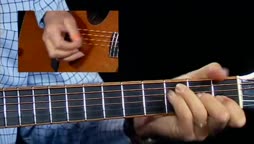
Once again, learn to play the melody on the first and second string so you can keep the chord position and alternating bass going during the entire chorus. Remember to let the bass lines ring to keep the sustain. There is also a place you will see that the lead will also sustain. You can see that when i use a bass note of the "G" chord, the bass note is played on the 6th string 5th fret for the "G" note. This is because of compensating for the "drop d" on the sixth string. When I play the decending notes on the 5th string, be sure and watch my left hand because you can see that my finger positions will change on the second string to maintain the same chord. You will probably want to spend time just practicing this particular run to get it smooth and effortless. You will also use it at the ending just before the song resolves.
This is simply an alternating bass scale using and the right hand will be as busy as the left. It starts with 2nd string on 3rd fret and 5th string on 3rd fret. Alternate the 5th and 4th strings as the 5th string decends from the 3rd to the 2nd to the 1st fret and then open "A" string. The last line of the song is just a two string harmony starting with the 2nd and 4th strings on 2nd fret "a" chord, and ascending all the way up the scale to resolve in "D" position on the 10th fret. This can be a very fun and entertaining song to perform. Just practice to make it smooth. Good luck!!
These pieces are beautiful renditions of gospel songs. Of particular note is "Amazing Grace" where the instructor changes, which beautiful effect, the key of the verses. HIs instruction is patient and inspiring. This is an excellent course.
M
MatthewWalsh
Verified buyer
11/20/24
Good songs
A great selection of full songs rather than just etudes. Nicely explained,
M
majdavids13
Verified buyer
09/29/24
Good for those that like Gospel and Fingerstyle
Just what I needed. Thanks.
T
Tom943
Verified buyer
09/06/24
Great set of Lessons.
I enjoyed working through several of the lessons. I enjoy the gospels themes explained and examples on playing them.
G
grayham
Verified buyer
05/20/21
Not for the beginner but great tutor everything explained very well very pleased with it