Trading Solos: Bebop

Interactive Video Jam Session with a Top TrueFire Artist

Marty FriedmanTommy EmmanuelSteve VaiEric GalesEric Johnson

Get this course and 1,000+ more with All Access

Try 14 days free. Cancel any time.

Purchase Individual Course for $9.99
Trading Solos: Bebop

About this course

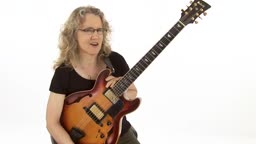
In Sheryl Bailey’s Bebop edition of Trading Solos, you’ll jam with Sheryl over five popular bebop progressions, in a variety of keys and feels. Sheryl kicks off the course sharing some of her tone tips to help you get a great sound. And then for each of the five progressions, Sheryl shows you a handful of moves and comping approaches. You’ll then take turns applying those ideas, trading solos, and comping for each other over the tracks.  

”The best way to get become a better player is to play with others! That's where the real learning happens, but for many folks, finding good players to play with can be a challenge. I have an amazing rhythm section lined up for you with bassist MaryAnn McSweeney and drummer Jordan Young because it's important to play with great rhythm sections that groove! The next step is that I share a few of my favorite licks on these iconic chord progressions that I've chosen to share with you. With a solid palette of voicings, grooving comping rhythms and a few tasty vocabulary words, you're now ready to reach higher ground!”

For each of the five bebop progression jam tracks, Sheryl will show you a handful of licks and comping approaches that you can use. Then, you'll take turns applying those ideas, trading solos and comping for each other.

Sheryl will explain and demonstrate all of the key concepts and approaches along the way.  You’ll get standard notation and tabs. Plus, Sheryl includes all of the backing tracks for you to work with on your own. In addition, you’ll be able to loop or slow down any of the videos so that you can work with the lessons at your own pace.

Grab your guitar and let’s trade solos with Sheryl Bailey!

What you'll learn

  • Execute syncopated comping rhythms on upbeats
  • Create melodic lines using chromatic embellishments
  • Comp with rootless voicings and upper structures
  • Comp effectively using only thirds and sevenths
  • Balance space and activity in rhythm section playing
Release date: 05/27/2019 • 1h 52m runtime
Start Course
Sample lessons
Track 1: Say What
Track 1: Say What
Track Overview
Track 1: Say What
Track 1: Say What
Comping Approaches: Demo
Track 1: Say What
Track 1: Say What
Three Lick Ideas: Demo
Let's Trade Solos
Let's Trade Solos
Track 1: Playalong

What's included

23 lessons • 15 charts • 5 Jam Tracks

Trading Solos: Bebop
Hi, I'm Sheryl Bailey. Welcome to Trading Solos: Bebop.

The best way to get become a better player is to play with others! That's where the real learning happens, but for many folks, finding good players to play with can be a challenge in our busy lifestyles, just with schedules alone! But now, via TrueFire you can jam with a professional and get your chops a blazing! I can share with you some basic chord voicings and then ways to develop them rhythmically and harmonically for great comping! I have an amazing rhythm section lined up for you with bassist MaryAnn McSweeney and drummer Jordan Young, because it's important to play with great rhythm sections that groove!

The next step is that I'll share a few of my favorite licks on these iconic chord progressions that I've chosen to share with you. With a solid palette of voicings, grooving comping rhythms and a few tasty vocabulary words, you're now ready to reach higher ground!

Grab your guitar and let's trade some solos!
Jazz Style Tips
Learning how to play with a rhythm section is about locking in with the drummer and bass player to be a team. Listening is the most powerful tool to develop to react to what's going on. Developing a good vocabulary of voicings is important to have the ability to "color" the music as it asks of you, and having a strong sense of time is important to lock it in the pocket with the bass and drums. Learning about syncopation will help you play hipper rhythms that make the groove deeper. Practicing with an amp, if you're an electric guitar player, is crucial towards developing your touch and sound, as your instrument is the electric guitar, not an acoustic guitar.
Track 1: Say What
"Say What?" is based on the modal jazz staple by Miles Davis, "So What". This is certainly an important situation to know how to navigate, a static, modal groove. How can you make the comping interesting from chorus to chorus? How can you develop hip melodic lines, that go beyond running scales? That's what I'm here to share with you!
Track 1: Say What
Grooving in the pocket and keeping it simple is the key on this modal tune. I like to use "open sounding" voicings in 4ths to keep the harmony open for the soloist and creating an open vibe. Locking into the rhythmic pattern gives space for the bass and drums to fill in the spaces to make the groove deeper. As I move to the next couple choruses, I add more color to my voicings and let the bass player cover the roots. In the last chorus, I explore creating movement on the static harmony by making them into II-7 V7's.
Track 1: Say What
The secret to making this simple chord progression sound slick is in the comping rhythms: Locking in with the rhythm section to really be a section, strong together to support the soloist. In the first chorus, I just lock in with the R.S., using an open sounding min7/11 voicing.

In the 2nd chorus, I lock in with a syncopated rhythm, keep it in the pocket and steady to make the groove heavier. Also, I imply a II-7 V7 progression on the static Dorian sound: This is commonly used by bebop players to create harmonic motion: "waves on top of stillness"

On the last chorus of comping, I use the II-7 V7 sound, but share some variations in the voicings by adding 9's and 13's, to sweeten the sound. The licks I've shared with you follow the concept of creating a II-7 V7 line over the static Dorian: Lick #1 uses the G7 bebop scale combined with a Dmin7 arp. Lick #2 outlines a Bmin7b5 over the Dmin7 - that equals a dim6 sound! Lick #3 outlines an Fmaj7 arpeggio against the Dmin7 - that equals Dmin7/9. So, the trick is to imply harmony against a static modal jam.
Let's Trade Solos
Let's jam! I'll start things off with a solo, and then it's your turn to take lead while I play rhythm. Listen for the comping techniques and soloing licks we talked about, and then try them out yourself. Don't forget to back me up while I'm soloing!
Track 2: All Thumbs
This G blues progression has some elements of the Wes Montgomery tune "The Thumb" - in particular the chromatic descending dom7 turnaround in the last 2 bars of the progression. I hope you'll enjoy the series of variations on chord voicings and the iconic licks I share with you on this G blues. I know you'll find some new ideas that you can use in any blues situation!

+ 16 more lessons

Start Course

Reviews

13 results

kenco

Verified buyer

01/28/25

Bebop trading solos.

Great player and teacher. Lots of material to work with for both comping and soloing.
Addahia

Verified buyer

01/06/25

Sensei Sheryl

What's not to like here? If you've been throuh her BEBOP DOJO, this TRAIDING SOLOS and 50 BEBOB LICKS YOU MUST NOW are you follow up. Amazing teacher, super fun imporv and ideas.

ukuni

Verified buyer

06/28/21

Good course

This is a good course, just a bit above my playing ability

marv9

Verified buyer

08/26/20

Bebop

informative and fun

jrdocbenson

Verified buyer

07/29/20

Trading solos

Very enjoyable

Stop searching. Start improving with All Access.

Try 14 days free. Cancel any time.