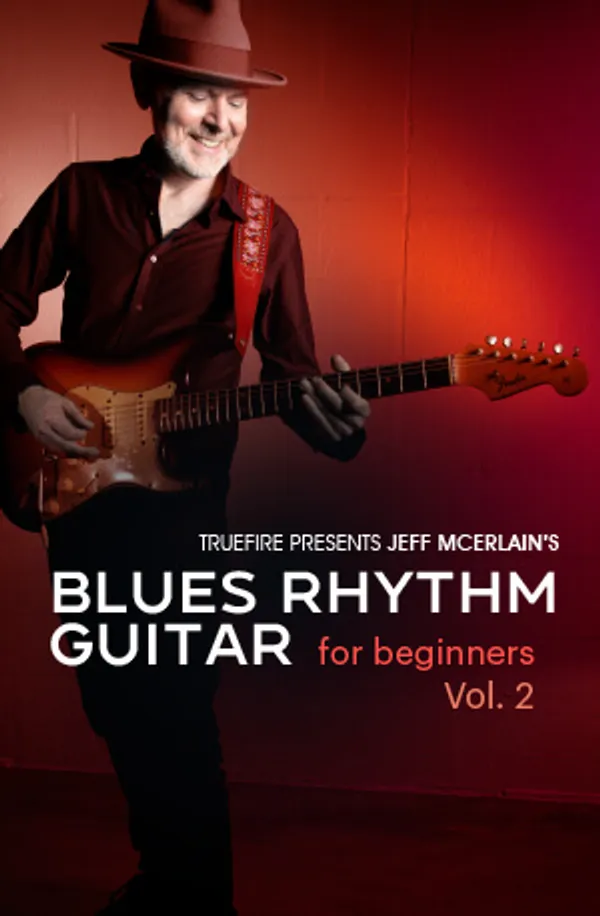

Take 5: Blues Arpeggios

Accelerated Study Program for Blues Guitar Arpeggios

Marty FriedmanTommy EmmanuelSteve VaiEric GalesEric Johnson

Get this course and 1,000+ more with All Access

Try 14 days free. Cancel any time.

Purchase Individual Course for $24.99
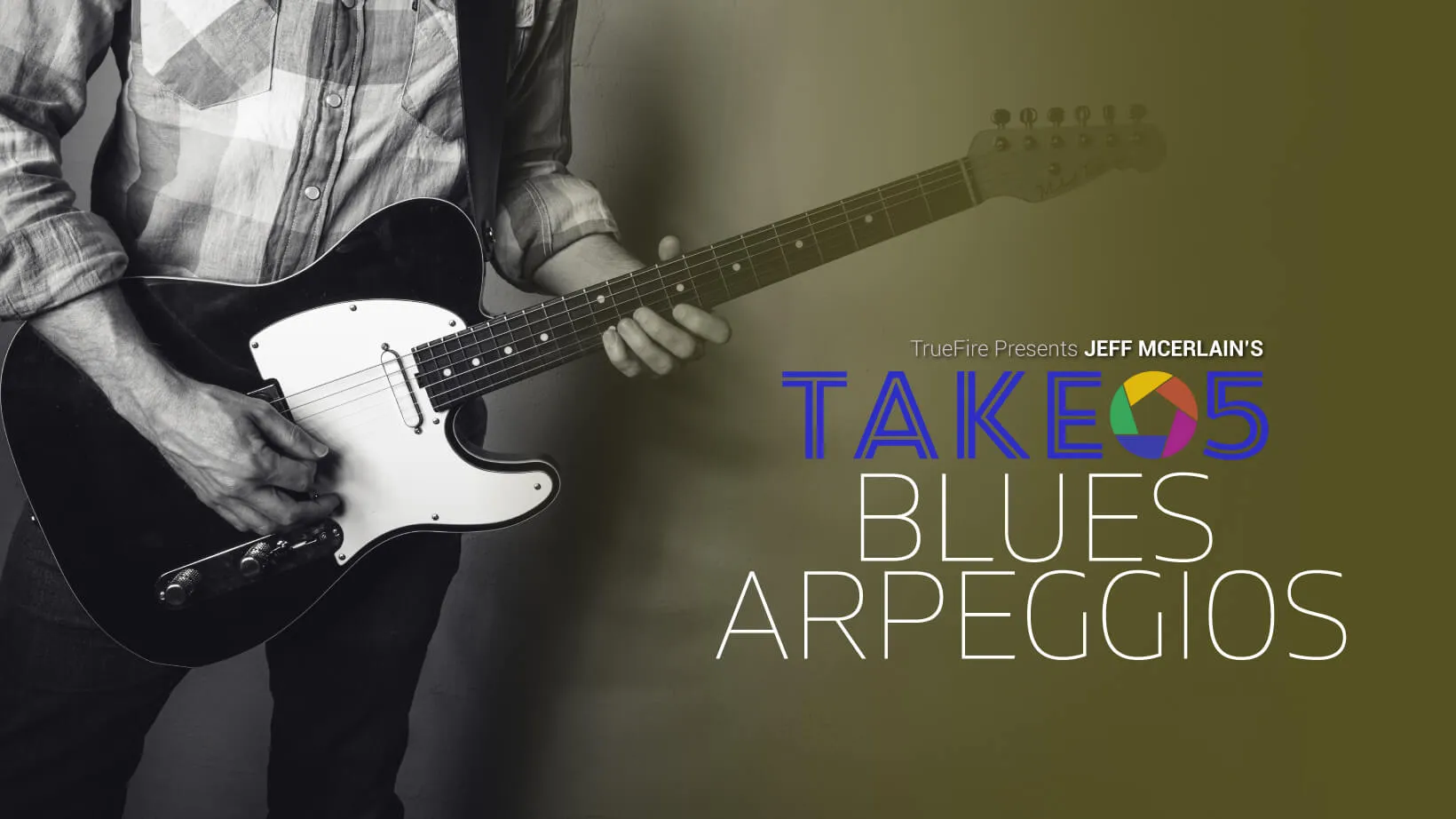
Take 5: Blues Arpeggios

About this course

Any great blues player will tell you that arpeggios are the secret to always hitting the right notes, at the right time. But how do you leverage the power of arpeggios as a soloing tool without sounding like you’re just playing arpeggios? Jeff McErlain has the answer!

This Blues Arpeggios edition of Take 5 from Jeff McErlain is an accelerated curriculum designed to help you unlock the improvisational power of arpeggios when crafting solos without having to struggle through a lot of tedious exercises.

”Arpeggios are the most important thing a musician can work on for improvising. Scales, of course, are very important, but as you may have encountered in your own playing, you often hit notes that sound wrong yet are in the scale. This is because the best sounding notes to resolve to are the ones that are in the chord. Arpeggios are derived from scales as each scale contains seven chords.

This course is designed to help you navigate a blues by using arpeggios as opposed to thinking scales. I find when I think about improvising out of the scale, I play very “scaly”. In other words, it is often uninspired and not very musical. When I think about improvising by embellishing arpeggios, I find my playing to be much more inspired. And you will too!”


You’ll start the course with a quick primer during which Jeff will introduce you to dominant 7th arpeggios -- the key to playing over any major or dominant blues. He’ll show you a number of ways to play arpeggios, all over the fingerboard, to unlock your potential for creative blues improvisation.

Jeff will then guide you through 5 arpeggio-based performance studies, progressing from basic to more advanced applications of the approach.

He will explain and demonstrate all of the key concepts and approaches along the way.  You’ll get standard notation and tabs for all of the Performance Studies. Plus, Jeff includes all of the rhythm tracks for you to work with on your own. In addition, you’ll be able to loop or slow down any of the videos so that you can work with the lessons at your own pace.

Grab your guitar and let’s Take 5 with Jeff McErlain!

About the Take 5 Series


TrueFire’s Take 5 courses feature an accelerated curricular approach to help students get up to speed quickly on a particular style or technique. Each Take 5 course starts with a primer on the particular style or technique and then guides the student through 5 performance studies progressing from basic applications to more sophisticated approaches.

Jeff McErlain's Preferred Gear

Below is a list of Jeff McErlain's preferred gear including guitars, amps, pedals, accessories, and more. What you see in Jeff's lessons may or may not be this actual gear, but if you are trying to capture Jeff's sound and tone, the gear listed below is recommended by Jeff and it's a great place to start!

Guitars

Amps

Pedals

Accessories & More

What you'll learn

  • Create tension by resolving to the b7 instead of the root
  • Learn multiple fingering positions for arpeggios across the entire fingerboard
  • Understand tritone movement between chord changes
  • Understand how to use dominant 7th arpeggios over blues progressions
  • Develop ear training for the flat 7th sound
Release date: 11/15/2018 • 1h 11m runtime
Start Course
Sample lessons
Level 3: Blues Arpeggios
Overview
Level 3: Blues Arpeggios
Performance
Level 3: Blues Arpeggios
Breakdown

What's included

19 lessons • 6 charts • 5 Jam Tracks

Take 5: Blues Arpeggios
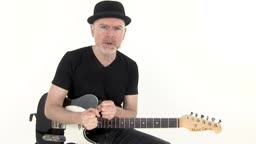
Hi, I'm Jeff McErlain. Welcome to Take 5: Blues Arpeggios. Any great blues player will tell you that arpeggios are the secret to always hitting the right notes, at the right time.

In this course, we'll start with a quick primer where I'll introduce you to dominant 7th arpeggios — the key to playing over any major or dominant blues. I'll show you a number of ways to play arpeggios, all over the fingerboard, to unlock your potential for creative blues improvisation. I'll then guide you through 5 blues performance studies, from basic to more advanced applications of arpeggios.

All of the performance studies are tabbed and notated and you'll get all the jam tracks to work with on your own. You can loop and slow down the videos to work at your own pace. Let's get started!
Blues Arpeggios
Arpeggios are the most important thing a musician can work on for improvising. Scales are very important of course, but as you may have encountered in your own playing, you often hit notes that sound wrong yet are in the scale. This is because the best sounding notes to resolve to are the ones that are in the chord. Arpeggios are derived from scales as each scale contains seven chords.

This course is designed to help us navigate a blues by using arpeggios as opposed to thinking scales. I find when I think about improvising out of the scale, I play very "scaly". In other words, it's often uninspired and not very musical. When I think about improvising by embellishing arpeggios, I find my playing to be much more inspired. There is a lot of information in this first section, so take your time with it.
Level 1: Blues Arpeggios
Our first performance study is a slow blues in the key of A. The three chords in a blues are A7, spelled A-C#-E-G, D7 spelled D-F#-A-C, and E7 spelled E-G#-B-D.

Take your time to familiarize yourself with the fingerings I showed you in the introduction section. Take note of how the chords and arpeggios lay on top of each other so you can visualize both the chords and arpeggios.
Level 1: Blues Arpeggios
As you can hear, this performance is pretty simple note wise by design, that doesn't mean it's easy to play. I suggest listening to the exercise and try to memorize the melody and hear the changes. Remember, these are exercises so it may not be the most engaging solo ever created, but that's on purpose. The idea here is to see the chord arpeggios and sounds played simply over the changes.
Level 1: Blues Arpeggios
In this example, I stuck to three arpeggio fingerings in position. You can see the chord shapes right inside of the arpeggios, and that's really important!

As you can also see, I enter each of the natural 3rds of each chord from a half step below. I do this to add a bit more of a bluesy element to the solo, because it sounds awesome! It's easy to do and really makes your playing a lot more sophisticated sounding. Above all, when practicing this one, try to play as musically as possible, do this with everything you play! Scales, chords, arpeggios, etc. Always practice being musical.
Level 2: Blues Arpeggios
In this study, we're going to play over a rumba groove and I'm going to use the arpeggios in a classic blues fashion. This is something you might hear the great B.B. King do. I'm sure you know this, but I can't recommend listening to and learning some B.B. King. OK, more than some, a lot of B.B. King.

He truly was spectacular in so many ways: a great player, singer, performer, person, and innovator. His level of sophistication and use of dynamics, phrasing, and tone are unparalleled. It's cool to see interviews with the man and realize he also knew a great deal about the instrument, much more than he would have one believe.
Level 2: Blues Arpeggios
This style of playing, mixing pentatonic scale and arpeggios, probably sounds pretty familiar. It should, as it's one of the standard approaches to what we might call "sweet" blues playing. Generally speaking, Texas style blues is a bit more minor pentatonic based, whereas Chicago style blues (B.B. King) is a little more major pentatonic based. So, when trying to familiarize yourself more with the Chicago style blues, be sure to listen to players like B.B. King. Many of the British blues guitar players like Eric Clapton and Peter Green drew heavily upon B.B. King and this sound. A great example of Texas blues would be Albert King — listen and compare those two and the difference becomes more apparent.

+ 12 more lessons

Start Course

Reviews

56 results

Riffster59

Verified buyer

12/23/23

Well presented and easy to understand.
dwa79

Verified buyer

09/20/23

Good Lessons

I love to see not only what Jeff’s doing but also what he’s thinking….rare and invaluable

Chris

08/12/23

Great Course!

Another fantastic course by Jeff, who is responsible for almost every step-change in my playing. If you really want to get arpeggios under your fingers in a way that will stick, you've come to the right place.

PeteMc

Verified buyer

03/16/23

Jeff is an excellent guitar instructor. His teaching style is clear and easy to follow. He makes it plain, to get the most out of the course requires us putting in the time practicing the right things. If you want to learn how to apply your dom7th arpeggios musically, this is a great entrance point!

brutans

Verified buyer

12/15/22

Blues arpeggios

Jeff is a great teacher. This is another great addition to his blues based courses.

Stop searching. Start improving with All Access.

Try 14 days free. Cancel any time.