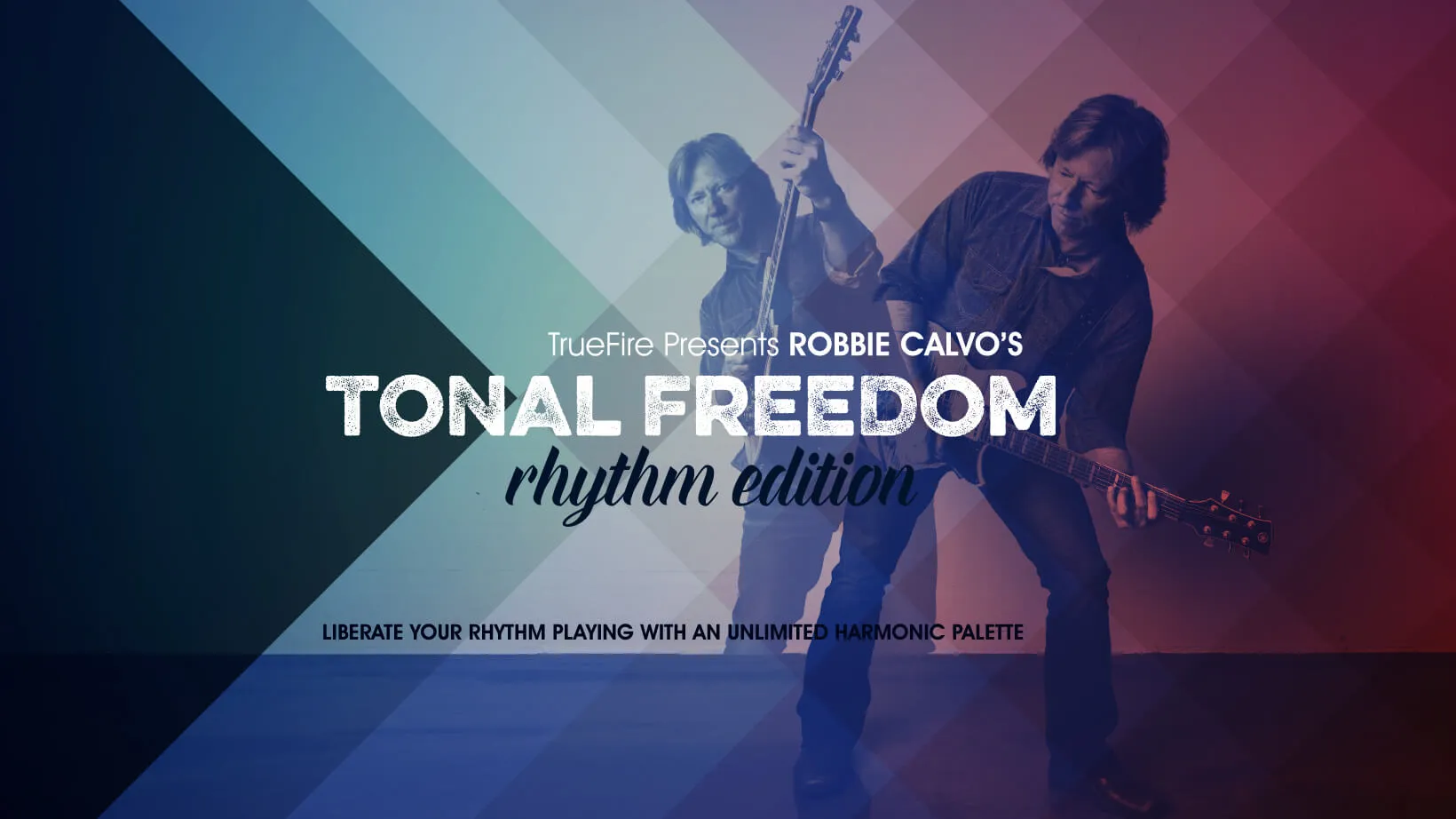
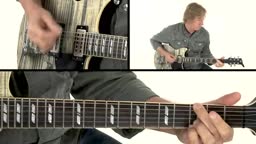
The tonal center of any chord progression is where you hear ‘Home’ or the resolution point of that chord progression. This resolution point is the key factor in understanding Modality, Blues harmony, and non-diatonic harmony.
In this Rhythm Edition of Robbie Calvo’s Tonal Freedom, you’ll learn how to play, create and analyze a variety of chord progressions, understand their harmonic structure, and identify their tonal center resolution.
Armed with this knowledge you’ll be able to create your own chord progressions, be able to instantly recognize the Tonal Center of other progressions and consequently, know how to apply the correct mode, scales, and arpeggios to create compelling melodic solos and improvisations.
”Having a solid understanding of Tonal Centers in any given chord progression is going to help you understand how to improvise correctly over that progression too. The 7 Modes of The Major Scale, for example, are simply 7 different resolution points within one key…we’ll be looking at 6 of those 7 resolution points and Tonal Centers within the Major Scale.
Outside of the Major Scale, we have Blues and Rhythm and Blues harmonic progressions that draw their chords from several different keys. Regardless of the chromatic nature of these progressions, you’ll still find that there is a Tonal Center resolution point to those progressions. We’ll also take a look at a typical Jazz progression to show how even the most complex progressions can be broken down into a series of Tonal Centers within a longer piece of music.”
In the first section of the course, Robbie presents a primer on Tonal Centers: What Are Tonal Centers?, Tonal Centers & Sweet Notes, Tonal Center Freedom, The 3 Types of Tonal Centers, Style & Genre Considerations, Course Materials & Analysis
Diatonic Major Progressions are the focus of the second section: Ionian Major, Lydian Major, and Mixolydian Dominant. The third section examines Diatonic Minor Progressions: Dorian Minor, Phrygian Minor, Aeolian Minor, and Locrian Thoughts
Non-Diatonic Progressions are studied in the fourth section: Rhythm & Blues Tonal Centers, Blues Tonal Centers, 8-Bar Dominant Blues, Minor Blues Tonal Centers, 12-Bar Minor Blues, Altered Dominant Tonal Centers, and Altered Dominant Funk. ii V I Progressions are presented in the fifth and final section of the course: Diatonic Jazz, Chromatic Jazz, and Descending ii V I Jazz.
All of the performance studies are tabbed and notated. You’ll have all of the backing tracks to work with on your own, plus you’ll be able to loop or slow down any of the videos so you can work with the lessons at your own pace.
Grab your guitar and let’s unlock your tonal freedom with Robbie Calvo!
What you'll learn
Create smooth transitions between altered dominant chords
Apply V of II (five of two) concept
Apply dynamic control using fingers vs. pick attack
Analyze chord progressions using Roman numeral analysis
Identify and use secondary dominants in progressions
Hi, I'm Robbie Calvo. Welcome to Tonal Freedom: Rhythm. The tonal center of any chord progression is where you hear "home" or the resolution point of that chord progression. This resolution point is the key factor in understanding modality, blues harmony and non-diatonic harmony, and consequently, how to apply your improvised lines.
In this course, we're going to take a close look at how to play, create and analyze a variety of chord progressions, as well as understand the harmonic structure of each progression and it's tonal center resolution. We'll be studying a variety of progressions built from the harmonized major scale. We'll look at all the popular modal tonal centers: Ionian, Dorian, Phrygian, Lydian, Mixolydian and Aeolian. We'll take a look at some blues harmony, R&B harmonic structures, an altered funk progression and a couple of jazzy blues II-V-I and II-bII-I progressions.
Armed with this knowledge, you'll be able to create your own chord progressions that have the desired tonality and resolutions that you're looking for in your compositions. You'll be able to recognize the tonal center of other progressions and consequently know how to apply the correct mode, scales, arpeggios, etc. for melodic, resolute improvisations. I'll be covering tonal center improvisation in the companion course, Tonal Freedom: Lead.
On completion of this course, you'll have built a solid recognition of tonal centers, stylized rhythm parts and the ability to create tonal center progressions and fully understand why this is so important to your lead guitar playing. Tonal freedom is the foundation to even greater musical chops!
I'm often asked by my students the best way to work through one of my guitar courses. My advice has always been to leave your guitar on the guitar stand and literally watch the whole course like a movie. Take notes of the video sections you think are relevant to you and your goals and only work on those sections.
If you've watched a course fully, you'll have a complete understanding of what the content offers, an understanding of the concepts presented and you can then "cherry pick" the items that are of most interest and relevance to focus your full attention on. Taking this approach will help you to not feel intimidated by the magnitude of the information, get you started at the correct point of information you were looking for...and lift any pressure to complete a whole course!
"Tonal centers" are the resolution point or resting place of a chord progression. You'll find throughout your lifetime of studies that nearly every conceivable chord progression will have a tonal center, which means it's an absolute must to study and understand this course.
Typically, the tonal center will be the first chord of the harmonic progression. Why? Well, because if your progression starts at that point, cycles through a series of chords and comes back to the first chord to repeat the same cycle, your ear will hear that chord as the resolution point...start and end. There are exceptions, however, that we'll discuss throughout the course. Having a solid understanding of tonal centers in any given chord progression is going to help you understand how to improvise correctly over that progression, too.
The 7 modes of the major scale, for example, are simply 7 different resolution points within one key. We'll be looking at 6 of those 7 resolution points and tonal centers within the major scale. Outside of the major scale, we have blues and R&B harmonic progressions that draw their chords from several different keys. Regardless of the chromatic nature of these progressions, you'll still find that there is a tonal center resolution point to those progressions. We'll take a look at several different examples in those genres to illustrate the point and discover varieties within the genres. We'll also take a look at a typical jazz progression to show how even the most complex progressions can be broken down into a series of tonal centers within a longer piece of music.
Recognizing where a chord progression resolves to will give you a harmonic structure and target chord to focus your improvisations on. The tonal center chord will also contain all of the "sweet notes" and resolution chord tones that you'll want to end your licks and melodic phrases on.
Having a solid understanding of tonal centers will help you create chord progressions, define and create modal progressions with the correct harmonic structures and also focus your melodic improvisations towards one chord when you solo. We'll be covering the improvisational aspect of tonal centers in the lead guitar edition of this course, and I'll be using the same chord progressions studied in this course so we can tie it all together for a concise, practical approach to tonal center rhythm playing and precise soloing applications.
There are 3 main types of tonal centers:
Diatonic - the chords in a Diatonic chord progression are derived from one key and can be major, minor or dominant.
Chromatic - progressions derived from a series of different keys: blues, R&B, etc.
Temporary - In the case of jazz progressions which typically descend through a series of Tonal Centers. I call these temporary tonal centers because they will move through a series of tonal centers within one progression or movement before returning to the "master" tonal center of the musical structure.
There are also secondary dominant chords within diatonic chord progressions. These are functioning as V chords moving towards a "temporary" I chord. I'll explain more about this in later sections of the course.
Tonal centers exist in every genre and style of music and this is why it is so important to understand the harmonic and melodic nature of this information. Once you have this power at hand, you'll have the freedom to create and improvise without fear of playing the wrong tones or resolving outside of the tonal center chord and its "sweet note" resolutions.
I ve been doing lots of Robbie's courses and they are all profitable. He is really an amazing teacher. This course provided me with tonal clarity, some very cool chords, voicing and sound palette, and the jamming tracks are fun and groovy, grate to take those chords and make your own discoveries.
P
playaxeman
08/12/22
eyeopener course Tonal Freedom, Rhythm Edition
This was really a eye-opnerer course that I would recommand to anyone who want to understand how chord progression are build and work together. It gives a solid understanding. The progressions are really are cool and fun to play and Robbie explains why. It also helps in improvising.
O
oldintheway
Verified buyer
07/28/22
Good stuff!
Just What I was looking for, this will give you a in depth look of different types of chord progressions in each modes, very valuable, study them and try to find Them in songs.
B
Bob J.
11/24/19
Tonal Freedom, Rhythm Edition
This is a must course and Robbie Calvo will soulfully touch the inner guitarist in you . Thank You Robbie, you are incredible.
C
Cstrazzulla
10/31/19
Robbie Calvo - Tonal Freedom - Rhythm
This is my 5th Robbie Calvo course that i have taken - all related to modes. Robbie is a great instructor and his music is really inspirational to me, so much so that I have actually created some of my own backing tracks of Robbie's lessons and played over them in public. Robbie's analysis and breakdown of what he is playing is very good. I have learned a lot about the modes as well as many new chords and solo ideas. At least to me some of Robbie's strumming patterns are quite advanced and I need all the help I can get
About the only area that I think Robbie could improve upon would be to spend a bit more time in the breakdown section on what his right hand is doing (scratches, muting etc.) when playing chords as is the case in this course. Consider in the breakdown section slowing down the strumming pattern, so we can really zero in on what you are doing to get such a "tight" sound.