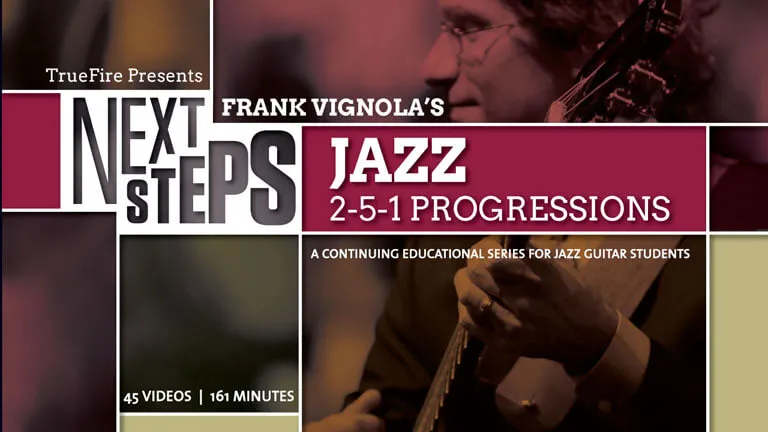
Next Steps Jazz: 2-5-1 Progressions

A continuing educational series for jazz guitar students

Marty FriedmanTommy EmmanuelSteve VaiEric GalesEric Johnson

Get this course and 1,000+ more with All Access

Try 14 days free. Cancel any time.

Purchase Individual Course for $14.99
Next Steps Jazz: 2-5-1 Progressions

About this course

Peanut butter and jelly. Laurel and Hardy. Pen and paper. Jazz standards and 2-5-1 progressions. They all go hand and hand together. The first three pairings are universally accepted, but only students of jazz would recognize just how true the fourth pairing is. Practically the entire jazz standard songbook is composed around 2-5-1 progressions. Learning how to comp and solo over the 2-5-1 is an essential rite of passage for ALL jazz guitarists.

Frank Vignola's 1-2-3 Jazz Guitar introduced you to three moveable jazz chord forms (Major 7th, Minor 7th and Dominant 9th), three jazz rhythms (swing, latin and the Charleston) and three ways to jazz-up your single line melodies. Congrats, you're ready to take your next step -- comping 2-5-1 progressions!

In the first section of Next Steps Jazz: 2-5-1 Progressions, Frank expands your chord vocabulary with more movable jazz chord forms: Fifth-string-root forms for the Major 7th, Major 6/9, Minor 7th and Minor 9th chords, and sixth-string-root forms for the Dominant 13th and Dominant Flat 13th. These new forms add color to your jazz chord vocabulary and also equip you to play the 2-5-1 progressions in any key, anywhere on the fretboard.

The second section explains what a 2-5-1 progression is and Frank shows you how to craft and identify them in any key. You'll learn how to use scale degrees from the major scale to build chords and progressions -- no thick theory here! Frank then steps you through a series of overviews, playing examples and playalongs for both major and minor 2-5-1 progressions in the key of G and A minor.

Your new vocabulary of fifth-string-root chord forms is put to work in the third section as you play through several major and minor 2-5-1 progressions in the key of C, D minor, Eb and F minor. You put everything to work in the fourth and final section of the course. Frank presents three song applications, each in different keys and each with both a slow and at-tempo playalong.

You will play your way through the course applying everything you learn along the way immediately in a musical context. The resulting refined understanding of 2-5-1 progressions coupled with your new chord vocabulary will put hundreds of jazz standards at your fingertips.

What you'll learn

  • Execute chord substitutions to stay in one position on the fretboard
  • Apply jazz chord vocabulary including m9, 13, b13, and 6/9 chords
  • Play through complete song applications using 2-5-1 progressions
  • Execute smooth transitions between Dm7, G13, and Cmaj7
  • Understand how to derive chord numbers from scale degrees
Release date: 01/11/2013 • 2h 41m runtime
Start Course
Sample lessons
Scale Degree Chords
Scale Degree Chords
Overview
The 2-5-1 Progression
Overview
2-5-1: Key of G
2-5-1: Key of G
At Tempo Playalong
2-5-1: Key of F Minor
At Tempo Playalong

What's included

45 lessons • 42 charts • 18 Jam Tracks

Next Steps Jazz: 2-5-1 Progressions
Welcome to Next Steps: The 2-5-1. In this course you'll be introduced to many new voicings of chords used in playing rhythm jazz guitar. There are countless variations and substitutions but in this course we'll focus on some of the most practical which will get you started playing with other musicians and help you further your knowledge of jazz guitar and music. Here we go!
Course Prerequisites
There are some basic things you will need to know before studying this course. You will need to know Gmaj7, Amin7 and D dominant 7 chords along with how to play them in a swing, charleston and latin rhythm. You will also need to know the names of the notes on the low E and A strings. If you already know these then you are ready to take your next steps.
SECTION 1
One of the great things about playing guitar is the ease of transposing keys. If you know one chord grip you can easily move the root note of the chord up or down the fretboard to change keys. In this section we'll discuss a few common chord grips that we will be using and eventually use them in chord progressions and apply them to songs.
Major 7th
If we are in the key of C this would be the 1 chord. This C major grip uses only the middle four strings and you will want to block the two outer E strings using your index finger so no extra strings ring out except for the middle four that we are fretting. Get comfortable with this grip by moving it up and down the fretboard.
Major 6/9
This is also used as a 1 chord but with a different color than a major 7th chord. It may be a little tricky fingering this chord at first because of the double bar, you are doing both with your index finger and ring finger. Once you get it, hold it and try to get your fingers comfortable making this shape. Then move it up and down for a great sound! This fingering is very similar to a dominant 9 chord which we will discuss in upcoming segments.
Minor 7th
A very common grip for a 2 chord. The fingering is similar to a major 7 in that you don't want the outer two E strings to ring out but it is a little trickier because you also need to bar using your index finger to do both. The way you place your index finger is very important and may take some time to get comfortable getting your index where it needs to be. Get comfortable and move it around.
Minor 9th
Okay let's take a break from barring. With this 2 chord we'll use all four fingers and just like a C major 7 we will want to block the outer two E strings. Also notice how a simple movement of your index finger can change the quality of the chord. These little tricks will become great tools when you need to quickly change between chords.

+ 38 more lessons

Start Course

Reviews

15 results

jessalar

Verified buyer

02/22/26

good way to get into the 2-5-1 jazz progresion

good way to get into the 2-5-1 jazz progressions. after this you can manage to get in most of the jazz standards


Ohio5665

Verified buyer

11/03/23

Product image Next Steps Jazz: 2-5-1 Progressions

Lots of valuable 2-5-1 info in these lessons. Frank starts you off with the basics and works you up to more advanced ideas.

jackiez

Verified buyer

12/18/21

Outstanding

Excellent course, there is a lot to unpack but presented in an easy to understand manner. It is one of my favorite courses and very important info for anyone learning Jazz.

morningfield

Verified buyer

12/30/20

Thanks!!

Jeff

08/20/20

Great introduction to jazz substitutions

For someone who has a pretty good understanding of guitar but needed help applying some of the knowledge, this was a great course. It helped me to focus on a limited amount of data, and apply that to real world progressions. This helped some of those chords actually stick in my mind.

Stop searching. Start improving with All Access.

Try 14 days free. Cancel any time.