Play Bass Guitar 5: Styles & Techniques

Styles & Techniques for Intermediate to Late Intermediate Bass Guitarists

Marty FriedmanTommy EmmanuelSteve VaiEric GalesEric Johnson

Get this course and 1,000+ more with All Access

Try 14 days free. Cancel any time.

Purchase Individual Course for $5.00
Play Bass Guitar 5: Styles & Techniques

About this course

Welcome to Play Bass 5: Styles and Techniques for intermediate to late intermediate students of bass guitar.

This Bass Learning Path core course is presented by 7 top TrueFire educators: Freekbass, David Santos, Stu Hamm, Andrew Ford, Jasper Mortier, Ariane Cap and Teymur Phell.

The Styles and Techniques curriculum is comprised of select bass guitar lessons from the educators’ existing TrueFire course libraries.

As you become a better bass player, you’ll need to be able to cover a wide variety of styles. You’ll also need to hone your technique. The lessons in this core course will expand your knowledge and help you become a more versatile bassist.

Play Bass 5 is arranged into 3 sections. In the first section you’ll work through essential blues concepts and grooves. In section 2 You’ll spend time digging into the R&B feel, and learning about the backbeat that is critical to being in the pocket. Then in the final section there are some great lessons on Rock and Roll bass playing.

The educators demonstrate all of the key examples over jam tracks (where and when applicable) to simulate a real-world application, in a musical context. All of the key examples are also tabbed and notated for your practice, reference and study purposes.

You’ll also get Guitar Pro files so that you can play, loop or slow down the tab and notation as you work through the lessons. Plus, you’ll have all of the available jam tracks to work with on your own.

Take as much time as you need to work through each video lesson before moving on to the next lesson. If you want to dig deeper or wider into any of the topics covered in this core course, check out the recommended supplementary courses in your learning path where you’ll find more examples, techniques and insight from top TrueFire educators.

Grab your bass and let’s get started!

What you'll learn

  • Navigate chord progressions using chord tones and scale tones
  • Create smooth bass lines that connect chord changes
  • Execute triplet phrasing with proper muting technique
  • Apply walking bass concepts to classic pop and rock songs
  • Imply chord changes and turnarounds in bass lines
Release date: 05/24/2018 • 4h 39m runtime
Start Course
Sample lessons
Intros, Breaks, & Endings
Concept 21
Slow Blues
Slow Blues
Soft Touch Groove 1
Lumpty Dumpty
Lumpty Dumpty
Lick 23
Pentatonics & The Blues
Demonstration

What's included

72 lessons • 49 charts • 43 Jam Tracks

Play Bass 5: Styles & Techniques
Welcome to Play Bass 5: Styles & Techniques!

This Bass Learning Path core course is presented by multiple top TrueFire educators. The curriculum is comprised of select bass guitar lessons from the educators' existing TrueFire course libraries.

As you become a better bass player, you'll need to be able to cover a wide variety of styles. You'll also need to hone your technique. The lessons in this core course will expand your knowledge and help you become a more versatile bassist. All the key examples are tabbed and notated. You can loop and slow down any of the videos to work at your own pace, plus, you'll have all the available jam tracks to work with as well. Take as much time as you need to work on each lesson before moving on to the next one.

If you want to dig deeper - or wider - into any of the topics covered in this core course, check out the recommended supplementary courses in your learning path. There, you'll find more examples, techniques and insight from top TrueFire educators.

Grab your bass, and let's get started!
Walking Shuffle
Walking Shuffle - Concept 13 is a video guitar lesson presented by Andrew Ford and is sourced from Blues Bass Survival Guide.

Here is a blues walking bass line sample using the 1-4-5 chord progression in C. The approach is similar to that of a jazz walking line which we will discuss more about later, but more pattern-oriented, smaller intervals between notes, more driving, aggressive and with more attack. The line I will demonstrate will exclusively be made up of quarter notes. See if you can hear some of the patterns as I play it. One of the main patterns in this example walks up from, or down to, the major 3rd chromatically. There is also other chromatic movement that adds flavor to the line while smoothly tying the chords together making it more consistent and linear sounding than a jazz blues walking line.
Pentatonic Scales
Pentatonic Scales - Concept 14 is a video guitar lesson presented by Andrew Ford and is sourced from Blues Bass Survival Guide.

Pentatonic scales are five note scales used in popular music. The two most common are the major pentatonic and the minor pentatonic scales. The intervals making up the major pentatonic are a whole step, whole step, minor third, whole step, and minor third. The intervals in the minor are a minor third, whole step, whole step, minor third, and whole step. So each is constructed of three whole step intervals and two minor third intervals. Let's play each scale, then afterwards play a riff based entirely on that scale.
Blues Scale
Blues Scale - Concept 15 is a video guitar lesson presented by Andrew Ford and is sourced from Blues Bass Survival Guide.

The blues scale is a lot like the minor pentatonic scale. Only difference is that it adds one additional note, which is the #4 or maybe more accurately labeled the b5. This is what we would call one of the blue notes in the scale, the others are the minor third and b7. This scale is often used on a dominant 7th chord or a minor chord. It is also used as a tool for beginning soloist so they can use one scale and solo through a whole 12 bar progression. Here is the A blues scale, you should learn this scale in all 12 keys. In addition, I have a one bar riff based on the A blues scale that shows one way to apply it. A couple of slurs are used also to make it more melodic.
Intros, Breaks, & Endings
Intros, Breaks, & Endings - Concept 21 is a video guitar lesson presented by Andrew Ford and is sourced from Blues Bass Survival Guide.

There are many ways to start a blues, one is a progression starting on the 5 chord, moving to the 4 chord then resolving to the 1 and finally returning to the 5 to set up the beginning of the song, each chord lasting one bar. Other times it may be just the 5 chord for a bar. Then other times you may just play through the whole 12 bar form for an intro, or just come right in with the head or melody with a drum or guitar pickup. Intros, like many aspects of the blues can be very spontaneous. In this first example we have a 12/8 blues in A with a one bar intro that starts on the 5 which is E. In example 2 we have a shuffle with a full 4 bar intro starting on the 5 again in the key of A. The progression is 5 chord, to the 4 for a bar, then resolving to the 1 and then setting up the beginning of the song with the 5 chord E again. This is just a small sampling of the many possible blues intros. Next we will look at 5 common endings you might encounter when playing the blues. Endings also can be very spontaneous so you should always be alert and in tune with the other band members. The first example is a two bar ending that comes in the 11th bar of the blues progression and goes from the 1 chord for 2 beats to the 4 chord for two beats. The next bar continues with the 5 chord for 2 beats and ends back on the 1 chord on beat 4 of the 12th bar. Example 2 is also a 2 bar ending that uses a diminished passing chord before walking down using a pentatonic motif. Example 3 features an ending that uses an Ab7 half step passing chord before moving to the final G chord. A very common motif. Example 4 uses a quarter note descending walking line before ending with the same motif as in Example 3. The quarter note line uses a D# passing tone that connects to the D in the last bar. In example 5 we have another shuffle figure using 8th notes walking down and ending with another D# passing tone that leads to our last phrase that uses the F note over the D7 chord as a blue note. It then continues to walk up chromatically and ends on the G. Next we have breaks. Breaks can happen anywhere in a song, but one normal spot is in the last chorus of a song. In this situation they normally will be cued very well by the leader. They can also happen in the 11th bar of the form or any place else that makes musical sense. Later in the performance section we will introduce another common break and the kicks that follow.

Turnarounds
Turnarounds - Concept 22 is a video guitar lesson presented by Andrew Ford and is sourced from Blues Bass Survival Guide.

A turnaround is a chord or group of chords at the end of a section of music that helps us transition to the next section, which is often back to the beginning. Hence the name, turn around and go back. The most common turnaround chord used in blues and other styles of music is the 5(V) chord. This V chord can be used by itself or as part of a group of chords that together create the turnaround as in a 1-6-2-5 progression. The turnaround is often found in the last two, or sometimes 4, bars of a section but there are no hard rules, it can be only the last bar, or even the last 2 beats of the last bar. Let's look at some common turnarounds, all of these will be in the key of A and will occur in the last 2 bars of the form.
Slow Blues
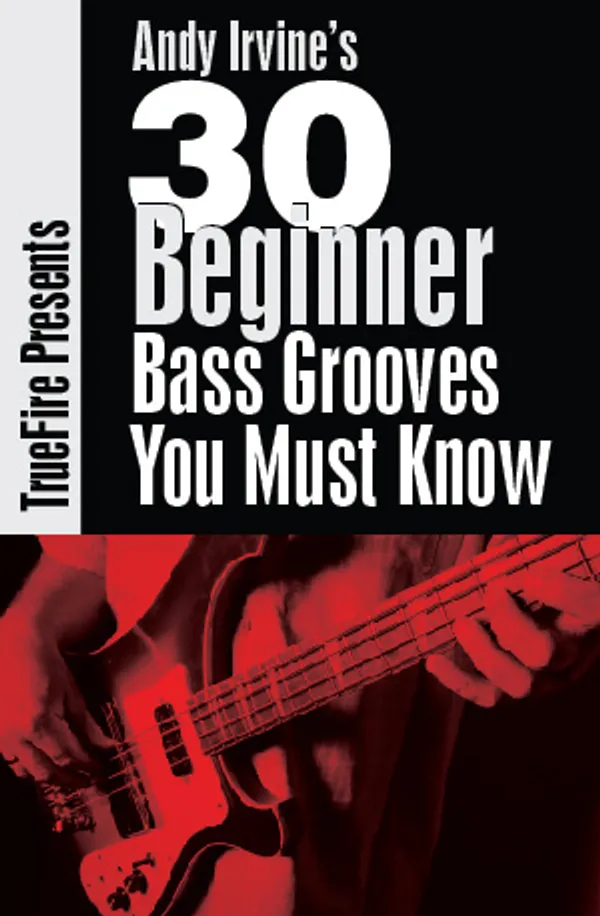
Slow Blues - Soft Touch Groove 1 is a video guitar lesson presented by Andy Irvine and is sourced from Bass Mechanics: Crucial Groove.

In this section, I'll demonstrate and describe two highly functional methods of playing harmonically supportive bass lines which also fill in the track with longer notes and introduce tasteful melodic counter melody.

+ 65 more lessons

Start Course

Reviews

5 results

mibanezft

Verified buyer

05/06/25

A good and educational method for handling the instrument, highly recommended for those who want to strengthen their knowledge.

Gilez

Verified buyer

11/14/21

Perfect.

Consigliato.

pfetsch

Verified buyer

03/03/21

Advanced

It Workshop well ,Ehen you combine this course with the suggested ones at the side

bassdoctor

Verified buyer

10/04/20

Styles & Techniques for all Bass Players

Help and inspiration for all bass players and a good reference.

vprice

Verified buyer

07/17/20

Lots of good material

There are lots of blues, R&B, and Rock grooves as well as some more funky stuff. Recommended.

Stop searching. Start improving with All Access.

Try 14 days free. Cancel any time.