



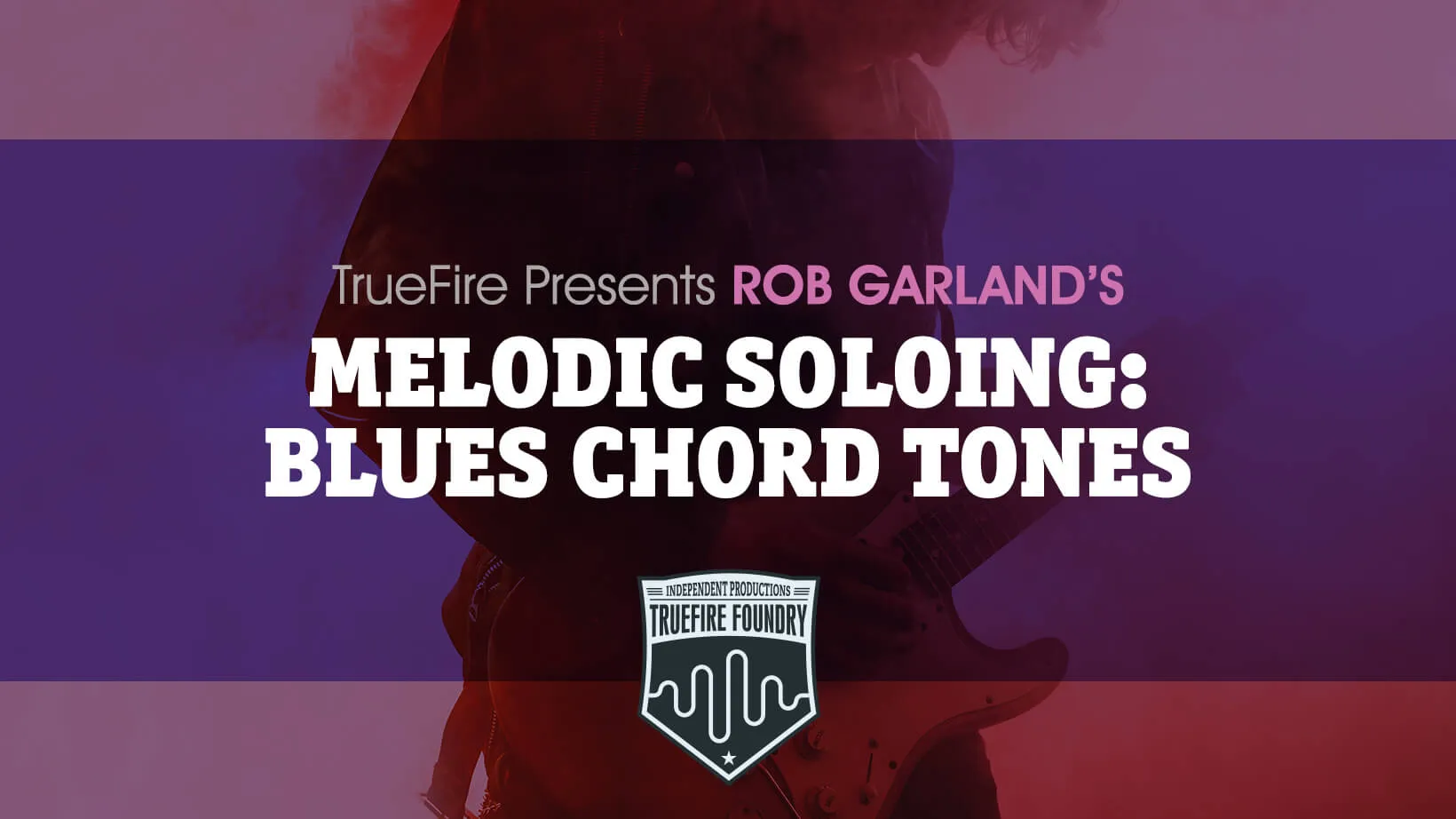



Melodic Soloing: Blues Chord Tones

Create Compelling Melodic Blues Solos

Marty FriedmanTommy EmmanuelSteve VaiEric GalesEric Johnson

Get this course and 1,000+ more with All Access

Try 14 days free. Cancel any time.

Purchase Individual Course for $19.99
Melodic Soloing: Blues Chord Tones

About this course

When soloing over blues and rock many guitar players use the pentatonic scale, which is a good place to start. However by addressing the chord changes of the song (and the good news is with the blues, there are usually only 3 chords) and targeting chord tones, your solo will soar to new melodic heights and you’ll be the envy of every pentatonic warrior at your local blues jam!

Melodic Soloing: Blues Chord Tones will show you how to easily find and utilize chord tones to create compelling melodic solos. To get you there quickly, Rob explains how the chord tones can be extracted from the actual chord voicings you are playing and how to make music with them, incorporating pentatonic scales and arpeggios.

The course includes how to apply chord tones when soloing over standard blues shuffles, 12 bar slow blues, minor blues and even blues progressions that move beyond the basic I-IV-V chords.

All of the key musical examples are tabbed and notated, plus Rob includes all of the jam tracks for you to work with on your own.

What you'll learn

  • Combine pentatonic scales with chord tone targeting
  • Use arpeggios as raw materials for musical improvisation
  • Target specific chord tones (especially thirds and flat 7s) during improvisation
  • Learn practice strategies for internalizing chord tone concepts
  • Develop awareness of chord changes while improvising
Release date: 05/30/2018 • 1h 45m runtime
Start Course
Sample lessons
Welcome!
Welcome!
Chord Tones = Melody
C7 Blues Quick IV
C7 Blues Quick IV
Overview
C7 Blues Quick IV
C7 Blues Quick IV
Demonstration
C7 Blues Quick IV
C7 Blues Quick IV
Breakdown

What's included

32 lessons • 23 charts • 22 Jam Tracks

Introduction
When soloing over blues and rock, many guitar players use the pentatonic scale, which is a good place to start. However, by addressing the chord changes of the song (and the good news is with the blues, there are usually only 3 chords) and targeting chord tones, your solo will soar to new melodic heights and you'll be the envy of every pentatonic warrior at your local blues jam!

Melodic Soloing: Blues Chord Tones will show you how to easily find and utilize chord tones to create compelling melodic solos. To get you there quickly, Rob explains how the chord tones can be extracted from the actual chord voicings you are playing and how to make music with them, incorporating pentatonic scales and arpeggios.

The course includes how to apply chord tones when soloing over standard blues shuffles, 12 bar slow blues, minor blues and even blues progressions that move beyond the basic I-IV-V chords such as an 8 bar blues and "stormy" changes.

All of the key musical examples are tabbed and notated, plus all of the jam tracks for you to work with on your own. Ready? Grab your guitar, and let's get going!
Welcome!
When soloing over blues and rock, many guitar players use the pentatonic scale, which is a good place to start.

However, by addressing the chord changes of the song (and the good news is with the blues, there are usually only 3 chords) and targeting chord tones, your solo will soar to new melodic heights and you'll be the envy of every pentatonic warrior at your local blues jam!

So, let's get started...
G7 Blues
What are chord tones and why should we use them on a blues? Chord tones are exactly what you think they are, the tones that make up chords!

For example, take a G7 chord, the I chord of a G blues: the chord is made up of a root, a 3rd, a 5th, and a b7th named as intervals from the root. This gives us the notes G-B-D-F. Those are your chord tones.

A dominant chord is made up of a major 3rd and a b7th. So, a G7 has root-3rd-5th-b7 (in relation to the major scale). A standard I-IV-V blues has 3 dominant chords. So, a G blues has the chords G7-C7-D7.
G7 Blues
Now we've played a G7 chord and looked at the notes that make up the chord, so let's examine the I-IV-V chords of a G7 blues. Let's play the chords, examine where the chord voicings come from and see what the notes are.

G7 blues:
|G7 |G7 |G7 |G7 |
|C7 |C7 |G7 |G7 |
|D7 |C7 |G7 |D7 ||

The I chord G7 has the notes G-B-D-F, the IV chord C7 has the notes C-E-G-Bb and the V chord D7 has D-F#-A-C.

Play the chords and see the chord tones inside them. The voicings I used were G7 (CAGED E7 shape), C7 (CAGED A7 shape) and D7 (CAGED C7 shape)**.

Next, we'll hear chord tones of the blues against a jam track.

** If you're not familiar with CAGED style chord voicings, check out my Chord Navigator: CAGED Triads course. And I promise I won't try to sell you anything else!! :-]
G7 Blues
Listen to the movement of the note B (3rd of G7 chord) to Bb (b7th of C7 chord). Then up to the note C (b7th of D7 chord).

Play along with the jam track and hear the notes move.

Then, listen to the movement of the note F (b7th of G7 chord) to E (3rd of C7 chord). Then up to the note F# (3rd of D7 chord).

Play along with the jam track and hear the notes move.
G7 Blues
Look at the movement of the 3rd of G7 here, the note B. I played just the 3rd and moved it to the b7th of C7, Bb. Then, I moved it up to the note C (the b7th of D7 chord). Look at where these notes are in the chord voicings. Be sure to play along with the jam track and hear the notes move.

Then, listen to the movement of the note F (b7th of G7 chord) to E (3rd of C7 chord). Then up to the note F# (3rd of D7 chord). And once again look at the chord voicings.
G7 Blues: Chord Tone Licks
Let's create licks based around the chord tones and movement between the chords. I'll play an initial lick idea or two, then in the next video, play and embellish them with the jam track. Then, I'll dissect what I played in the breakdown video that follows.

+ 25 more lessons

Start Course

Reviews

7 results

Craig

Verified buyer

03/27/26

Essential blues masterclass

I have purchased more Truefire courses than I care to admit and more than I'll ever complete in a lifetime. This course is a real sleeper. Probably the best explained course on chord tone blues soloing and arpeggios that I've seen. Not a repository of cool licks, that's covered more extensively in other courses. But fairly unique as a means to understand why those licks work and to guide a more refined, musical approach to improvisation. Not only that, it teaches you 4 core blues progressions, including arpeggios for dominant, major and minor chords- a standard 12 bar dominant chord blues, a minor blues in the style of "Thrill is Gone" which includes a Maj 7th chord, a Stormy Monday blues that works over the Allman Bros version and an 8 bar blues (Nobody Knows you). The production is now relatively dated and it doesn't incorporate Soundslice- these are the main drawbacks. However if you can get past that, the content is essential.

rryder67

Verified buyer

05/03/23

Melodic Soloing - Blues Chord Tones

I'm looking forward to Rob Garland's course. Sometimes the 'ol Pentatonic scale seems stale. So, some melodic additions will be more than welcomed.

Min T.

09/13/21

Great introduction to chord tone soloing

This course is underrated! Though the production quality could be better, but the content is top notch.

Joël J.

08/23/21

Beyond blues

This very practical course help a lot hearing and playing through the blues changes but this approach can also be used on any tune including jazz standards (Summertime, Autumn Leaves and many others) mixing pentatonic scales and chord tones.

sindibad

05/01/20

Blues Chord Tones

It is essential knowledge that is taught in these lessons. Good teaching.

Stop searching. Start improving with All Access.

Try 14 days free. Cancel any time.