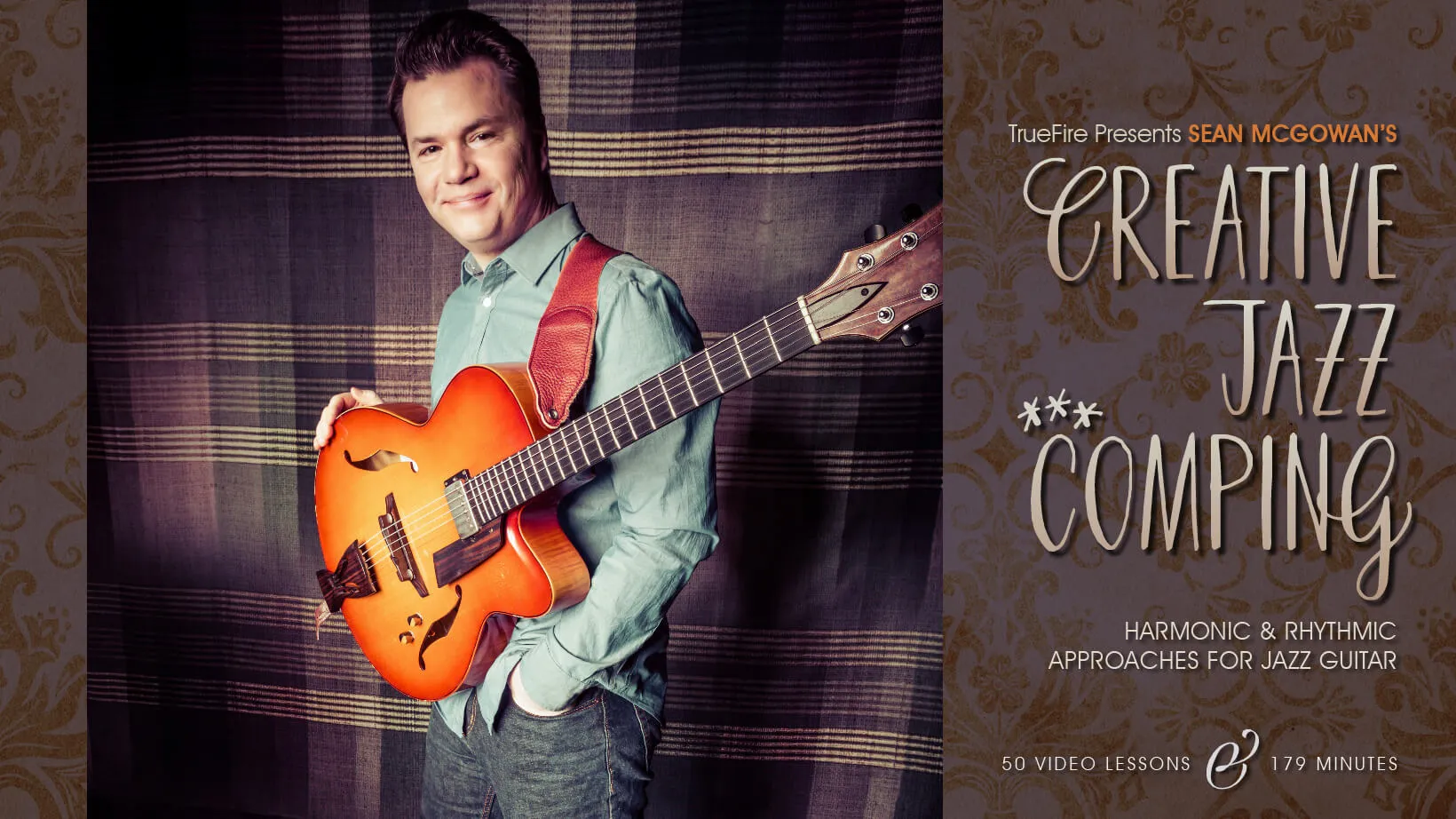
Creative Jazz Comping

Harmonic & Rhythmic Approaches for Jazz Guitar

Marty FriedmanTommy EmmanuelSteve VaiEric GalesEric Johnson

Get this course and 1,000+ more with All Access

Try 14 days free. Cancel any time.

Purchase Individual Course for $14.99
Creative Jazz Comping

About this course

The sophistication and improvisational nature of jazz, with its complex and swiftly moving chord progressions, is what attracts guitar players to the genre despite its steep learning curve. Jazz guitarists must develop a considerable vocabulary of chord voicings, along with a solid understanding of harmonic and rhythmic devices, to confidently hang in the rhythm section supporting vocalists and soloists.

Sean McGowan’s Creative Jazz Comping is designed to help organize and simplify the process of learning, memorizing, and applying chordal ideas and comping strategies in a modern jazz context.

“I’ve organized this course into 6 sections.  In the first section, we’ll start by discussing comping and its importance in jazz, some recommended listening, as well as a few exercises to get our hands ready for all the chords we’ll be learning. We'll also look at different ways of articulating chord by exploring fingerstyle techniques, hybrid picking, strumming, and using the thumb.”
"There are some talented Jazz instructors on TrueFire and Sean McGowan is right up there with them. His method is so relaxed he makes what he does look effortless. Economy of movement and great teaching insights make this a great pathway into the realm of the jazz guitar greats." - David Parker, TrueFire Student
Section 1 lessons include: Jazz Comping Philosophy, Listening for Jazz Comping, Warm-Up & Stretching, and Jazz Comping Articulation.

In the second section, Sean introduces a system that makes it easy to learn and utilize chord shapes based on Guide Tones and extensions. ”I’ll show you how to build - and more importantly - understand and apply numerous chord voicings, without memorizing a bunch of random shapes. The guide tone system will provide a two-tiered approach to simplify the fretboard, and better understand the function and use of extensions within complex chord voicings.”

Section 2 lessons include: Guide Tone Voicings: Root 5 & 6, GT+1 Voicings: One Extension, GT+2 Voicings: Two Extensions, Guide Tone Voicings for a ii-V-I, Guide Tone Horizontal Inversions, and Guide Tone Vertical Inversions.

In the 3rd Section, you’ll explore the middle register of the guitar with Phat Philly voicings and learn ways to create motion in your comping. ”I'll show you an alternative approach to the guide tone system that explores the middle register of the guitar, focusing on strings 5-2, and learning voicings that sound great in a blues/soul jazz context.”

Section 3 lessons include: Phat Philly Voicings, Phat Philly Voicings for a ii-V-I, Triangle Shapes, Triangle Shapes for a ii-V-I, and Figure Eight Shapes.

Section 4 focuses on Triad Hybrids and Slash Chords. ”Yet another way to approach comping and chord voicings - especially in a modern jazz context - is by using slash chords and triad hybrid structures. This approach will really breathe some new life into well-worn standards, and offer a fresh approach to tunes you already know and play.:

Section 4 lessons include: Slash Chord Voicings, and Slash Chord Applications for a ii-V-I.

Section 5 drills down on swing rhythms and syncopation techniques to spice up your playing. ”Undoubtedly, one of the most important aspects of effective comping is rhythmic acuity, a solid understanding of syncopation devices and techniques, and helping the song - and soloist - swing in your role as an accompanist.”

Section 5 lessons include: Rhythmic Philosophy, Using Anticipation, Delayed Attack, Combining Anticipation & Delayed Attacks, The Charleston Rhythm, Charleston Variations, and The Jazz Waltz.
"One of the best players and teachers on TrueFire. This guy knows his stuff." - Nimeu, TrueFire Student
In the 6th and final section, you’ll apply all the concepts and techniques from the previous sections over 6 comping performance studies. “We’ll combine all of our Creative Comping techniques and concepts and comp over six studies based on popular progressions used in classic and contemporary jazz styles.”

Sean will explain and demonstrate all of the key concepts and approaches along the way.  You’ll get standard notation, tabs, and diagrams for the key examples and performance studies. Plus, Sean includes all of the rhythm tracks for you to work with on your own. In addition, you’ll be able to loop or slow down any of the performances so that you can work with the lessons at your own pace.

Grab your guitar and let's get creative with Sean McGowan!

What you'll learn

  • Navigate chord inversions smoothly with voice leading
  • Combine anticipation and delayed attack techniques in a single progression
  • Create melodic interest in the top voice while comping
  • Comp with appropriate use of space and sustained voicings
  • Understand when to lay out and when to be rhythmically active
Release date: 02/28/2018 • 2h 59m runtime
Start Course
Sample lessons
GT+2 Voicings: Two Extensions
Demonstration
Phat Philly Voicings for a ii-V-I
Demonstration
Slash Chord Applications for a ii-V-I
Demonstration
Combining Anticipation & Delayed Attacks
Demonstration

What's included

50 lessons • 26 charts • 8 Jam Tracks

Creative Jazz Comping
Hi, I'm Sean McGowan and welcome to Creative Jazz Comping! Jazz is a sophisticated genre of music that can often feature a lot of complex and swiftly moving chord progressions. In order to hang in this setting, we need to have a considerable vocabulary of chord voicings, as well as a solid understanding of both harmonic and rhythmic devices. Creative Jazz Comping is designed to help organize and simplify the process of learning, memorizing, and applying chordal ideas and comping strategies in a modern jazz context.

I've organized this course into six sections. In the first section, we'll start by discussing the importance of comping in the jazz tradition, recommended players and recordings to check out, as well as exercises to get our hands ready for all of the chords we'll be learning.

Section Two introduces a system that makes it easy to learn and memorize chord shapes based on guide tones and extensions. In the third section, we'll explore the middle register of the guitar using what I like to call, "Phat Philly" voicings (dedicated to the great tradition of Philadelphia jazz guitarists), and different ways to create motion within your comping.

The fourth section hones in on triads, hybrid structures, and slash chords. The fifth section focuses on swing rhythms and syncopation techniques to spice up your playing. In the final section, we'll put all the concepts to work over six études.

I'll perform each étude and then break it down for you in detail, explaining all of the core concepts and approaches as we go. You'll have charts, standard notation, tabs, and all of the rhythm tracks to work with along the way. And, you can loop or slow down any of these performances, so you can work with the materials at your own pace. Grab your guitar and let's get started!
Jazz Comping Primer
As we get into comping, we'll start off with some hand stretches and basic warm-ups that are an important part of any practice and/or performance session. We'll also talk about some of my favorite jazz guitarists in terms of their comping styles and innovations. I'll give you a list of recommended recordings to check out that feature incredible comping by players such as Jim Hall, Mundell Lowe, Wes Montgomery, and many more. We'll also look at different ways of articulating chord by exploring fingerstyle techniques, hybrid picking, strumming, and using the thumb.
Jazz Comping Philosophy
While many jazz guitarists focus on soloing techniques and strategies, comping is a very important but often overlooked element of jazz. Developing a number of different ways to comp through different styles of music, as well as different instrumentations, etc. will deepen your understanding and appreciation of music and harmony, and will serve many different musical situations you'll be a part of.
Listening for Jazz Comping
This section features an annotated list of essential listening featuring various recordings and guitarists that illustrate the concepts featured throughout this course. I'll analyze some of my personal favorites in terms of their comping styles and what to listen for in their playing and contributions to the music.

Recommended Players & Recordings

Jim Hall:
  • Jim Hall Live!
  • Big Blues - with Art Farmer
  • Take Ten - with Paul Desmond
  • The Bridge - with Sonny Rollins
  • Undercurrent - with Bill Evans
  • Intermodulation - with Bill Evans
  • Interplay - with Bill Evans Quintet
  • Live at the North Sea Jazz Festival - with Bob Brookmeyer
  • Alone Together - with Ron Carter
  • Little Big Horn - with Nat Adderley
Classic Piano & Guitar:
  • Wes Montgomery & Wynton Kelly - Smokin' at the Half Note
  • Kenny Burrell & Tommy Flanagan - Introducing Kenny Burrell
Piano, Guitar & Bass Trios:
  • Tal Farlow - The Swinging Guitar of Tal Farlow
  • Herb Ellis - Triple Treat (with Monty Alexander & Ray Brown)
  • Billy Bean - The Trio (with Walter Norris & Hal Gaylor)
  • Eddie Duran - A Flower is a Lovesome Thing (with Vince Guaraldi Trio)
Early Jazz Guitar:
  • Eddie Lang - Duo recordings with Joe Venuti, accompanying Bix Beiderbecke, duo recordings with guitarists Lonnie Johnson, Carl Kress & Dick McDonough
With Vocalists:
  • Barney Kessel - Julie is Her Name (with Julie London)
  • Mundell Lowe - After Hours (with Sarah Vaughan)
  • Joe Pass - Easy Living (with Ella Fitzgerald)
  • Tuck Andress - Tears of Joy (Tuck & Patti)
Modern:
  • John Scofield - So Near, So Far (with Joe Henderson)
  • Pat Metheny - Wish (with Joshua Redman)
  • Pat Metheny - Pursuance: The Music of John Coltrane (with Kenny Garrett)
  • Bill Frisell - The On Broadway Series (with Paul Motian)
  • Bill Frisell - Bill Evans (with Paul Motian Quartet)
  • Lage Lund - The OWL Trio
  • Maarten van der Grinten - Between a Dog and a Lamppost (with DIG d'DIZ)
Warm-Up & Stretching
Before starting a practice session or performance, it's important to warm up the hands and body, and to stretch all of the important muscles that have a vital role in playing the guitar. This section features some exercises and stretches that loosen up the hands and fingers, forearms and wrists, promote relaxation, and assist with alleviating performance anxiety and stress through breath.
Jazz Comping Articulation
This section introduces and works through, in detail, a number of ways to physically articulate chords in various comping situations.
Guide Tone Based Comping
This next section of the course shows you how to build - and most importantly - understand and apply numerous chord voicings, without memorizing a bunch of random shapes. The guide tone system will provide a two-tiered approach to simplify the fretboard, and better understand the function and use of extensions within complex chord voicings.

+ 43 more lessons

Start Course

Reviews

18 results

Manfred400

Verified buyer

12/30/25

Hands-on support to leave comping routine behind!

This is exactly what I was looking for: a hands-on support for an experienced player - who got stuck in routines when comping. Sean’s advice is straight to the core of comping and shows how to leave all these memorised schemes behind. It was worth every minute I spent with this course - and I still return to it from time to time.

olivierhage

Verified buyer

09/19/25

Awesome course with loads of creative ideas and approaches.

Simon H.

02/26/24

Top notch course

This course is truls amazing. Sean surely is a gifted teacher and his enthusiasm shines through in every video. By far the most valuable jazz guitar course I’ve purchased to date. Many thanks Sean and Truefire, looking forward to more content from Sean.

Ohio5665

Verified buyer

09/24/22

Sean Mcgowans courses are fantastic! He is a great guitarist and teacher and explains everything clearly. I have been enjoying these challenging lessons of his a lot!

tombruhin

Verified buyer

09/08/21

Creative and fresh new ideas

A refreshing course. Can find quite some new inputs and ideas … as the title says CREATIVE ones of course

Stop searching. Start improving with All Access.

Try 14 days free. Cancel any time.