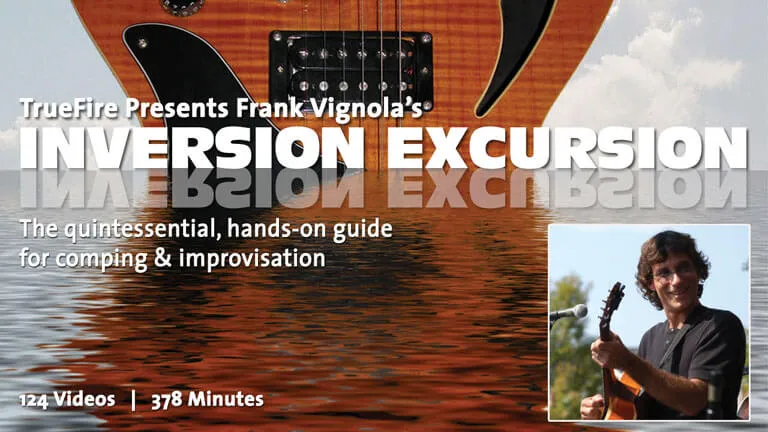
Inversion Excursion

The quintessential, hands-on guide for comping and improvisation

Marty FriedmanTommy EmmanuelSteve VaiEric GalesEric Johnson

Get this course and 1,000+ more with All Access

Try 14 days free. Cancel any time.

Purchase Individual Course for $24.99
Inversion Excursion

About this course

It's jam night. Someone calls out the inevitable A minor to D9 vamp. You take the first solo and light the joint up. Now it's your turn to comp. First couple of choruses, no problem. Next few, your comp is getting a little tired but you're hanging in there. Now the soloist starts to ramp things up and you're plumb out of ideas. Audience gets restless. Soloist glares. Gig is up. Been there? Yup, join the club

Any instructor will tell you that the vast majority of players suffer from the same malady with respect to their rhythm playing; a severely limited vocabulary of chords, comping applications and rhythm patterns. And those stacks of chord books and rhythm exercises that most of us have stashed somewhere are gathering dust for a good reason - they just don't work. What to do? Take a few trips with Frank Vignola on his Inversion Excursion.

Your Inversion Excursion guide is Frank Vignola. Frank is one of the most accomplished, multi-dimensional artists in the biz. Monster player, composer and improviser, Frank's played with everyone from Les Paul to Donald Fagen. Frank's pedigree is a mile long and a quick Google will illustrate why there's no one better qualified to take you on this trip.

Pack smart on your Inversion Excursion with 124 full-length video guitar lessons covering 62 sets of inversions, across all chord types and all string groups. 800 PDF pages of charts illustrate all 62 sets, in all 12 keys (see example chart) providing a handy reference for over 2,500 Root, 1st inversion, 2nd inversion and 3rd inversion chords.

Best part of your trip? No ginko biloba required. Unlike those chord books in the closet, Inversion Excursion is no dull memorization process. True to TrueFire form, you will play your way through this study program building your vocabulary of chords, patterns and applications in a musical context working through 59 video lesson performance examples, which demonstrate a wide variety of rhythm patterns and comping applications for blues, rock, jazz, twang and everything in between. Study a set of inversions, pick a key, grab a new pattern and apply over one of the 60 practice rhythm tracks included with Inversion Excursion. Bingo.

Over the course of your Inversion Excursion journey you'll develop a massive vocabulary of chords, patterns and applications that you can pull out when comping, arranging, composing and improvising. In short, you'll NEVER find yourself struggling to come up with something fresh and appropriate, if not downright dazzling.


What you'll learn

  • Explore chord voicing variations
  • Learning multiple chord voicings
  • Learn multiple inversion positions across different string sets
  • Develop comping and harmonic skills
  • Developing accompaniment techniques
Release date: 10/14/2008 • 6h 18m runtime
Start Course
Sample lessons
C Major Chord Inversions
Introduction
C Major Chord Inversions
1st 2nd 3rd Strings Lesson
C Major Chord Inversions
1st 2nd 3rd Strings Perf
C Major 6 Chord Inversions
1st 2nd 3rd 4th Strings Lesson

What's included

125 lessons • 58 charts • 6 Jam Tracks

Inversion Excursion
I am extremely excited to bring you this inversion excursion course. This is not your typical chord inversion book nor is it just another explanation of a couple of different inversions of a major 7th chord. My goal of this course was to make it the most comprehensive course and study available to learn inversions and how they work and most importantly how to apply them. In this course we journey into just about every inversion you could think of. From major to minor to dominant and just about every extension you could think of. Major 7th's, Major 6th's, Minor 7th, 6th and 11th, Dominant 7th, 9th, 13th and even augmented are discussed and displayed for you. We also discussed for each inversion play along jam track are right hand rhythms and concepts that can be used or at least should be explored. So, enjoy the journey on this inversion excursion.
Charts and Rhythm Tracks
Please use the Extra Assets links to download zip files with charts and rhythm tracks (MP3 and Midi files). Please note that you will be downloading charts for all 62 sets of inversions, in all 12 keys. 806 charts in total (1488 PDF pages of charts).
C Major Chord Inversions
Let us start with major chord triads in C major. All "fancy" chords start with a triad. The major chord triad is C-E-G which is the first, third and fifth step of the scale. This is the basis of all major and dominant chords. We start with the triad on the 1st, 2nd and 3rd strings. Root position means that the root or C note is in the lowest part of the chord or in the bass. First inversion means that the 3rd is in the bass and the 2nd inversion means the 5th is in the bass. Same chord, but different way of putting notes together. In this section we go through the C triad on all the different sets of strings. 1st, 2nd and 3rd, then 2nd, 3rd and 4th, then 3rd, 4th and 5th then 4th, 5th and 6th. We also go through what I call the spread inversions where a string is skipped to give a larger sounding chord. Then we move onto the extensions such as major 7th, major 6th and just about every other chord extension I could come up with. Don't forget that learning your triads will help you to learn the extended chords because all extended chords are based on the triad.
C Major Chord Inversions
These are the C major triads on the 1st, 2nd and 3rd strings. Start slowly learning the three different inversions on the first 3 strings. Try strumming four beats per inversion moving smoothly between chords. Think ahead and visualize where your fingers need to go while strumming the chord you are currently on. This will help you to move smoothly in between chords. Always look to see how this triad fits into larger bar style chords or chord grips that you may already know. For each inversion, look at the chord and pick out each of the chord tones naming the notes.
C Major Chord Inversions
Now it's time to practice these inversions with a jam track. Start by strumming 4 or 8 beats per inversion moving to each inversion in a smooth and effortless manner. When learning something new, we tend to tighten up putting way too much pressure on the guitar neck which in turn makes it harder to play smoothly. Relax while making the move in between inversions and concentrate on trying not to squeeze the guitar neck too hard. We will work the same jam track for all major chords. This way you don't have to learn a new groove for each jam track and can fully concentrate on the inversions. The simple groove jam track we will use to study these major inversions is designed to make it easier to learn the inversions and work with different comping techniques. Start with playing the same rhythm as the bass player is using. This will help you lock into the groove. Once you feel comfortable with this jam track, move on to another jam track in a different key and learn the inversions in other keys.
C Major Chord Inversions
These are the C major triads on the 2nd, 3rd and 4th strings. Start slowly learning the three different inversions on these 3 strings. Try strumming four beats per inversion moving smoothly between chords. Think ahead and visualize where your fingers need to go while strumming the chord you are currently on. This will help you to move smoothly in between chords. Always look to see how this triad fits into larger bar style chords or chord grips that you may already know. For each inversion, look at the chord and pick out each of the chord tones naming the notes.
C Major Chord Inversions
Now it's time to practice these inversions with a jam track. Start by strumming 4 or 8 beats per inversion moving to each inversion in a smooth and effortless manner. When learning something new, we tend to tighten up putting way too much pressure on the guitar neck which in turn makes it harder to play smoothly. Relax while making the move in between inversions and concentrate on trying not to squeeze the guitar neck too hard. These inversions are great with a simple strumming pattern. I give you a nice simple strumming pattern to start but please create your own rhythm patterns and strumming patterns. It is also nice to slide into the chord starting one fret before the inversion and simply slide up to the appropriate inversion.

+ 118 more lessons

Start Course

Reviews

26 results

ricopagode2014

Verified buyer

06/09/26

Very good

Direkoglu

Verified buyer

04/27/26

Best instructor on TrueFire

Great lesson, very helpful. Best instructor on TrueFire.

Basgod

Verified buyer

12/22/25

Love it. Great information. Frank lays it out. easy to understand chords and fingerings

Fabio

12/01/24

Never stop learning

I like Frank Vignola's approach to teaching, is wonderfully not rushed (something we need a lot these days). This course is monumental, and could (and will) keep me occupied for years, for learning never stops, and inversions are endless - and frankly quite rewarding when you start to master them. . . well, master a tiny part of them. I think everyone could benefit from watching this one, even only the "easy" part (major, minor, seventh).

jeff k.

11/28/22

cumulative effect!

The course builds wonderfully; by the time you get to the final exercises concerning the cycle of 4ths, you'll have enough to keep things interesting for yrs.

Stop searching. Start improving with All Access.

Try 14 days free. Cancel any time.