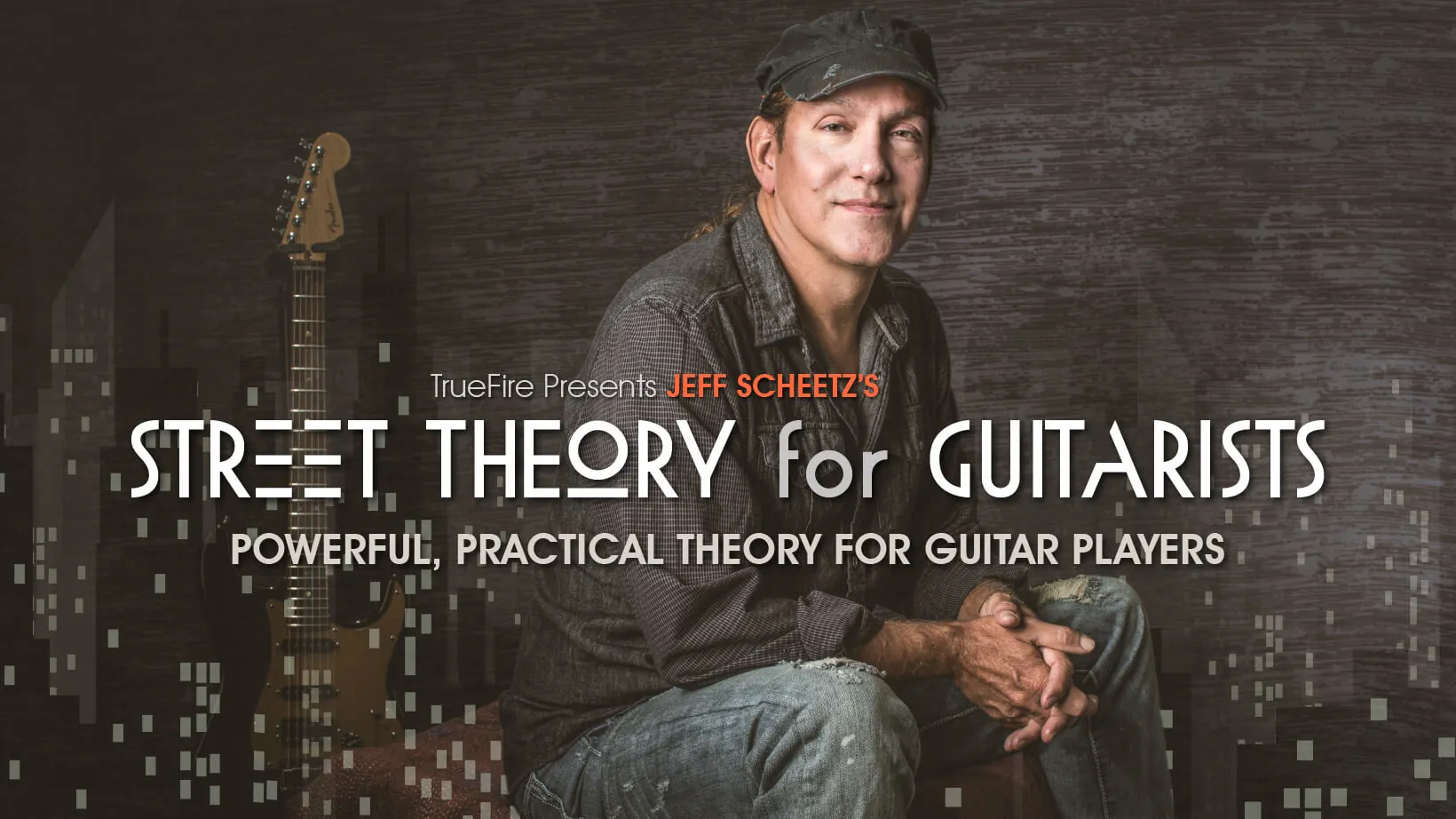
Street Theory for Guitarists

Powerful, Practical Theory for Guitar Players

Marty FriedmanTommy EmmanuelSteve VaiEric GalesEric Johnson

Get this course and 1,000+ more with All Access

Try 14 days free. Cancel any time.

Purchase Individual Course for $24.99
Street Theory for Guitarists

About this course

Learning and applying music theory can be confusing and frustrating for guitar players. It’s such a vast subject with hundreds of general principles and concepts. Which ones are essential for you to know? How are they applied in a real world musical context? Which ones will have the most immediate impact on your playing and accelerate your growth as a musician?

Presented by Jeff Scheetz, TrueFire’s Director of Education, Street Theory for Guitarists answers all of those questions in plain language with demonstrations of each principle on the fretboard, specifically for guitarists. The course includes 5 hours of video instruction and a 123-page manual of charts, neck diagrams, tab and notation!
"I've been working through Jeff Scheetz's "Street Theory" class as Music Theory was one area I could never grasp. This time though, with Jeff's course, I'm finally getting it and it feels awesome! My playing has gone far beyond what I thought I was capable of and it inspires me to play more and more every day." - Saverio Mazzotta, TrueFire Student
”Learning theory doesn’t have to be this boring, tedious process. Most guitarists know bits and pieces of theory but just haven’t been able to put it all together. Street Theory for Guitarists connects all of the dots by focusing on the most practical, essential theoretical concepts.

You’ll learn these concepts in a musical setting, and by doing so, you’ll be able to apply them immediately in your playing. Learning the same “street” theory that top guitar players use, and learning it by playing and jamming instead of just reading a book, is the key to taking your playing to the next level and beyond.”

"Well done Jeff. I just reviewed this and I am amazed at the quality and quantity of information and demonstrations you've packed into this... and for ONLY 39 bucks. I also watched the Soloing in CAGED - Demonstration... dude that is the clearest demonstration & best explanation that I've ever heard. I learned more in that 6 mins of your teaching video than I've learned in years! Thank you! - Doug Hupp, TrueFire Student
Jeff organized the course into four sections; Fundamentals, Chords, Scales, and Other Essential Theory. For each theoretical concept, Jeff will first explain the idea in clear and accessible language, and then demonstrate the concept on guitar to illustrate practical applications on guitar.

In the Fundamentals section, Jeff covers a range of foundational theoretical principles and clears up some of the most common terms that cause confusion. Topics include Confusing Terms, The Musical Alphabet, Note Names: 6th & 5th Strings, Finding Octaves, The Chromatic Scale, The Major Scale, Understanding Intervals, and Interval Position Shapes. Most of these concepts will connect to the theoretical principles presented in the following sections.

In the Chords section, Jeff presents all of the essential theory and practical applications of chords. Topics include: Building Chords, Root 5 and 6 Barre Shapes, Harmonized Scale, Roman Numerals & Progressions, 7th Chord Theory , Extended, Altered & Chord Subs, The Most Important Notes, Chords With Too Many Notes, What Key Is This Song In?, Modal Progressions & Tonal Centers, Inversions: Low Three Strings, Inversions: All Strings, Slash, Add, and Sus Chords, and Voice Leading.

In the Scales section, Jeff guides you through all of the essential Street Theory for scales and modes. If you’ve ever struggled to fully grasp how to navigate the fretboard, or improvise using scales or modes, this section alone is worth the price of admission. Topics include: Minor Pentatonic, Major Pentatonic, Pentatonic Application, The Blues Scale, 7 Major Scale Patterns, Modes: Parallel Scales Approach, Modes: Parent Scale Approach, Soloing With Modes, and Modes: Scale Pattern Approach.

In the Other Theory Essentials section, Jeff demonstrates more Street Theory principles to expand your soloing skills and understanding of the fretboard. Topics include: Arpeggios, Arpeggios Within Scales, Soloing With Arpeggios, Harmony Lines, Moving Harmonies, CAGED System Chords, Pentatonic Scales in CAGED, and Soloing in CAGED.
"I just wanted to say I have been addicted to guitar many years as well as student of TrueFire for several of those years. I have recently purchased Jeff Scheetz “Street Theory” course and I would like you and Jeff to know I believe it is a Masterpiece. I can’t overstate how much it has helped me on my path and I just wanted to truly thank everyone responsible for this exceptional compilation. You have created a legacy." - Robert Morgan, TrueFire Student
Street Theory for Guitarists includes 5 hours of video instruction and on-screen diagrams and animations. You’ll get a massive 123-page manual with charts, neck diagrams, and all of the key examples tabbed and notated for your practice and reference purposes. Plus, Jeff includes all of the jam tracks to work with on your own.

Grab your guitar and let's dig into Street Theory with Jeff Scheetz!

What you'll learn

  • navigate scale across entire fretboard
  • Creating more complex chord voicings
  • Identify interval shapes on the fretboard
  • Understand how modes relate to parent major scales
  • Understand melodic and harmonic intervals
Release date: 06/21/2017 • 4h 44m runtime
Start Course
Sample lessons
Roman Numerals & Progressions
Demonstration
Inversions: All Strings
Demonstration
Modes: Parallel Scales Approach
Demonstration
Harmony Lines
Harmony Lines
Demonstration

What's included

45 lessons • 40 charts • 5 Jam Tracks

Street Theory for Guitarists
Hi, I'm Jeff Scheetz, and welcome to Street Theory for Guitarists! Learning and applying music theory can be really intimidating, and frustrating for many guitar players. It's a huge subject with a ton of concepts and applications. But, how do you know which ones will have the most immediate impact on your playing? Street Theory for Guitarists solves that problem. We'll cover the most practical and useful applications of theory, and show you how it all works on guitar.

For example, we'll cover intervals and how to quickly visualize them on guitar. You'll learn the formula for constructing chords so you can play them anywhere on the neck, and I'll show you how to create chord scales so you can crack the code to the most popular chord progressions.

You'll learn how to quickly determine what key your favorite songs are in so you can make proper chord selections and choose the correct scales to solo with. We'll also work on chord concepts like extended and altered chords, slash, add, and sus chords. I'll even show you how to use inversions to create cool rhythm parts.

You'll learn all 7 patterns of the major scale, and all 5 patterns for the minor pentatonic, major pentatonic, and blues scales. I'll show you how to create more interesting rhythm parts using voice leading, and three different methods to unlock the improvisational power of modes.

These are just a few of the concepts and applications we'll cover here in Street Theory for Guitarists. The course is packed with on-screen diagrams and animations, you'll get a massive manual with charts and neck diagrams, and all of the key examples are tabbed and notated. Plus, you'll get all the jam tracks to work with on your own. Grab your toys, let's make some noise!
Fundamentals
Having a grip on the fundamentals in this section will make the rest of the course make a lot more sense! Take your time on these subjects and make sure you absorb them before you move on. Even if some of these concepts may seem familiar to you, I recommend that you go over them in case there are any slight variations that might help you with the rest of the course.
Confusing Terms
One of the stumbling blocks to learning guitar theory, and just learning guitar in general, is the fact that often times the same thing can have several different names. Different instructors refer to exactly the same thing with completely different terms, and that can get confusing.

Theory has a certain air about it - that is all set in stone and absolute. But just keep in mind that's not always the case; there can be many ways to look at certain aspects of theory depending on how you are using it, and some things are referred to with different terms.
The Musical Alphabet
You may already know your musical alphabet. It starts out just like the English alphabet - ABCDEFG - then repeats. 7 letters, so that translates into 7 notes. But, we have 12 notes in Western civilization music, so we need to add some sharps and flats between each note. But, the key thing to remember is this: No sharps or flats between B and C or E and F.
Note Names: 6th & 5th Strings
There are a ton of notes all over the guitar neck, and while it's cool to know them all, I first want you to memorize the notes on just two strings: the 6th and the 5th strings. These are extremely important. Many of the chords, scales, and theoretical concepts in this course will be using root notes on these two strings.

The root note is what names a chord or scale. The root note is important. While you can have root notes on other strings, most of the things you'll play will have a root on the 6th or 5th strings, so it's really crucial to memorize these.
Finding Octaves
OK, so now that you know the notes on the 6th and 5th strings, let me show you a way that will allow you to identify any note on any string, anywhere on the neck. This is another great way to help you visualize the fretboard. Octave shapes are an important part of putting together your theory.
The Chromatic Scale
The chromatic scale is a scale that plays all the notes. It's what you get when you start on one note and go up 12 half steps. It also allows you to connect notes from a scale by adding in notes that are outside of the scale in between the scale notes. These are also called passing tones or passing notes.

+ 38 more lessons

Start Course

Reviews

105 results

Spiegelkind

05/14/26

Jeff is the teacher you wish you had when you were starting out

A comprehensive course of the basic theory needed to call yourself a musician, seen through the lens of the street guitarist. Go at your own pace and interiorize all of the concepts that Jeff explains so accesibly, and you'll have a great toolkit for life.

Philipp2195

Verified buyer

03/26/26

great course

Great instructor, learned a lot

Sangeetko

Verified buyer

03/24/26

This is one of the best that every one should have.

Unterwasserboot

Verified buyer

03/04/26

Get out of your routines

Jeff Covers all the important issues for a beginner to rather experienced player who would like to know more about music theory and won't be stuck in the same old routines. He's a good teacher. Recommended 👍

Dylansc86

Verified buyer

02/07/26

Really helps with understanding the guitar better

Stop searching. Start improving with All Access.

Try 14 days free. Cancel any time.