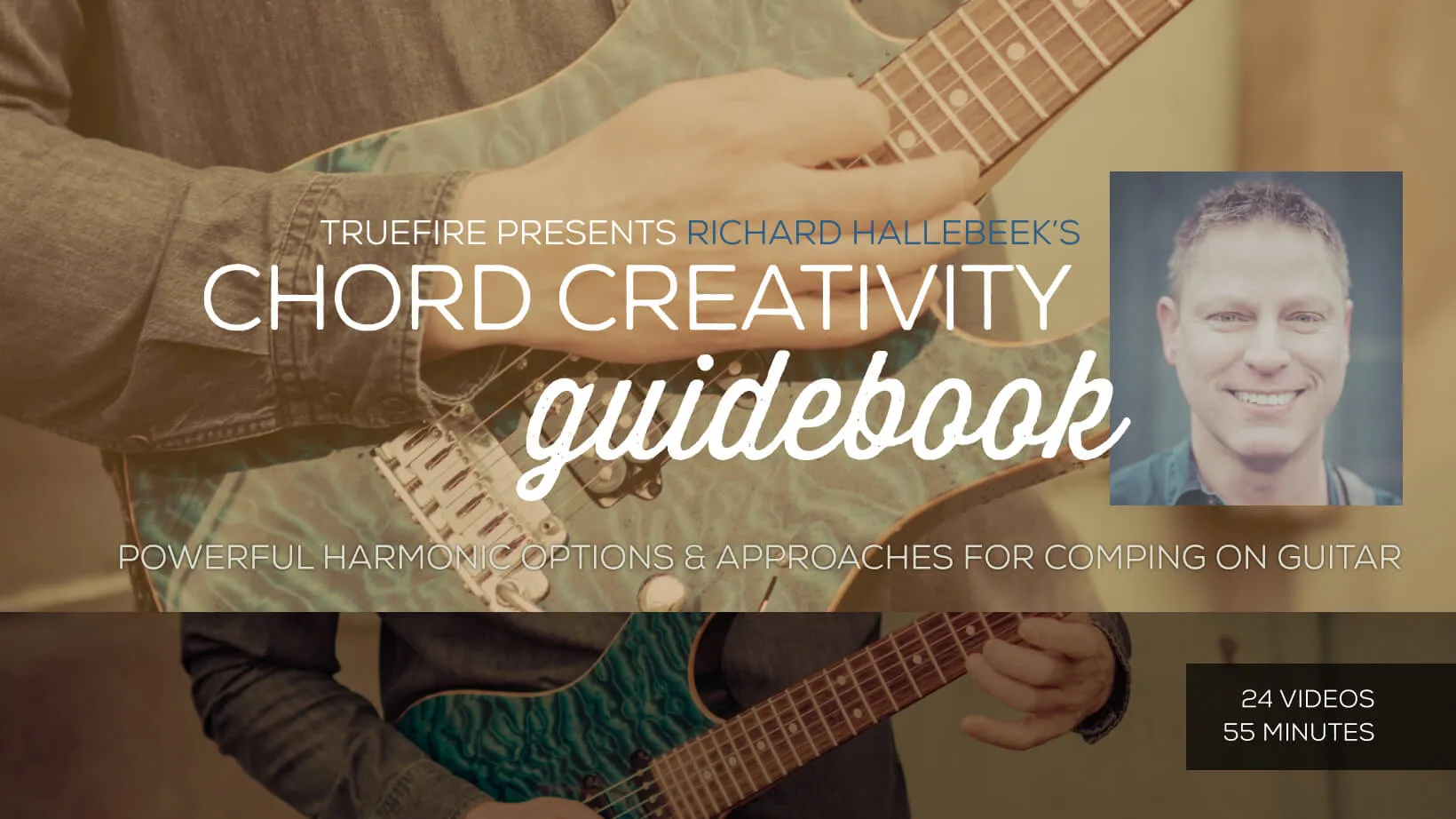
Chord Creativity Guidebook

Powerful Harmonic Options & Approaches for Comping on Guitar

Marty FriedmanTommy EmmanuelSteve VaiEric GalesEric Johnson

Get this course and 1,000+ more with All Access

Try 14 days free. Cancel any time.
Purchase Individual Course for $9.99
Chord Creativity Guidebook

About this course

Most students of guitar tend to focus their studies on soloing even though 90% of the time they are playing on the bandstand, is playing rhythm guitar. In this Chord Creativity Guidebook from Richard Hallebeek, you’ll learn how to take the scales you already know and create fresh and colorful chords that are simple to apply in any musical style.

"Every player has been in a situation when you are playing live, jamming over one chord, with the soloist is playing multiple choruses of solos, and at one point you have no idea what chords to play anymore. With these concepts and performance examples, you'll be able to create a greater variety in your chord comping, giving you more options and a better insight. I'll show jazz, rock, and blues players how to get more mileage out of their chordal playing."

In this Guidebook, Richard will present and demonstrate a variety of creative concepts, illustrated with performance examples, for building a diverse palette of chords and voicings to comp with in any style.

Each of the concepts is first explained in detail by Richard and is then demonstrated with performance studies using jam tracks. These tracks are the real deal; in many cases they’ve been released on albums by Richard and other world renowned Jazz Rock artists.

"For every topic that I’m talking about, there’s a live example of different songs I recorded throughout the years with (among others) Virgil Donati, Jimmy Johnson, Derek Sherinian, Brett Garsed and Randy Brecker. Those tracks are also included as jam tracks, giving you the opportunity to comp with those world class soloists."

Richard will show you how to create chords out of pentatonic scales along with a variety of concepts for creating chords out of the modes. You’ll also learn how to get colorful sounds using the melodic minor scale as a basis for chords, and use octave shapes with a third in between. You’ll work on chords built of 4th intervals, as well as symmetric scales that will produce diminished chords, amongst other tonalities. Richard will also show you a series of alternative shapes and creative ways to play them. Even within blues and rock tonalities, you’ll learn a lot of inventive options.

All of the key examples are tabbed and notated for your practice, reference and study purposes. You’ll also get Guitar Pro files so that you can play, loop and/or slow down the tab and notation as you work through the lessons. Plus, Richard generously includes all of the rhythm tracks for you to work with on your own.

Grab your guitar and let’s get creative with Richard Hallebeek!

What you'll learn

  • Explore alternative chord voicings
  • Multiple chord hitting techniques
  • Understand drop 2 and drop 3 chord voicings
  • Understand how to convert complex chords to power chords
  • Learn how to modify chord structures
Release date: 01/31/2017 • 0h 55m runtime
Start Course
Sample lessons
Hitting Chords
Hitting Chords
Concept 1
Chords in Pentatonic
Concept 2
Chords in Pentatonic
What's in Store
Chords in Pentatonic
Q.E.D.

What's included

24 lessons • 20 charts • 11 Jam Tracks

Chord Creativity Guidebook
Hi, I'm Richard Hallebeek and welcome to Chord Creativity Guidebook. In this course, I'll show jazz, rock, and blues players how to get more mileage out of their chordal playing. Most guitar players focus on soloing, while in real life, we play chords 90% of the time. I'll teach you how to use the scales you already know to create chords that are simple to use in every musical style.Every player has been in a situation when you are playing live, jamming over one chord, with the soloist is playing multiple choruses of solos, and at one point you have no idea what chords to play anymore. With these concepts and performance examples, you'll be able to create a greater variety in your chord comping, giving you more options and a better insight. We'll create chords out of pentatonic scales and use a variety of concepts to create chords out of modes. You can also get cool sounds using the melodic minor scale as a basis for chords, or use octave shapes with a third in between. We'll dig into chords built of 4th intervals, as well as symmetric scales that will give you diminished chords, among others. I'll also show you some alternative shapes and creative ways to play them. Even within blues and rock, you have a lot of options to be inventive with these concepts.For every topic that I talk about, there's a live example of different songs I recorded throughout the years with Virgil Donati, Jimmy Johnson, Derek Sherinian, Brett Garsed, and Randy Brecker (and more). Those tracks are also included as jam tracks, giving you the opportunity to comp with those world class soloists. This is not about complicated theory - it's about making music in practical real-life situations; creative ideas you can put to work in no time flat.Richard Hallebeek would like to thank: Suhr guitars, Matt Picone and Fractal Audio, TC Electronic Pedals, Root Pedals, Hook amps, Nils Krook for guitar maintenance, Marco Bosch custom picks and Jam Origin Midi Guitar software. Photos by Moama.
Hitting Chords
Let's start out by looking at how to hit your chords. Here's four examples of "comping", or playing chords that I use. I like all these ways of playing chords. It's a matter of musical style, taste, and if it fits in there or not. Let the rule be: if it sounds good, it is good!
Chords in Pentatonic
Every player probably knows one or more positions of the pentatonic scale and uses those scales for soloing. The good news is that there are some great chords to be found in the pentatonic scale.
Chords in Pentatonic
In this example, there's a solo part with some chord changes going on. I'll use the pentatonic scale exclusively to play chords through this section. When I'm comping, I'm thinking about the top note and common tones. You can make little melodies with the top note.
Chords in Pentatonic
In Q.E.D. we're putting the chords from the pentatonic scale to work.
Chords in Modes
You can find some cool chords in your Ionian, Dorian, Phrygian, etc. scales. So, if you know how to solo with these scales, you can also find great chord voicings in there. You also gain the advantage of really getting to know your modes by looking for chord voicings in there.
Chords in Modes
Now we're using chords from the modes. This progression moves from Fm to Bm.

+ 17 more lessons

Start Course

Reviews

11 results

Gunnarsson90

Verified buyer

11/16/25

Well worth the money!

Amazing lesson. Regret I didn’t buy this sooner. Instant fusion chords!

Fred

10/17/25

Outstanding chord lesson

Richard is the real deal and gives away high-value material that will take time to digest but could cost you much more to acquire! The concepts presented here are rarely taught anywhere else and they are very clearly explained you will need to pause and rewind a few times :)

Osokin

Verified buyer

01/03/23

Expand Your Chordal Palette!

Richard Hallebeek is an excellent guitar player and a very good teacher. In this course he shows how to create fresh sounding chords from different scales. This is quite advanced material, but very rewarding and will certainly open your ears up to some new possibilities.

rafahc

Verified buyer

11/20/22

Otros colores

Richard hallebek ha hecho un buen curso con este chord creativity,es un curso que recomiendo por que sale un poco de lo habitual de los acordes básicos de 7, y va más allá con posiciones de 9@ sacando colores y sonidos espectaculares para enriquecer las progresiones de acordes habituales y obligando a conocer el mastil,si te gusta la armonía que para mí es la base esencial de cualquier tema o composición y progresión de acordes y quieres seguir aprendiendo este es un curso muy intuitivo que deberíamos valorar muy alto,eso sí primero aprende como se construyen los acordes básicos,de 7 etc para luego poder analizar como se construyen estos acordé más complejos y habrás enriquecido tu vocabulario sacarás sonidos que te pueden valer para cualquier estilo musical,estudialo y aplícalo,despacio pero seguro,muy bien por Richard hallebek,tendría que hacer más cursos y con enfoques como estos,cinco estrellas

funkyman

12/29/20

Chords! 😫 😩 😖

When I was studying in college, I used to take my guitar with me and practice during breaks. One day, one of my classmates asked me for a piece of advice to help his playing. My response was rapid and targeted; Chords! I was practicing the Chord Bible by Warren Nunes and Chord Chemistry by Ted Greene. The last advice I gave my friend was; don't be afraid of chords. Today he performs as a solo artist in Puerto Rico and I recently, pre C19, went to see him perform here in Orlando. Today we have Richard Hallebeek. This is one of the best guitar chord courses I have ever seen. I hear the influences of Holdsworth and Gambale among others in his chord voicings. But, Richard makes them easy to understand and apply. You can gain a world of knowledge by mastering chords. This video is the answer to many struggling with chords. This is an investment in your playing and is worth every penny.

Stop searching. Start improving with All Access.

Try 14 days free. Cancel any time.