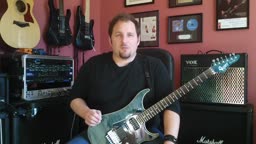
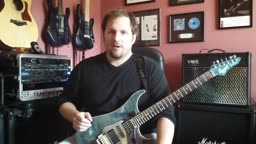
TrueFire Foundry courses are independently produced courses presented by a hand-picked selection of top-notch artists and educators from around the world. Filmed in the educator’s own studio, Foundry courses bring fresh educational concepts and very effective teaching methodologies to TrueFire Students. Scott Allen’s Foundry course, Rock Chops will show you soloing techniques, tricks, and creative approaches for the modern rock guitarist.
Hello I'm Scott Allen — welcome to my TrueFire Foundry course, Rock Chops, which I produced in my own studio.
Rock Chops will cover the A-Z of rock guitar soloing. By the end of the course you should have a comprehensive understanding of the basic tools required for rock and metal lead guitar, and a greatly improved vocabulary. You should also have a much better idea on how to develop your technique going forward.
We will start with learning pentatonic scales, licks and sequences. Here we will cover learning all of the pentatonic scales and how to develop speed, coordination and vocabulary by applying sequences. We will then further develop vocabulary with some very cool and easy to use burning licks.
Then we will move on to understanding the diatonic scales and start to work on getting our chops and vocabulary together by applying 16th note, 16th note triplet, legato, horizontal and diagonal sequences. These are concepts made famous by players like Steve Vai, Joe Satriani, Paul Gilbert, and Randy Rhoads.
Next we will learn our triad arpeggios and begin learning how to sweep pick. We will cover the basic shapes for our arpeggios and learn how to use the metronome to develop speed and synchronization, the most important things that relate to sweep picking.
Along the way we will learn some artist specific arpeggios, which are arpeggios that are favored by some of the great guitar players in rock. Here we will cover arpeggios favored by Randy Rhoads, George Lynch, Paul Gilbert, and Eric Johnson.
After that we will get into extended arpeggios that will cover more of the neck and will get into more modern shredders styles such as Marty Friedman, Jeff Loomis, and Chris Broderick. Next up will be learning about two handed tapping techniques made famous by the great Eddie Van Halen. Here we will cover the basics of the technique as well as crossing strings and applying some very cool and commonly used tricks.
As soon as the basics of the technique are down it is time to kick it up a notch and apply this concept to diatonic scales and start to use the entire neck as our playground for tapping in the style of greats like Steve Vai, and Reb Beach.
At the end of the course you will have covered everything from your basic pentatonic and diatonic scales, developing synchronization, speed, arpeggios, sweep picking including multi octave sweeps.
You will learn to use the metronome to develop muscle memory, synchronization and speed, as well as basic and more advanced tapping.It is truly as A-Z crash course in rock and metal lead guitar.
Ready to power up your Rock Chops? Grab your guitar and let’s get dig in!
NOTE! Scott Allen organized the course into 8 weekly sections for those students that prefer to have a specified regimen of material across a specified time schedule. However, for those students who prefer to work at their own pace, or even skip around you are certainly encouraged to approach the course in that way as well.
Welcome to the Rock Chops course. In this course, we'll cover all of the basics of rock lead guitar playing and how to develop great technique. We'll look at pentatonic scales, developing speed, pentatonic licks and sequences, diatonic scales, sequences, visualization, arpeggios, sweep picking, extended arpeggios, and tapping. By the end of the course, you should have not only better chops but insight on improvisation. Also, we should have an awful lot of fun!
Here we'll go through the basic entry point of our chops building adventures, which deals with knowing your scales. This is where we jump off from.
The first thing we need to do to start working on our general technique building is learning scale sequences. These will help you develop visualization, fret hand finger independence, pick dexterity, vocabulary, rhythmic awareness, and speed. You need to treat using sequences in a similar way that you would think of a workout routine in that it is all about consistency. These also sound really cool once brought up to speed.
This is another pentatonic sequence. This time we'll focus on playing the triplet sequence. As the name implies, it's using a triplet rhythm, so everything you'll play here will be three notes per beat.
Here we'll learn how to properly use the metronome to develop not only speed, but control at any tempo. The key to this is to start slowly with any example you use and incrementally up the tempo. It is important to have high standards and make sure that you never increase the speed until you have total control over what you are playing. Remember it doesn't do us any good to play fast and sloppy, we want fast and clean. To make that happen, the metronome is your best friend.
Our first pentatonic sequence is one of the most commonly used sequences in rock music. This is the group of four sequence. When you think of what a sequence is, you should think a pattern that repeats throughout a scale. These are useful not only to developing speed, but also vocabulary, visualization, and coordination. Your chops start right here.
This pentatonic sequence has the distinction of being both easy and utterly awesome sounding when brought up to speed. Make sure that you are using alternate picking throughout.
Scott Allen is a monster guitar player and an excellent teacher, and in this course he offers some top quality guidance on how to really develop your 'rock chops'. The material is quite challenging, so probably best suited to intermediate/advanced players.
S
solinski
Verified buyer
01/16/21
Very useful
This is a really good course that teaches practical material in a good way. Scott Allen obviously knows his stuff and is a good teacher. He teaches a lot of quality information and skills in an easy-to-digest fashion. Overall it is a great course, but I agree with another reviewer that the sound quality could be better.
M
mbell49
Verified buyer
07/31/20
No time wasted here!
I have had a long layoff from playing rock, and this was the ideal course to help me revive old, forgotten skills and learn some new tricks. No time wasted on fluff - much appreciated! Covers Pentatonic and Diatonic scales sequences. Legate, sweeping arpeggios, tapping. Also included some “Artist specific” arpeggio licks from Eric Johnson, Paul Gilbert, Randy Rhodes, as well as a two-handed tapping approach.
J
Jeffochka
10/31/18
Choppin' Broccoli
Scott Allen is a good teacher and the material he covers in this course is nothing short of brilliant. My only real complaint, and the reason for a 3-star rating, is that the sound quality is not up to the same standards kept to in all other courses taught here on TrueFire. The mic picks up all the sounds of the guitar in its original state (picking, clacking, etc.) and it overpowers the amplified sound. Hopefully they can redo this course with better sound quality.