




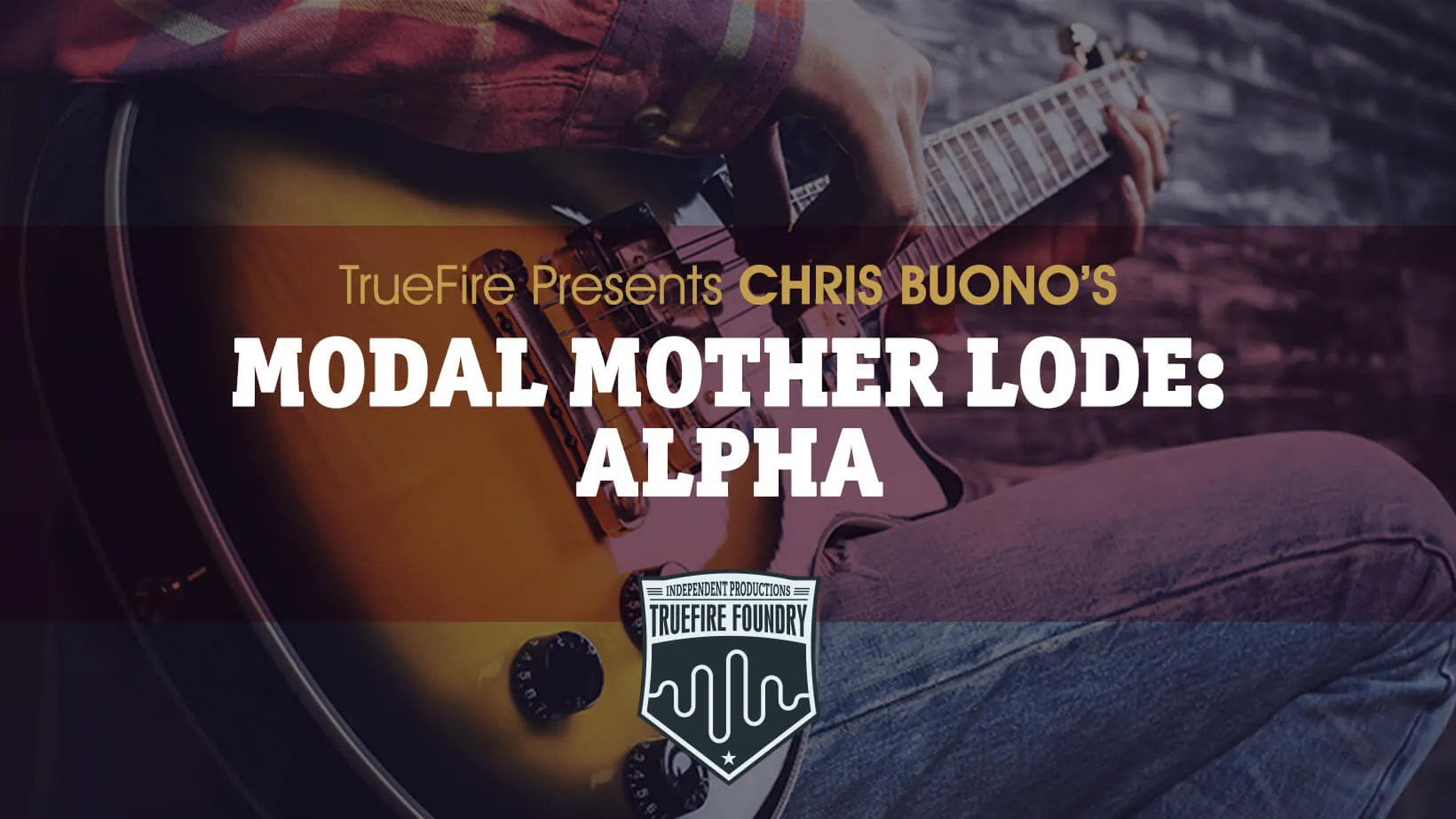

Modal Mother Lode Alpha

Powerful Techniques For Mode Recognition and Improvisation

Marty FriedmanTommy EmmanuelSteve VaiEric GalesEric Johnson

Get this course and 1,000+ more with All Access

Try 14 days free. Cancel any time.

Purchase Individual Course for $19.99
Modal Mother Lode Alpha

About this course

TrueFire Foundry courses are independently produced courses presented by a hand-picked selection of top-notch artists and educators from around the world. Filmed in the educator’s own studio, Foundry courses bring fresh educational concepts and very effective teaching methodologies to TrueFire Students. Chris Buono’s Foundry course, Modal Mother Lode: Alpha will impart powerful ear training and modal techniques for improvisation.

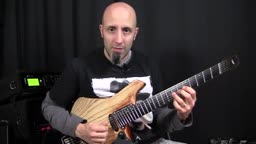
Hello I'm Chris Buono — welcome to my TrueFire Foundry course, Modal Mother Lode, which I produced in my own studio.

Modal Mother Lode | Alpha kicks off my three-part Modal Mother Lode Course series with a unique look into eight essential modes that share a common bond - a major 3rd. Starting with the mother of all modes Ionian AKA the major scale youll dig into Mixolydian, Lydian, Lydian Dominant, Lydian Augmented, Ionian #5, Harmonic Major and Phrygian Dominant. What makes this course so unique is my time-tested multi-faceted approach to modal study, which is rooted in parallel comparison and propelled by application.

All three courses will be structured in the same way. You'll have eight sections of intense melodic and harmonic playing as you make informed comparisons of the modes sound against each other. Each mode will be presented through a scale fingering concept I call "one octave cells" that I will show you in the section’s introduction video. There I will also hip you to the mode's degree formula, its inherent sounds and its possible applications. Once you have the one octave cell under your fingers it will be time for you to go in deep and play.

Just like the three courses mirror each other in structure so do the section’s lessons and their content. Each section features three style-based applications that you'll be shedding in preparation of your video submissions that directly use the one octave cell and its extenders.

You'll have an 8-bar rock lick, a 16-bar funk vamp and a 12-bar blues solo to investigate these modal sounds. Everything you'll play will make use of a parallel root - in this case C. Everything you play will be based off the same three ideas this is about where that record scratch sound comes in.

That's right: Everything you'll play is based off the same three ideas. Same lick, same vamp, same 12-bar solo. Think of these three style-based ideas as templates based off the same root, just within different modal environments. That's what parallel comparison is all about and that's how you truly get the most accurate picture as to what a mode (or any scale for that matter) is all about. If you're thinking there's no way Harmonic Major can pass for a blues soloing vehicle, just wait!

This method worked wonders for every aspect of how I deal with modes and now it's time for it to work for you — come take the journey!

NOTE! Chris Buono organized the course into 8 weekly sections for those students that prefer to have a specified regimen of material across a specified time schedule. However, for those students who prefer to work at their own pace, or even skip around you are certainly encouraged to approach the course in that way as well.

What you'll learn

  • Compare Mixolydian to Ionian mode
  • Exploring augmented triad sounds
  • Advanced modal harmonization techniques
  • Modal improvisation across styles
  • Comparing modes to Ionian template
  • Understand Mixolydian mode structure
  • Understand quartal harmony in Ionian mode
  • Understanding Ionian #5 mode fingerings
Release date: 12/01/2014 • 3h 07m runtime
Start Course
Sample lessons
Week 3: Lydian | Introduction
The Sound, the Cell, the Substance
Week 3: Lydian | Rock Lick 1
Performance
Week 3: Lydian | Rock Lick 2
Breakdown & Analysis
Week 3: Lydian | Funk Vamp 1
Performance

What's included

58 lessons • 32 charts • 4 Jam Tracks

Modal Mother Lode: Alpha
Hey! Welcome to my Modal Mother Lode course! This course is all about one thing. Well...OK, fine a few things with one very important thing at the center of it all: hearing the modes. All 28 of them (that's right, 28 - more in just a minute).

If you've come this far, you probably know what modes are or at least have an idea. But, just in case you're still figuring them out on some level, the modes are highly usable scales, each with their own sound signature, that exist within an interrelated family made up of seven scales in total. There are four primary modal systems with each one having a central parent scale that all the other scales are built from. They are:

Diatonic
Melodic Minor
Harmonic Minor
Harmonic Major

The Modal Mother Lode course will hip you to many important modal concepts, but the absolute central intention is to get you to clearly hear each mode's tonal identity. Sure, I'll tell you about each mode's formula and give you a very cool fingering approach to work with them, but it's the sound we're after plus a way to identify it. Each one of these 28 scales puts forth an individual sound that must be recognized and digested in order to begin to use them to their fullest potential. To do this, Modal Mother Lode will make use of a concept I call parallel comparison. Parallel in this instance refers to the same root or tonal center. The comparison part is where you play these scales from that common tonal center, in the case C, and compare the sounds to one another. At the while I'll be calling out scale degrees (numerical placement of a note in a scale/mode) to help train your brain to instantly recall this numeric language of modal formulas. It sounds simple and a bit complex all in one. But, trust me, it works! And, the roads I went down in the course to put parallel comparison to work are just plain fun.

Again, welcome! Now let's get to work!
Wait, Modal Mother What?
Modal Mother Lode | Alpha kicks things off with a unique look into eight essential modes that share a common bond - a major 3rd. Starting with the mother of all modes - Ionian AKA the major scale - you'll dig into Mixolydian, Lydian, Lydian Dominant, Lydian Augmented, Ionian #5, Harmonic Major and Phrygian Dominant. What makes this course so unique is my time-tested multi-faceted approach to modal study, which is rooted in parallel comparison and propelled by application.

This course includes eight weeks of involved melodic and harmonic playing choices that serve as a guide to making informed comparisons of the mode's sound against each other. Each mode will be presented through a scale fingering concept I call one octave cells and its extenders. I will hip you to each one in the weekly introduction video where I will also provide an attached horizontal scale grid-based chart that clearly displays the cell and its extenders. In the same video, I will also turn you on to the mode's degree formula, its inherent sounds and what main ingredients contribute to that sound. Once you have the one octave cell and its extenders under your fingers it will be time for you to go in deep and play.

Each week you'll have three style-based applications to choose from. You'll have a rock lick, a funk vamp, and a 12-bar blues solo to investigate these modal sounds with. Play one, play two, play them all! Everything you'll play will make use of a parallel root C. Once you come out of the proverbial shed record a video submission I can inspect and respond to. Once you get through Ionian - the mother of all modes - everything presented thereafter will be based off those same three ideas...

...this is about where that record scratch sound comes in.

That's right: Everything you'll play is based off the same three ideas. Same lick, same vamp, same 12-bar solo. Think of these three style-based ideas as "templates" based off the same root, just within different modal environments. That's what parallel comparison is all about and that's how you truly get the most accurate picture as to what a mode (or any scale for that matter) is all about. If you're thinking there's no way harmonic major can pass for a blues soloing vehicle - just wait! This method worked wonders for every aspect of how I deal with modes and now it's time for it to work for you!

More on the styles and approach...

Rock

You'll start off with a rock lick that does the job right. Overflowing with attitude by way of clever usage of legato and bending you'll get a great first impression of the mode's sound via the one octave cell and its extenders and how it feels to play it. This lick will be modally morphed verbatim in the following modes throughout all three courses. Be sure to pay close attention to the scale degree talk in the Breakdown & Analysis videos. Also watch for the mode-specific chord from my own personal trick bag of voicings designed to further drive home the mode's identity with something just plain cool at the close of each passage.

Funk

Next up will be a shift to harmonic playing within 16 bars of funky goodness. Now, it's no secret the funk is my jam. Part of what makes it so delicious to my ears is quartal harmony (pronounced "chordal" by me sometimes - sorry!), which is a harmonic device that relies on stacked intervals of a 4th. These three-note chords or "stacks" will be comprised of perfect 4ths, combinations of both perfect and augmented 4ths - even instances of diminished 4ths at times! Along with the stacks you'll have a chance to explore other adjacent string, three-note chords born of these modal environments. Every chord's purpose is to harmonize the underlying target note melodies, which will be called via scale degree designations. Every vamp is based off a common syncopated 16th-note feel that grooves and stays in play throughout the three courses. All the harmony supporting the target note melody ideas are once again built from the one octave cell and its extenders you will learn about in each mode's corresponding Introduction video. Just like the rock lick, you'll have a modal voicing at the close to geek on for added modal madness.

Blues

Once more making use of the one octave cell and its extenders you'll com up on a 12-bar blues solo constructed from the mode at hand. There will be solos that will follow a horizontal approach (one melodic device for all three changes) as well as vertical approach (an applied melodic device for each chord change) all identified by scale degree designation. If you're thinking there's no way harmonic major can pass for a blues soloing vehicle - just wait! It's all about phrasing, feel, and really hearing what the mode has to offer and learning how to best harness what you have at your disposal.
Week 1: Ionian | Introduction
The Ionian Mode
The sound, the cell, the substance

The Ionian mode - AKA the major scale - should be considered the giver of life within a parallel comparison environment. Not only is it the parent scale to the diatonic series of modes, it's where it all starts. It's the only scale formula that has no alterations. Every mode including the three other parent scales formulas are assessed from Ionian. It's our first step down the parallel comparison path. It's the most pure and goes like this:

1 2 3 4 5 6 7

When you start to learn about the other 27 modes and their formulas they'll be based from these three style-based template ideas. Get that concept understood and you're off to a good start. Making it an even better start is getting the one octave cell and its extenders under your fingers to the point where it's second nature. That's the ground zero template come to life. Once you're there, you're ready for the templates. They are...

The Rock Lick
Kicking off the rock vibe is this killer lick played in the 17th position (Did someone say, "screaming rock star lick!?") that will be morphed and played again and again note-for-note throughout this course. You'll introduce your ears to the sound of Ionian and its fretboard architecture to your hands through this lick as learn where all the bends and pull-offs are while getting hip to the various rhythmic devices. Be sure to bend in tune and watch the corresponding Breakdown & Analysis video for the slightly tricky legato placements so you'll always play the lick with the intended style. In the final bar look out for the modally cool Cmaj7sus2 intentionally voiced for the gobs of gain I'm using!

The Funk Vamp
Here in Ionian the stacked 4ths will be both perfect and augmented. Their sound is infectious and a great additive to this course's goal, which is to provide invigorating playing environments for you to deeply key in on the sounds of the modes by way of parallel comparison. Here you'll learn what will be the common syncopated 16th-note feel employed throughout all the following funk vamps. At the close of this eight bar vamp will be a modally appropriate Cmaj7 6/9 chord to cap things off with style.

The Blues Solo
The blues solo will introduce modally kosher lick ideas that will get the modal morph treatment throughout the course. Those licks will also serve as templates in another way as subsequent blues solos based in other modes require derivatives of these licks to better suit the mode. No matter what the lick turns out to be, be sure to key in on the phrasing and, of course, the scale degrees. They are what I will use throughout all three style templates to give names to the sounds we're chasing!
Week 1: Ionian | Rock Lick 1
The Ionian Mode
The sound, the cell, the substance

The Ionian mode - AKA the major scale - should be considered the giver of life within a parallel comparison environment. Not only is it the parent scale to the diatonic series of modes, it's where it all starts. It's the only scale formula that has no alterations. Every mode including the three other parent scales formulas are assessed from Ionian. It's our first step down the parallel comparison path. It's the most pure and goes like this:

1 2 3 4 5 6 7

When you start to learn about the other 27 modes and their formulas they'll be based from these three style-based template ideas. Get that concept understood and you're off to a good start. Making it an even better start is getting the one octave cell and its extenders under your fingers to the point where it's second nature. That's the ground zero template come to life. Once you're there, you're ready for the templates. They are...

The Rock Lick
Kicking off the rock vibe is this killer lick played in the 17th position (Did someone say, "screaming rock star lick!?") that will be morphed and played again and again note-for-note throughout this course. You'll introduce your ears to the sound of Ionian and its fretboard architecture to your hands through this lick as learn where all the bends and pull-offs are while getting hip to the various rhythmic devices. Be sure to bend in tune and watch the corresponding Breakdown & Analysis video for the slightly tricky legato placements so you'll always play the lick with the intended style. In the final bar look out for the modally cool Cmaj7sus2 intentionally voiced for the gobs of gain I'm using!

The Funk Vamp
Here in Ionian the stacked 4ths will be both perfect and augmented. Their sound is infectious and a great additive to this course's goal, which is to provide invigorating playing environments for you to deeply key in on the sounds of the modes by way of parallel comparison. Here you'll learn what will be the common syncopated 16th-note feel employed throughout all the following funk vamps. At the close of this eight bar vamp will be a modally appropriate Cmaj7 6/9 chord to cap things off with style.

The Blues Solo
The blues solo will introduce modally kosher lick ideas that will get the modal morph treatment throughout the course. Those licks will also serve as templates in another way as subsequent blues solos based in other modes require derivatives of these licks to better suit the mode. No matter what the lick turns out to be, be sure to key in on the phrasing and, of course, the scale degrees. They are what I will use throughout all three style templates to give names to the sounds we're chasing!
Week 1: Ionian | Rock Lick 2
The Ionian Mode
The sound, the cell, the substance

The Ionian mode - AKA the major scale - should be considered the giver of life within a parallel comparison environment. Not only is it the parent scale to the diatonic series of modes, it's where it all starts. It's the only scale formula that has no alterations. Every mode including the three other parent scales formulas are assessed from Ionian. It's our first step down the parallel comparison path. It's the most pure and goes like this:

1 2 3 4 5 6 7

When you start to learn about the other 27 modes and their formulas they'll be based from these three style-based template ideas. Get that concept understood and you're off to a good start. Making it an even better start is getting the one octave cell and its extenders under your fingers to the point where it's second nature. That's the ground zero template come to life. Once you're there, you're ready for the templates. They are...

The Rock Lick
Kicking off the rock vibe is this killer lick played in the 17th position (Did someone say, "screaming rock star lick!?") that will be morphed and played again and again note-for-note throughout this course. You'll introduce your ears to the sound of Ionian and its fretboard architecture to your hands through this lick as learn where all the bends and pull-offs are while getting hip to the various rhythmic devices. Be sure to bend in tune and watch the corresponding Breakdown & Analysis video for the slightly tricky legato placements so you'll always play the lick with the intended style. In the final bar look out for the modally cool Cmaj7sus2 intentionally voiced for the gobs of gain I'm using!

The Funk Vamp
Here in Ionian the stacked 4ths will be both perfect and augmented. Their sound is infectious and a great additive to this course's goal, which is to provide invigorating playing environments for you to deeply key in on the sounds of the modes by way of parallel comparison. Here you'll learn what will be the common syncopated 16th-note feel employed throughout all the following funk vamps. At the close of this eight bar vamp will be a modally appropriate Cmaj7 6/9 chord to cap things off with style.

The Blues Solo
The blues solo will introduce modally kosher lick ideas that will get the modal morph treatment throughout the course. Those licks will also serve as templates in another way as subsequent blues solos based in other modes require derivatives of these licks to better suit the mode. No matter what the lick turns out to be, be sure to key in on the phrasing and, of course, the scale degrees. They are what I will use throughout all three style templates to give names to the sounds we're chasing!
Week 1: Ionian | Funk Vamp 1
The Ionian Mode
The sound, the cell, the substance

The Ionian mode - AKA the major scale - should be considered the giver of life within a parallel comparison environment. Not only is it the parent scale to the diatonic series of modes, it's where it all starts. It's the only scale formula that has no alterations. Every mode including the three other parent scales formulas are assessed from Ionian. It's our first step down the parallel comparison path. It's the most pure and goes like this:

1 2 3 4 5 6 7

When you start to learn about the other 27 modes and their formulas they'll be based from these three style-based template ideas. Get that concept understood and you're off to a good start. Making it an even better start is getting the one octave cell and its extenders under your fingers to the point where it's second nature. That's the ground zero template come to life. Once you're there, you're ready for the templates. They are...

The Rock Lick
Kicking off the rock vibe is this killer lick played in the 17th position (Did someone say, "screaming rock star lick!?") that will be morphed and played again and again note-for-note throughout this course. You'll introduce your ears to the sound of Ionian and its fretboard architecture to your hands through this lick as learn where all the bends and pull-offs are while getting hip to the various rhythmic devices. Be sure to bend in tune and watch the corresponding Breakdown & Analysis video for the slightly tricky legato placements so you'll always play the lick with the intended style. In the final bar look out for the modally cool Cmaj7sus2 intentionally voiced for the gobs of gain I'm using!

The Funk Vamp
Here in Ionian the stacked 4ths will be both perfect and augmented. Their sound is infectious and a great additive to this course's goal, which is to provide invigorating playing environments for you to deeply key in on the sounds of the modes by way of parallel comparison. Here you'll learn what will be the common syncopated 16th-note feel employed throughout all the following funk vamps. At the close of this eight bar vamp will be a modally appropriate Cmaj7 6/9 chord to cap things off with style.

The Blues Solo
The blues solo will introduce modally kosher lick ideas that will get the modal morph treatment throughout the course. Those licks will also serve as templates in another way as subsequent blues solos based in other modes require derivatives of these licks to better suit the mode. No matter what the lick turns out to be, be sure to key in on the phrasing and, of course, the scale degrees. They are what I will use throughout all three style templates to give names to the sounds we're chasing!
Week 1: Ionian | Funk Vamp 2
The Ionian Mode
The sound, the cell, the substance

The Ionian mode - AKA the major scale - should be considered the giver of life within a parallel comparison environment. Not only is it the parent scale to the diatonic series of modes, it's where it all starts. It's the only scale formula that has no alterations. Every mode including the three other parent scales formulas are assessed from Ionian. It's our first step down the parallel comparison path. It's the most pure and goes like this:

1 2 3 4 5 6 7

When you start to learn about the other 27 modes and their formulas they'll be based from these three style-based template ideas. Get that concept understood and you're off to a good start. Making it an even better start is getting the one octave cell and its extenders under your fingers to the point where it's second nature. That's the ground zero template come to life. Once you're there, you're ready for the templates. They are...

The Rock Lick
Kicking off the rock vibe is this killer lick played in the 17th position (Did someone say, "screaming rock star lick!?") that will be morphed and played again and again note-for-note throughout this course. You'll introduce your ears to the sound of Ionian and its fretboard architecture to your hands through this lick as learn where all the bends and pull-offs are while getting hip to the various rhythmic devices. Be sure to bend in tune and watch the corresponding Breakdown & Analysis video for the slightly tricky legato placements so you'll always play the lick with the intended style. In the final bar look out for the modally cool Cmaj7sus2 intentionally voiced for the gobs of gain I'm using!

The Funk Vamp
Here in Ionian the stacked 4ths will be both perfect and augmented. Their sound is infectious and a great additive to this course's goal, which is to provide invigorating playing environments for you to deeply key in on the sounds of the modes by way of parallel comparison. Here you'll learn what will be the common syncopated 16th-note feel employed throughout all the following funk vamps. At the close of this eight bar vamp will be a modally appropriate Cmaj7 6/9 chord to cap things off with style.

The Blues Solo
The blues solo will introduce modally kosher lick ideas that will get the modal morph treatment throughout the course. Those licks will also serve as templates in another way as subsequent blues solos based in other modes require derivatives of these licks to better suit the mode. No matter what the lick turns out to be, be sure to key in on the phrasing and, of course, the scale degrees. They are what I will use throughout all three style templates to give names to the sounds we're chasing!

+ 51 more lessons

Start Course

Reviews

5 results

Revman2015

02/28/21

Eyes wide open

Chris Buonos Modal Mother load guitar course is a must do course. In fact it could be the course for opening many a door.You’ll learn a lot from this course.His Variances caught me by surprise. Some seriously complex stuff if your up to the challenge. He is seriously good.

Hendrik F.

Verified buyer

05/14/12

I am a long time Guitar Gym member and was given the opportunity to preview the week 1 material. WOW - I can only say this: A very thought through and methodical approach to modes and its immediate musical application. Be warned though: it is a Chris Buono workshop - Sarge is back - Intensity written all over the place - but in a very good and entertaining way! This is one of the great places - maybe THE place to go, if you really want to step up your game understanding & applying modal concepts to your soloing. However there is one commitment to make (and I am not talking about the ridiculous low price): You have to put the time in! The benefit: you will improve not just one single skill, you will become a much better musician in a hurry. I'll sign up for this. Hey Chris, c ya there - soon! :)

Dweezil Z.

Verified buyer

05/13/12

I am so glad that this information is being presented this way by Chris. I love the parallel comparison method he utilizes. The little cells he focuses on evoke the unique personality of the modes and it really helped me grasp the modal concept in a compositional and improvisational way, like never before. Thank you Chris! Great work.

Daniel C.

Verified buyer

05/12/12

So I've been lucky enough to already get a start on Modal Mother Lode and I can 100% say it is THE way to learn the modes. Chris Buono understands the value of applying concepts to musical examples; something not found in any other system I've seen. You (the player) will first of all be given some tasty guitar licks spanning different genres, that can easily be applied to real world situations such as jamming with a band or composing your own music. The examples are well crafted and work together to show how the modes work and what they sound like - there are no useless formulas to memorize! You are not just learning the modes in this course, you're playing them and internalizing them. Learning the modes for the first time has been made fun and effective. Only sign up for this if you want to be a better musician; don't be surprised if you find yourself improving at an alarming rate :)

Hey I.

Verified buyer

05/11/12

Hey there, having already jumped in and got my teeth into this Modal Mother Lode of a workshop as I was a privileged beta tester of sorts, I can only give you my honest perception as a long term Sherpa student and Truefire junkie! Chris Buono has done it again with a learning approach that is unique, Sherpalicious in fact! and the content and delivery is A1 and spot on the money. The clarity and simplicity of the information presented, described and taught is actually inspiring and so relevant, it gets you picking up the guitar and straight into the "meat and potatoes" of modes and their realistic application immediately.. Real world examples in a way that gets you playing... This is a Lode Of Class videos and instantly useable tools and techniques to take your playing instantly up a few notches or 7.... Ha.. get on board.. See you all in the workshop.. Well done Truefire and well done Chris Buono.... This is stuff is awesome.. really it is...

Stop searching. Start improving with All Access.

Try 14 days free. Cancel any time.