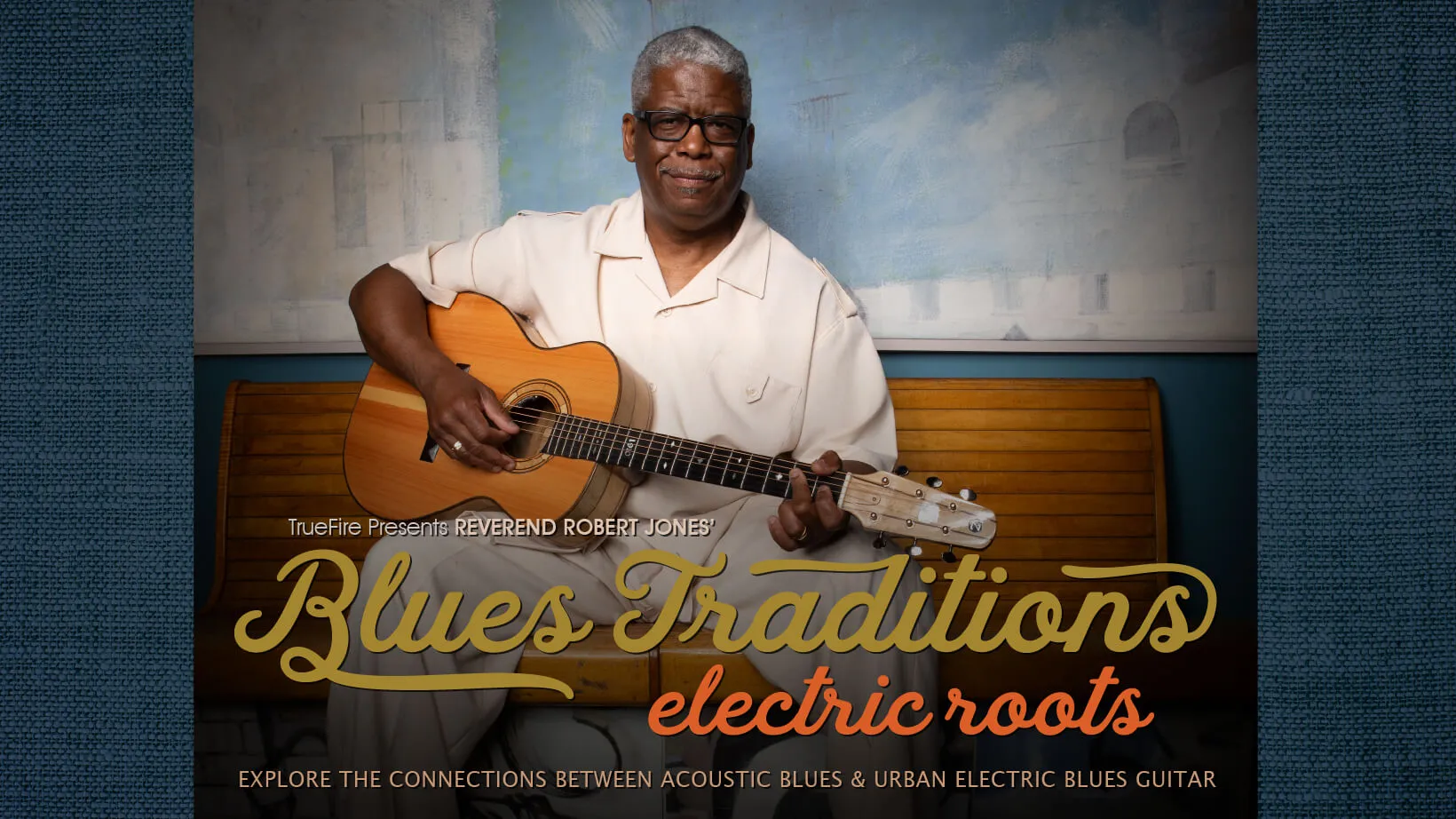

Blues Traditions: Electric Roots

Explore the Connections Between Acoustic Blues & Urban Electric Blues Guitar

Marty FriedmanTommy EmmanuelSteve VaiEric GalesEric Johnson

Get this course and 1,000+ more with All Access

Try 14 days free. Cancel any time.

Purchase Individual Course for $14.99
Blues Traditions: Electric Roots

About this course

Muddy Waters, Elmore James, John Lee Hooker, Howlin’ Wolf along with other blues legends of the ‘40s are all widely respected as the pioneers -- the very roots --- of urban electric blues. The harder-edged blues vocabulary they created has inspired virtually every generation of blues guitarists since.

However, these pioneers of electric blues were likewise inspired by the vocabulary and stylings of the generation of acoustic blues artists who came before them. Reverend Robert Jones’ Electric Roots edition of Blues Traditions explores the connections between the acoustic blues traditions and the early urban electric traditions.

”I’ve organized the curriculum into four sections. Each section focuses on a specific pioneer of electric blues -- We'll examine their distinct instrumental voice and study the acoustic blues artists that influenced their music and electric presentation.

We’ll start with Muddy Waters and study his musical connections to players like Son House and Robert Johnson. Early Delta Blues influences like Charlie Patton, Jimmy Rogers, and Tommy Johnson helped shape the electrified sounds of the legendary Howlin’ Wolf.

Elmore James drew upon acoustic blues influences from Robert Johnson and the man with the golden guitar himself, Tampa Red. And finally, we’ll look at the master of the Blues Boogie himself, John Lee Hooker and explore the Hill Country Blues traditions through his contemporaries R.L. Burnside and Mississippi Fred McDowell”


For each of the legendary artists, Reverend Jones presents background, demonstrations, and then a series of performance studies and breakdowns, all of which detail the underlying techniques and stylistic approaches that were passed on from generation to generation of guitar players.

"The purpose of these lessons is to show how traditional acoustic blues styles helped to shape the seminal sounds of classic electric blues. We'll focus on the styles of four highly influential blues guitarists, namely Muddy Waters, Howlin' Wolf, Elmore James, and John Lee Hooker. We'll explore some of the general sounds that characterize their sounds, and then we will attempt to trace some of the country blues artists who helped to shape their electric guitar styles. “

Reverend Jones will explain and demonstrate all of the key concepts and approaches along the way. You’ll get standard notation and tabs for all of the performance studies. Plus, you’ll be able to use TrueFire’s learning tools to sync the tab and notation to the video lesson. You can also loop or slow down the videos so that you can work with the lessons at your own pace. All of the backing tracks are included to work with on your own as well.

Grab your guitar and let’s get back to our roots with Reverend Robert Jones!

What you'll learn

  • Learn about the transition from acoustic to electric blues in Chicago
  • Recognize the connection between Mississippi Hill Country blues and Detroit electric blues
  • Appreciate the minimalist approach to blues performance (guitar and foot percussion)
  • Understand why certain blues standards are essential repertoire
  • Understand the importance of rhythm and improvisation in John Lee Hooker's style
Release date: 11/11/2019 • 1h 43m runtime
Start Course
Sample lessons
Roots & Musical Innovation
Course Primer
Muddy Waters
Muddy Waters
Overview
Muddy's House of Johnson
Acoustic Roots: Demo
Homesick Blues
Homesick Blues
Electrified: Overview

What's included

39 lessons • 16 charts

Blues Traditions: Electric Roots
Hi, I'm Reverend Robert Jones. Welcome to the Electric Roots edition of Blues Traditions!

Muddy Waters, Elmore James, John Lee Hooker, Howlin' Wolf along with other blues legends of the ‘40s are all widely respected as the pioneers - the very roots of urban electric blues. The harder-edged blues vocabulary they created has inspired virtually every generation of blues guitarists since. However, these pioneers of electric blues were likewise inspired by the vocabulary and stylings of the generation of acoustic blues artists who came before them.

In this course, we're going to explore the connections between the acoustic blues traditions and the early urban electric traditions. I've organized the curriculum into four sections. Each section focuses on a specific pioneer of electric blues - we'll examine their distinct instrumental voice and study the acoustic blues artists that influenced their music and electric presentation.

All of the key examples are tabbed and notated and you'll be able to sync the tab and notation to the video using TrueFire's learning tools. You'll be able to loop or slow down the videos so that you can work with the lessons at your own pace.

Grab your guitar and let's get started.
Roots & Musical Innovation
The purpose of these lessons is to show how traditional acoustic blues styles helped to shape the seminal sounds of classic electric blues. We'll focus on the styles of four highly influential blues guitarists, namely Muddy Waters, Howlin' Wolf, Elmore James and John Lee Hooker. We'll explore some of the general sounds that characterize their sounds, and then we will attempt to trace some of the country blues artists who helped to shape their electric guitar styles. In this lesson, I used two very different guitars. The acoustic demonstrations are done on a custom built OO size flat top built by Gary Zimnicki (www.zimnicki.com). The wood was recovered from a house built in Detroit in 1910. The guitar that I use for the electric demonstrations is a Silvertone archtop (model 2256) built in and sold only in 1940. It's equipped with an old DeArmond model 1000 pickup, and played through a Fender Deluxe with a "Hall Of Fame" reverb pedal and little distortion from an "OCD, Fulltone" pedal.
Muddy Waters
McKinley Morganfield aka Muddy Waters was one of the most important blues guitarists in the history of the style. Born in 1915, Rolling Fork, Mississippi, when Waters moved North to Chicago in the 1940's he brought with him a style of guitar that was heavily influenced by the music of the Mississippi Delta. Originally, Waters had probably played a variety of cheap flat-top acoustic guitars. However, when he was photographed by the Library of Congress at the age of 19, he was seen to be playing a National steel bodied guitar, possibly a Duolian model. When Muddy arrived in Chicago, though, it was apparent that he needed something with more volume than an acoustic, even a National, could produce. Consequently, many early electric blues player chose archtops fitted with DeArmond pickups (the monkey on a stick).
Muddy's House of Johnson
When Muddy Waters came to Chicago in the 1940's there was already an established blues scene. Early artists like Hudson Whittaker (Tampa Red), Georgia Tom Dorsey and Big Bill Broonzy had laid a foundation with acoustic blues sounds, but Muddy represented a later generation of blues men who had migrated directly from Mississippi and brought a harder edged sound drawn from the Delta. Muddy Waters was known to have said that he had three major influences namely, Robert Johnson, Son House and himself. This piece shows how Muddy borrowed from older musicians, especially Son House, to develop his own style.
Homesick Blues
One of the things that set Muddy Waters' music apart was that it appealed to a large number of African Americans that had migrated to big cities like Detroit, New York and, of course, Chicago. The theme of this song is homesickness and separation from your significant other.
Homesick Blues
This piece is played in Open G tuning (D-G-D-G-B-D). "Homesick Blues" is based on Water's piece "I Feel Like Goin' Home". He used this progression and these licks for a number of his recorded pieces though. This piece is related to tunes like Son Houses' "Jinx Blues", Willie Brown's "Future Blues" and Charley Patton's, "Moon Goin' Down". The key to the piece is the descending figure played on strings 6 and 4, (3rd fret, 2nd fret, 1st fret, open). This pattern works as a lick sing over on the "I" chord, but it also works as a turnaround.
Homesick Blues
The sustain of an electric guitar allowed early Chicago blues men to play slower and more simplified rhythms than they did on acoustic instruments. Notice how the slower accompaniment sets a pocket that, not only makes room for soulful vocals, but also allows other instruments (harmonica, piano, etc.) to participate in the call and response of the song.

+ 32 more lessons

Start Course

Reviews

9 results

ReverendZ

Verified buyer

06/20/25

Electric Roots

Excellent course, very knowledgeable instructor with great teaching style.

Greenwave

Verified buyer

12/22/21

The Reverend delivers real blues

Loving the blues roots lessons and insightful history and easy teaching style of the Reverend - top marks!

jeff63

Verified buyer

07/05/20

The Reverend Robert Jones

I am no longer able to hold a flat pick (and keep it there) and I can’t keep a thumb pick out of my way or the guitar’s way, so I stumbled upon The Reverend Robert Jones. His style of teaching is just right for someone like me who knows some stuff, but is trying to basically re-learn how to play. Not overly aggressive, but enough “come on, get your act in gear” to get you motivated for more and more. And what more fun than to learn how all that great blues music came to be - the man is a gifted historian/story teller. And finger roller, which is perfect for me - never done it before. I actually bought Blues Traditions and Electric Roots together, then figured out I needed some other input to be able to continue and am getting those basics fingering techniques from another teacher, Richard Gilewitz. I am getting some great pick hand how to’s from that. This is a great platform folks, inexpensive for the quality instruction you get from a fabulous array of extremely talented musicians and you don’t have to worry about getting sick (important to us over 60). I pre-purchased a Martin SC-13e last month (wish I knew when it will arrive) and I get 3 months of full access when it shows up - CAN’T WAIT! Trying so hard to get ready for when my Martin shows (ok, a mexi martin, but a Martin none the less), so I won’t look like a complete idiot. Thanks for being there TruFire, I do appreciate it. PEOPLE: Take advantage of this site - you won’t regret it. Jeff B. Blanca, CO

rbroeg

Verified buyer

04/20/20

Fantastic Early Electric Blues course

I love Robert Jones approach. On the breakdowns he gives several approaches to each lick and encourages his students make the licks their own. He basically teaches you how to improvise in the style of the early electric pioneers. And he gives fascinating history lessons as he teaches.

coltrig

Verified buyer

04/09/20

Blues Traditionas : Electric Roots

Fills in some interesting gaps

Stop searching. Start improving with All Access.

Try 14 days free. Cancel any time.