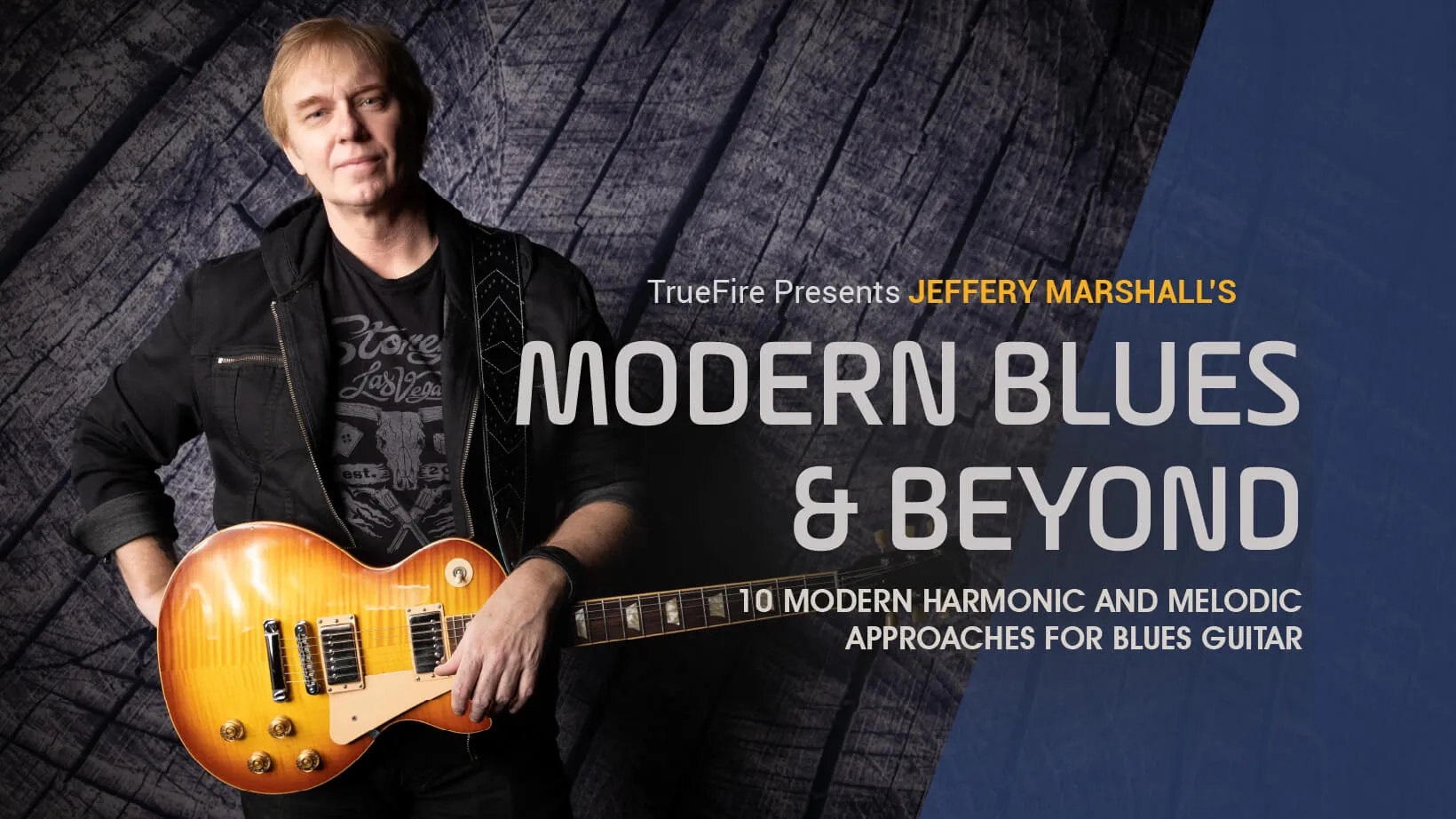

Modern Blues & Beyond

10 Modern Harmonic and Melodic Approaches for Blues Guitar

Marty FriedmanTommy EmmanuelSteve VaiEric GalesEric Johnson

Get this course and 1,000+ more with All Access

Try 14 days free. Cancel any time.

Purchase Individual Course for $14.99
Modern Blues & Beyond

About this course

Contemporary guitarists like Robben Ford, Larry Carlton and John Scofield use a variety of sophisticated harmonic and melodic approaches when playing the blues. While many of these modern comping and soloing approaches stem from their jazz background, the underlying principles are easily applied to the blues form.

Jeffery Marshall’s Modern Blues & Beyond takes the mystery out of these jazz-influenced approaches, giving you an easy to learn and even easier way to start using them in your blues playing immediately.

”I’ll breakdown and decode 10 of the most impactful approaches and then we’ll apply each of them over a blues jam track for musical context.

We’ll explore modern blues comping and soloing applications for diminished and diatonic triads, stacked fourths, tritone subs, harmonic minor in a minor blues, re-harmonizing the blues scale, and much more.

Everything is tabbed and synced to the video. Using TrueFire’s learning tools, you can slow down or loop any of the video lessons to work with the video lessons at your own pace.”


Jeffery will explain and then demonstrate all of the harmonic and melodic approaches over blues jam tracks for musical context. You’ll get standard notation and tabs for all of the performances, which you can sync to the video lesson using TrueFire’s learning tools.

You can also loop and slow down any section of the video to work with the lessons at your own pace. Plus, the backing tracks are also included to practice with on your own.

Grab your guitar, and let’s “go beyond the blues” with Jeffery Marshall!

What you'll learn

  • Master augmented triad arpeggios as melodic devices
  • Learn to phrase four-note-per-string patterns musically
  • Develop ability to imply chord changes through scale selection
  • Learn jazz blues turnaround vocabulary (F9 to E7 to A)
  • Develop strategies for creating and resolving tension in blues solos
Release date: 05/05/2022 • 2h 54m runtime
Start Course
Sample lessons
Altered Paths to Two-Five Blues
Performance
Harmonic Minor in Minor Blues
Lesson Demonstration
Harmonic Minor Blues Improv
Overview
Harmonic Minor Blues Improv
Performance

What's included

42 lessons • 20 charts • 10 Jam Tracks

Modern Blues & Beyond
Hi, it's Jeffery Marshall here. Contemporary guitarists like Robben Ford, Larry Carlton and John Scofield use a variety of sophisticated harmonic and melodic approaches when playing the blues.

While many of these modern comping and soloing approaches stem from their jazz background, the underlying principles are easily applied to the blues form.

In this course, we’ll explore modern blues comping and soloing applications for diminished and diatonic triads, stacked fourths, tri-tone subs, harmonic minor and more, applying each approach over a jam track along the way.

Everything is tabbed and synced to the video. Using TrueFire’s learning tools, you can slow down or loop any of the video lessons to learn at your own pace.

Grab your guitar and let’s dig in.
Diminished Triads for Blues Comping
Every dom7 chord has a diminished triad built into from the 3rd of the chord. For example A7 has a C# dim triad. It is basically the A7 chord without the root. This is a clever way of getting away from playing the root of the chord which can be reserved for you bass player. This also thins out your chord and allows you to move a bit more freely around the guitar without using big block 6 string chord and is arguably more tasteful. When you go to the 4 chord in a typical 12 bar blues, that in most cases will also be a dom7 chord. The same applies. You use the dim triad from the 3rd of you 4 and 5 chords also giving you the same effect. for this reason I think it is important to learn your diminished triad on different string groups and the various inversions so you can maximize this concept as it is a great too for rhythm comping!
Light, Lean & Tasty
Every dom7 chord has a diminished triad built into from the 3rd of the chord. For example A7 has a C# dim triad. It is basically the A7 chord without the root. This is a clever way of getting away from playing the root of the chord which can be reserved for you bass player. This also thins out your chord and allows you to move a bit more freely around the guitar without using big block 6 string chord and is arguably more tasteful. When you go to the 4 chord in a typical 12 bar blues, that in most cases will also be a dom7 chord. The same applies. You use the dim triad from the 3rd of you 4 and 5 chords also giving you the same effect. for this reason I think it is important to learn your diminished triad on different string groups and the various inversions so you can maximize this concept as it is a great too for rhythm comping!
Light, Lean & Tasty
Every dom7 chord has a diminished triad built into from the 3rd of the chord. For example A7 has a C# dim triad. It is basically the A7 chord without the root. This is a clever way of getting away from playing the root of the chord which can be reserved for you bass player. This also thins out your chord and allows you to move a bit more freely around the guitar without using big block 6 string chord and is arguably more tasteful. When you go to the 4 chord in a typical 12 bar blues, that in most cases will also be a dom7 chord. The same applies. You use the dim triad from the 3rd of you 4 and 5 chords also giving you the same effect. for this reason I think it is important to learn your diminished triad on different string groups and the various inversions so you can maximize this concept as it is a great too for rhythm comping!
Light, Lean & Tasty
Every dom7 chord has a diminished triad built into from the 3rd of the chord. For example A7 has a C# dim triad. It is basically the A7 chord without the root. This is a clever way of getting away from playing the root of the chord which can be reserved for you bass player. This also thins out your chord and allows you to move a bit more freely around the guitar without using big block 6 string chord and is arguably more tasteful. When you go to the 4 chord in a typical 12 bar blues, that in most cases will also be a dom7 chord. The same applies. You use the dim triad from the 3rd of you 4 and 5 chords also giving you the same effect. for this reason I think it is important to learn your diminished triad on different string groups and the various inversions so you can maximize this concept as it is a great too for rhythm comping!
Diminished Triads for Blues Improv
Just as with rhythm guitar, diminished triads are a great tool for improvisation. Of course you can adapt which dim triad to use depending on which chord you are on. Just as with rhythm guitar you can use these to imply other chords in your lines. I like to blend these in with other lines of course and also add some chromatic notes around some of the tones.
Just Enough Tension
Just as with rhythm guitar, diminished triads are a great tool for improvisation. Of course you can adapt which dim triad to use depending on which chord you are on. Just as with rhythm guitar you can use these to imply other chords in your lines. I like to blend these in with other lines of course and also add some chromatic notes around some of the tones.

+ 35 more lessons

Start Course

Reviews

8 results

littlesister

Verified buyer

02/23/26

Modern Blues and Beyond

A good course, with essential stuff to learn from a guitar master.

Russell100

Verified buyer

09/09/25

A next step for me

Well done. It has techniques I've been wondering about but wouldn't have been able to figure out on my own.

brosblues

Verified buyer

02/24/25

So Far So Excellent

I bought the course hoping that it would offer ideas to freshen up my blues playing. I have not yet completed the course, but so far, the course has delivered on its promise!

jklingensmith

Verified buyer

12/07/22

Really useful

While not at all heavy on theory, if you have a little even just a little knowledge of the basics, this course can give you a whole host on useful approaches to grow your repetoire and knowledge beyond simple pentatonics. Concepts are well explained and demonstrated.....I found it really helpful.

Quark77

Verified buyer

06/10/22

Simple yet complex

Simple concepts to create complex riffs and solos. I've just started and find something new/surprising in every lesson. Love it.

Stop searching. Start improving with All Access.

Try 14 days free. Cancel any time.