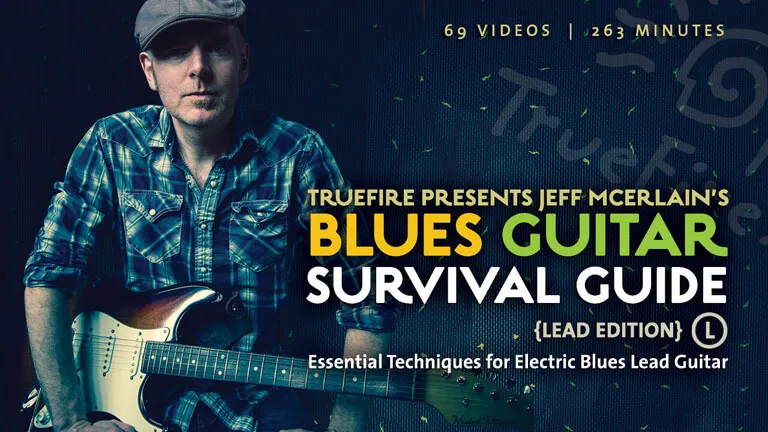

Blues Guitar Survival Guide - Lead

Essential techniques & insight for blues lead guitar.

Marty FriedmanTommy EmmanuelSteve VaiEric GalesEric Johnson

Get this course and 1,000+ more with All Access

Try 14 days free. Cancel any time.

Purchase Individual Course for $24.99
Blues Guitar Survival Guide - Lead

About this course

I'm going down to Rosedale,
Take my rider by my side.

Everyone knows that Robert Johnson really didn’t sell his soul to the Prince of Darkness at the crossroads of Highways 61 and 49 in Clarksdale. Silly urban myth. Everyone knows that the devil always hangs close to a river and there’s no river anywhere near those crossroads. It was the crossroads of Highway 8 and Highway 1 in Rosedale where Johnson cashed in his soul for killer blues guitar chops. Ask Son House or check a map. But hold on... before you go rushing down there to do your own deal, Jeff McErlain’s got a much better proposition...

Jeff’s Lead Guitar edition of the Blues Guitar Survival Guide distills a massive range of blues-centric leads guitar techniques, stylings, harmonic knowledge and creative approaches into a hands-on, accelerated and highly intuitive curriculum. No tedious theory, no boring exercises -- you will play your way through the course exploring and learning essential concepts and then immediately applying them in a musical context.

In the first section of the Survival Guide, Jeff presents and demonstrates what he considers to be the 35 most essential techniques, concepts and approaches for playing blues lead guitar: Minor Pentatonic Scale, Minor Blues Scale, Major Pentatonic Scale, Major Blues Scale, Mixing Major and Minor, Composite Blues Scale, Dominant Pentatonic Scale, Minor Pentatonic with 6th, Tritones, Chord Tones, Using 3rds, Using 6ths, Bends, Half Step Bends, Whole Step Bends, Minor and Major 3rd Bends, Tweaking the 3rd, Tweaking the 7th, Between Bends, Albert King Style Bends, Vibrato, Double Stops, Picking Methods, Dynamics, Phrasing, Dynamics of a Phrase, Sonic Choices, Hammer Ons & Pull Offs, Discovering the Upbeat, The Blues Form, One Note, Repeated Licks, Octaves, Melodic Patterns, and Blues Rhythmic Patterns.

In the second section, you will learn 10 lead guitar studies that apply everything covered in the first section. Jeff will demonstrate the solo study and then break down every note, every technique, every harmonic approach and every concept. Each lead guitar study is performed over a rhythm track, which you in turn will use to perform and improvise over as well. Of course, everything is tabbed and notated for you.

The 10 rhythm tracks cover all of the styles of blues you will encounter on the bandstand today: Jazzy Minor Blues, Straight Rock Blues, Rumba Blues, Classic Texas Blues, Uptempo Shuffle Blues, Classic Minor Blues, Call and Response Blues, Big Bend Blues, Slow Blues and a Southern Rock Vamp. and Guitar Pro files are included as well.

So, hold on to your soul for now. You’ll still have to shed the material but McErlain’s Blues Guitar Survival Guide is a much safer way to go.

And by the way, Robert Johnson never mentioned Rosedale in his original lyrics for Cross Road Blues -- Eric Clapton’s version quoted those lines from Johnson’s 1937 recording Traveling Riverside.

I'm going down to Rosedale,
Take my rider by my side.
You can still barrelhouse, baby,
On the riverside.

Jeff McErlain's Preferred Gear

Below is a list of Jeff McErlain's preferred gear including guitars, amps, pedals, accessories, and more. What you see in Jeff's lessons may or may not be this actual gear, but if you are trying to capture Jeff's sound and tone, the gear listed below is recommended by Jeff and it's a great place to start!

Guitars

Amps

Pedals

Accessories & More

What you'll learn

  • Play a classic minor blues progression with bVI7 and V7 changes
  • Use fingerstyle technique for dynamic control in blues solos
  • Apply vibrato to bent notes for emotional expression
  • Use thumb to achieve warm jazz tone
  • Outline chord changes using the blues scale and targeted bends
Release date: 08/15/2013 • 4h 23m runtime
Start Course
Sample lessons
Tweaking the 3rd
Tweaking the 3rd
Concept 17
Albert King Style Bends
Concept 20
Straight Rock Blues
Straight Rock Blues
Performance
Straight Rock Blues
Straight Rock Blues
Breakdown

What's included

69 lessons • 24 charts • 32 Jam Tracks

Blues Guitar Survival Guide: Lead
Hello and thanks for joining me for the Blues Guitar Survival Guide Lead Edition. I am really excited to be bringing you this information and my thoughts on blues guitar soloing. I have broken the course down into two sections. The first is the Essential Concepts, here I share with you what you need to become an accomplished blues soloist. The second section is the Lead Guitar Studies, that is where we put the essential concepts to work in real life, practical playing situations. The blues is dear to my heart and is at the core of all my guitar playing. The blues is the common denominator in so many styles of music and it is also the place where musicians can all meet. The blues is the basis of jazz, rock, funk, and most kinds of popular music. Take your time, the blues takes a lifetime to master, it is the journey that is the joy of music. You will never be done, and to me that is my favorite part of it all.
SECTION 1
Welcome to the Essential Concepts Section, here I lay out thirty five of the most important elements you need to become a great blues soloist. I have set these up so that one builds upon the other, so please go through them chronologically. That being said please also feel free to jump around if you are feeling frisky. The one thing I will stress is that you can never know something too well. I relearn this all the time. For example, I am still working on the pentatonic scales and always seem to find new things to do or new sounds lurking in those five notes. Creating this course really helped me become a better player as I had to lay these concepts out clearly, that made me revisit many things I felt I knew. Once again, as always, I discover something new.
Minor Pentatonic Scale
The A minor pentatonic scale is most likely the first scale you learned on the guitar and there is a lot of music in those notes. A pentatonic scale is a 5 note scale as opposed to the normal 7 note scale. It is simply a natural minor scale with the 2nd and 6th degrees removed. An easy way to look at it is as a minor scale with the half steps removed. For example A minor is A B C D E F G, A minor pentatonic is A C D E G. By removing the B and F we remove the notes that can be problematic at times, especially the F. Please check out the 4 note groupings and one string at a time methods, these really helped me solidify the scale and the notes on the neck.
Minor Blues Scale
The Minor Blues scale is just a minor pentatonic scale with an added b5. The b5 is often called the blue note, hence the name of the scale. To most players the pentatonic and blues scale are synonymous because they are so ubiquitous. The blues scale can be traced back to African roots and found its way into the field hollers of slaves and plantation workers in the early 1900's. I highly suggest checking out some of the field recordings of that time on YouTube, that sound is the essence of the blues. On a technical note, the blue note is not usually "sat on" for any long period of time as it causes a dissonance that when used properly adds a great tension. That tension always calls for release.
Major Pentatonic Scale
The major pentatonic scale like the minor pentatonic scale is just a major scale with the half steps removed. As its name suggests it produces a more major and happy sound. Generally speaking it is more closely associated with Chicago blues like players like BB King, as opposed to Albert King who has more of a minor Texas blues sound. Of course these are large generalizations but think of them as simple player related guidelines. If it's darker sounding it's minor blues, if it's brighter sounding it's major blues. I highly suggest playing over a major groove to get used to the sound and feel of the major pentatonic scale because if you are not used to it, like anything, it takes time.
Major Blues Scale
The major pentatonic scale formula is R 2 3 5 6, to get a major blues scale we add in a b3rd. So the new formula is R 2 b3 3 5 6. When using this scale we have to be careful to treat the b3rd as a passing tone as it really clashes with the major 3rd of the major chord we would be soloing over. It sounds great and makes things a bit more... bluesy. I really associate this sounds with the Allman Bros, especially tunes like Melissa, Blue Sky, and Ramblin' Man. Not blues tunes I know but they are great uses of the major blues scale is its pure form. This scale is also used a great deal in country music as well and really helped me in those situations, which fortunately don't happen that often! I love country music, I just don;t play it very well!
Mixing Major and Minor
The real good stuff starts to happen when we mix the major and minor blues scales. This is what Jimi, Eric, Jeff, Peter, BB, Buddy, Albert, Albert, Freddie, and everyone who I left out does! My personal favorites are the British blues guys like Clapton and Peter Green. These two players in particular melded what the classic American blues players were doing into a new approach of the blues. A classic example of this mixture of the major and minor blues scales is Clapton's solo on Crossroads. This solo still kills me, it is perfection.

+ 62 more lessons

Start Course

Reviews

36 results

seancarmody1217

Verified buyer

06/28/26

Excellent Lead Guitar Course

This is a very thorough and well placed course that has really expanded my lead playing vocabulary and technical skill. I highly recommend it.

icadjenovic

Verified buyer

12/24/25

nice licks, great teacher, material is for intermidiate level

2canoe

Verified buyer

01/17/24

An Early Jeff MCERLAIN Course and a Good One

Another good course by Jeff McErlain . One that's a little older but it is real good. The lead edition. Jeff covers important concepts with the addition of a lot of pfds. I find some older courses contain gems of information that get left behind with the more advanced courses. Weather you want to start or review building with these foundations is the key. Thanks Jeff

PatrickSamuel

Verified buyer

11/20/23

Everything is really done in a perfekt methodical way. Jeff is truly one of a kind, concerning to be a teacher. It comes in understandable small blocks, well chosen material, tastefull licks. These courses are kinda goldmines.. Thank you

BDHerndon

Verified buyer

11/02/22

great selection of licks

Not just a basic guide. Really good, playable chops.

Stop searching. Start improving with All Access.

Try 14 days free. Cancel any time.