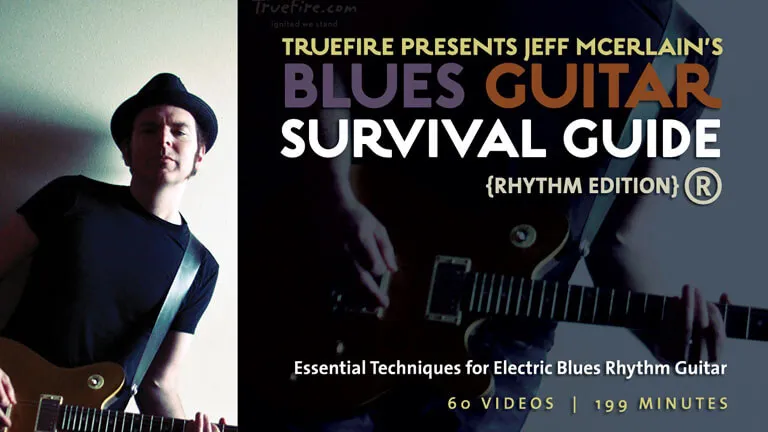
Blues Survival Guide: Rhythm

Essential techniques & insight for blues rhythm guitar

Marty FriedmanTommy EmmanuelSteve VaiEric GalesEric Johnson

Get this course and 1,000+ more with All Access

Try 14 days free. Cancel any time.

Purchase Individual Course for $24.99
Blues Survival Guide: Rhythm

About this course

If you’re a wilderness hiker, knowing how to make fire without matches is an essential survival skill. The 9 most popular methods include flints, rocks, magnifying glasses and rubbing sticks together. Our favorite method? Rub a chocolate bar on the bottom of a soda can to polish it into a sun-reflecting parabolic mirror. Respectively, if you’re a blues guitar player, knowing how to play solid rhythm guitar is likewise an essential survival skill especially on the bandstand at jams. Our favorite method? Eat a chocolate bar, drink a can of highly-caffeinated soda and then camp out in the shed for a fortnight with Jeff McErlain’s Blues Survival Guide: Rhythm Guitar.

If you had a dollar every time some poor soul is up on the local blues jam bandstand looking like a deer caught in the headlights because someone called for a 12/8 or a gospel or a jazz blues or even a little twist on a classic shuffle and they don’t have a clue what to do -- you’d be reading this on your yacht in Tahiti. Yet, there’s always that one cat who knows what to play and when to play it whatever is called out. Also note that that’s the player that everyone seems to want up on bandstand with them.

Jeff has invested the time on the front-end of this rhythm guitar edition of Blues Survival Guide: Rhythm to ensure that you have ample guidance to get up to speed on all of the essential blues rhythm guitar concepts and feels needed to ‘survive’ any situation on stage. All you have to do is invest the time on the back-end to work through the material and shed it until it permeates your DNA. Everything you really need to know is demonstrated and explained here in Blues Survival Guide: Rhythm Guitar.

In the first half of the course, Jeff presents 23 essential concepts and key insights that every blues rhythm guitarists absolutely must know: The Basic Blues Form, Alternate Blues Forms, Blues Feels, Call And Response, Blues Chord Voicings, Dominant Chords, Tritones, 6ths, Addressing The 3rd, Fills, Double-Stops, Picking, Turnarounds, Dynamics, The Four T's, Rig Setup, The Masters, Accenting Downbeats, Accenting Upbeats, Combining Accents, The Bo Diddley Beat, Stop-Time Blues and the Boogie Woogie Pattern.

In the second half of the course, Jeff has prepared 22 rhythm guitar studies -- two for each of the following feels: Boogie-Woogie Blues, Minor Blues, Rhumba Blues, Shuffle Blues, Riff-Based Blues, Gospel Blues, Straight Rock Blues, Jump Blues, 12/8 Blues, Jazz Blues and the Classic Shuffle. Add these feels and grooves to your blues bag and it won’t be you caught in those headlights ever again.

Jeff first presents an overview for each set of two rhythm studies and then performs them entirely for you to follow along with. All of the rhythm studies are performed over a rhythm track for context and each of those rhythm tracks are also provided for you to practice with on your own. Everything is tabbed and notated for you as well and Guitar Pro files are included as well.

Keep that chocolate bar and soda can skill up your sleeve should you ever get caught in the cold out in the woods. In the meantime, dig deep into the Blues Survival Guide: Rhythm Guitar.

Jeff McErlain's Preferred Gear

Below is a list of Jeff McErlain's preferred gear including guitars, amps, pedals, accessories, and more. What you see in Jeff's lessons may or may not be this actual gear, but if you are trying to capture Jeff's sound and tone, the gear listed below is recommended by Jeff and it's a great place to start!

Guitars

Amps

Pedals

Accessories & More

What you'll learn

  • Create fills using both minor pentatonic and Mixolydian scales
  • Play a blues progression with a bridge structure
  • Use flat third to natural third movement for blues flavor
  • Experience a performance demonstration of rhumba blues style
  • Observe the integration of rhumba rhythm with blues progression
Release date: 05/22/2013 • 3h 18m runtime
Start Course
Sample lessons
Blues Feels
Blues Feels
Concept #3
Addressing The 3rd
Addressing The 3rd
Concept #9
Boogie-Woogie Blues 1
Performance
Riff-Based Blues
Riff-Based Blues
Overview

What's included

60 lessons • 36 charts • 28 Jam Tracks

Blues Guitar Survival Guide: Rhythm
Hello and welcome to the Blues Rhythm Guitar Survival Guide! I am so happy you decided to join me. Being an excellent rhythm guitarist is essential for any player, think about it, most of our time is spent playing rhythm. That fact being true, it's funny that most guitars players don't spend a lot of time honing this skill. I was the same way until I started playing in blues bands and realized that I quickly ran out of things to play, over played, didn't know enough tunes, feels, and grooves. I didn't listen very well and never paid attention to the rhythm section. All common newbie issues. Fortunately I was playing with some pretty patient guys who helped me along the path. This course lays out some of the essential elements, feels, and techniques needed to get you on the way to becoming a great rhythm guitar player. So let's get started!
SECTION 1
In this section I will be covering the essential concepts that I will use in the rhythm studies later. Please refer back to these sections as I not only discuss each element, I provide you with some exercises to help you along the way. Feel free to hop around, they are not in any particular steadfast order.
The Basic Blues Form
Here is the basic 12 bar blues form. I know this is easy, but please don't sell it short. I can't tell you how many times I have encountered people messing up the form on a blues. This is the equivalent of having a rug pulled out from underneath you and on a gig is pretty bad. The band, singer, and soloist are counting on you to hit the right chord at the right time, if you mess it up your chances of getting a call back are slim! I highly recommend practicing with recordings, the enclosed jam tracks, and solo with a metronome. I know this seems easy but I have messed it up myself on gigs and I didn't get called back! You need to internalize the form so you feel it, not think abut it.
Alternate Blues Forms
The minor blues and 8 bar blues forms are hugely important and can really switch up the sound of a set. One of the problems with blues bands and blues jams is that they can devolve into a basic 12 bar shuffle on every tune. That is very difficult to listen to for a whole evening and something BB King, or Stevie Ray would never do. There are many examples of a minor blues such as "The Thrill is Gone", "Chitlin's Con Carne", "All You Lovin" and Zep's "Since I've Been Lovin' You". The classic 8 bar blues is "Key to The Highway" a classic version of this one and my intro to the song and form is on the Derek And The Dominoes record, Layla and Other Assorted Love Songs.
Blues Feels
Variation is what makes for a great night of blues, if everything becomes a mid tempo shuffle I start to loose my mind. A perfect example is on the classic recording BB King Live at The Regal. There are 10 tracks on the recording and they are all great and with different feels. BB knew how to switch it up. Key to the blues is what we call a swing eighth note as you can see in my demonstration it is very difficult to play the blues without them. Some basic feels are the slow 12/8 shuffle such as "Stormy Monday". What does 12/8 mean? It means we have 12 eighth notes per bar. That breaks up into 4 groups of triplets, 1-2-3, 4-5-6, 7-8-9, 10-11-12. Other feels is an up tempo shuffle like "You Upset Me Baby" from Live at the Regal, for us blues rockers Van Halen uses this feel in "Ice Cream Man". Other blues feels is New Orleans 2nd Line, Funk, Country, straight, swing, waltz, etc. I think you get the idea!
Call And Response
The call and response blues form is a classic. Here we are taking the idea that a singer will be singing over the first two bars of each four bar phrase of the blues, we call this the call. The response is on the following two bars, this is the musical answer to the musical question just asked. This is exceptionally common, if we listen to Hendrix's Red House we can clearly see this demonstrated. The key here is to make sure we stay in time and in the phrase length of 2 bars. If we start end too soon or late, or if we come in too early or late the fill will sound wrong or off. This is one of my favorite things to practice.
Blues Chord Voicings
We can never have enough chord voicings in our bag. Here I will show you the basic dom7 voicings to altered chords. Does A7b9 b13 make your head spin when you see it? Have no fear, it's easy! A Dominant 7 chord is made up of a root, 3rd, 5th and b7 of a scale the tensions are just the notes in between those pitches. For example G7 is G,B,D,F, and comes from a C major scale. Therefore the notes in between our chord tones are A,C, and E or 2nd, 4th, and 6th degrees of the scale. If we want to add them into out chord we bring them up an octave and they become 9,11, and 13. We call these NATURAL tensions because they occur naturally in the key. An altered tension is when those same notes are changed (altered) to become b9,#9, b5, and b13. It is essential that we keep the 3rd and b7 of the dominant 7 chord, this is the tritone that I will explain in detail in the next segment!

+ 53 more lessons

Start Course

Reviews

44 results

MikeShafer

Verified buyer

05/20/26

Jeff McErlain Teaches the Real World of PLaying

I've been a fan of Jeff's courses for about four years now and find he understands how to demonstrate and teach "playing in the real world". That is developing skills that both allow one to progress in the genre, whether blues or rock, and to have the chops to jam with other musicians.

ToddWMcK

Verified buyer

01/25/26

Very instructive. I wish there was closed caption, but the instructor is good

Johnsguitar

Verified buyer

09/19/25

Another great course.

Just getting started with this but it already is opening up new ideas to explore

pmorey

Verified buyer

12/17/22

Jeff gives plenty of clear direction. His lessons are packed full of good information.

Quark77

Verified buyer

09/29/22

Great Blues toolbox

Jeff McErlain is one of my favorite teachers here. In this survival guide he presents the basic tool box for playing Blues in a simple and digestible way. I like his to the point explanations and his clear voice. While well accessible to novice players, he also offers lots of interesting details for more advanced players.

Stop searching. Start improving with All Access.

Try 14 days free. Cancel any time.