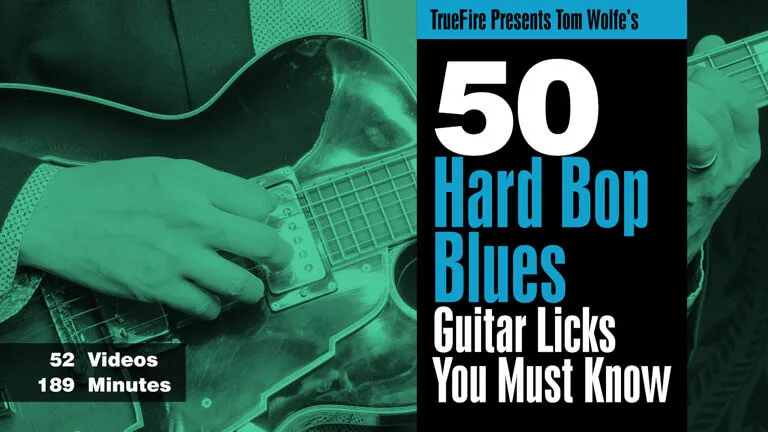
50 Hard Bop Blues Licks You MUST Know

50 essential hard bop jazzy blues lines you must know

Marty FriedmanTommy EmmanuelSteve VaiEric GalesEric Johnson

Get this course and 1,000+ more with All Access

Try 14 days free. Cancel any time.

Purchase Individual Course for $14.99
50 Hard Bop Blues Licks You MUST Know

About this course

Besides being phenom guitar players in their respective styles, what do Barney Kessel, Joe Pass, George Benson, Kenny Burrell, Grant Green, Jimi Hendrix, Steve Howe, Pat Martino, Pat Metheny, Lee Ritenour, Larry Coryell, Stevie Ray Vaughan, Eric Johnson, Joe Satriani, and Steve Lukather all have in common? They all credit Wes Montgomery as one of their biggest influences. Truth is that EVERYBODY, regardless of their preferred style, has been influenced by Wes in one significant way or another. Tom Wolfe takes you directly to the source of this inspiration with this collection of 50 Hard Bop Blues Licks You MUST Know.

Wes Montgomery is most widely known for the music he made during the 60‘s and for his signature approach for improvisations, which usually began with single note passages, then an octave solo section, finally culminating with a highly-charged chordal solo. Wes’ seminal approach changed the landscape for ALL guitarists for ALL time. In this collection, Tom presents an extremely versatile vocabulary that not only celebrates Wes’ contributions but also captures the stylings of the blues and jazz guitarists that he influenced.

Not only will Tom expand your vocabulary, he will also reveal all of the underlying harmonic approaches and techniques being applied: Major and minor blues scales, pentatonic applications, applications for both the flatted and major 3rd, triplet ornamentations, articulation, use of ghost notes, alternate fingerings, encapsulation, bending, chromatic passing tones,? ii-V lines, 6th intervals, octaves (of course!), hemiola (the 3 against 4 feeling in a 4/4 time signature), tension and resolution, color tones, pedal points, side-stepping, diminished voicings, rhythmic intensity, syncopation, chordal soloing techniques and so much more.

All of the licks are presented over a rhythm track so that you can hear and practice them in a musical context. Each performance is then followed by a detailed breakdown of the line along with the techniques and harmonic approach being employed to perform it. Everything is tabbed and notated, plus you get all of the rhythm tracks to practice the lines with by yourself.

Grab your guitar and buckle up for this guided whirlwind tour back to the source of Hard Bop Blues!

What you'll learn

  • Execute descending major 7 arpeggios
  • Play a complex bebop-influenced blues lick with strong directional movement
  • Create tension and intensity in a solo using sustained notes
  • Apply encapsulation technique to delay resolution
  • Apply pedal point concept to the first four bars of a blues
Release date: 09/25/2013 • 3h 09m runtime
Start Course
Sample lessons
Straight Ahead Blues
Lick 19
Extended Encapsulation
Lick 24
A Notey Lick
A Notey Lick
Lick 27
Octaves ala Wes
Octaves ala Wes
Lick 28

What's included

52 lessons • 50 charts • 50 Jam Tracks

50 Hard Bop Blues Licks
Beginning with The Incredible Jazz Guitar of Wes Montgomery in 1959 to his early passing in 1968, Wes Montgomery made an incredible contribution to jazz performance on the guitar. He is most widely known for his fabulous improvisations beginning with a single note passage, then moving to the octave solo section and culminating with an improvised chordal solo. This approach to jazz guitar performance changed the horizon from that point on for all guitarists. This series is dedicated to exploring bebop blues licks in the stylings of Wes Montgomery. Come join and take a look as we explore some of the basic components of the incredible jazz guitar of Wes Montgomery.
Major 3rd Blues
Generally most guitarists learn the blues scale or minor pentatonic scale early as they progress in their practice. It is an important component in the vocabulary of the improvising guitarist. But overlooked in those scales is the major 3rd of the chord. A very important and useful tone in melodic development. This lick is a very simple way to stress the tone melodically in the first four bars of a blues chorus and still have a very bluesy and swinging sound.
Rhythmic Major 3rd Blues
In this second phrase, we will continue with the major 3rd lick. As you learned in the first phrase, the major 3rd lick emphasizes four basic tones - the root, third, fourth and the fifth of the scale. It is important to choose tones that fit the harmonic structure to give good melodic balance. Another component of interest in improvisation is rhythmic development. So we will take the major 3rd lick and vary it rhythmically to demonstrate a way to develop an extended blues improvisation.
Ornamentation Blues Lick
Not only are melody and rhythm important in the development of a good blues improvisation, but in jazz blues, the use of ornamentations is an integral part of the vocabulary. This lick emphasizes a triplet ornamentation using the basic flatted 3rd blues scale in B-flat.
Quarter-Note Blues
Wes Montgomery would play any number of phrases and develop melodies from the beginning of the solo to the end, giving the listener a cohesive and provoking melodic improvisation. While his solos were built in the bebop tradition, he remained very true to the blues vocabulary. Many notes or few, he could speak melodically with passion. This lick is a very simple, yet swinging blues phrase in the style of Wes Montgomery.
Blue Six
This lick combines both the major 3rd and the blue 3rd demonstrating the interchangeability of the two tones in the blues solo. The 3rd when played below the root is a 6th below and gives a rich interval, that is punchy in a melody. It is ornamented with two higher tones (the 4th and 5th) and then answered with a blues ornamentation that we explored in a previous lick (#3).
Blue Seven
The flatted-3rd of the blues is a very commonly used tone in the blues and is one of the primary tones of the scale. But other tones are also very useful in a bebop-style jazz blues. The flatted-7th is very useful and while not as bluesy sounding as the flatted-3rd, it offers a very melodic and different quality to a solo. Using the triplet ornamentation, this lick emphasizes the flatted-7th and then resolves to the root of the blues.

+ 45 more lessons

Start Course

Reviews

26 results

morningfield

Verified buyer

05/15/25

Thanks
paulhinex

Verified buyer

04/12/25

Fun licks

newzappa

Verified buyer

02/28/25

Excellent taste in licks

Very well presented with a great selection of useful licks.

Addahia

Verified buyer

01/12/25

Develop your jazz!

Very cool teacher, and some really enjoyable licks. If you want to train your self into bebop, this is a grate course to do so, before moveing on to Sheryl Baily's "50 be bop licks you must know". This ones are more accesible and easier to learn and practice over the backing track. I would say that 30 licks would have been enough. After a point, some licks become very similar to the ear. I would recommend doing Fareed Haque´s "30 begginer jazz licks" before this one if you need to lay the foundations on the typical jazz swing. This progresion of courses was life changing for my self.

dbeckstead12

Verified buyer

12/21/24

Great variety of licks in a genre that can be difficult to navigate for the novice and intermediate level jazz player.

Stop searching. Start improving with All Access.

Try 14 days free. Cancel any time.