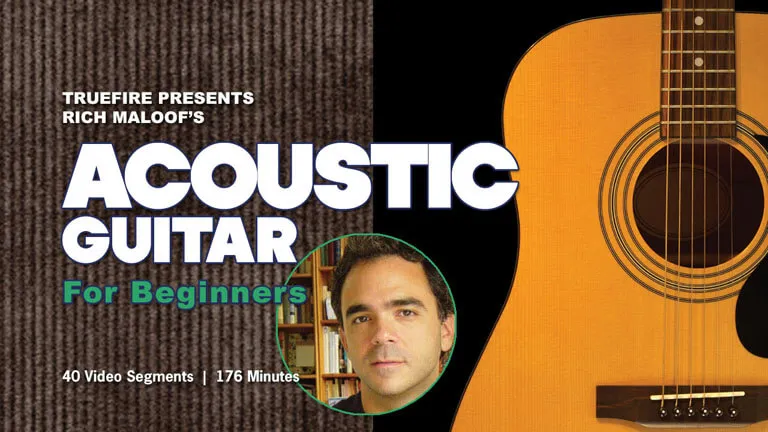

Acoustic Guitar For Beginners

Fast-track course for getting up and strumming on acoustic

Marty FriedmanTommy EmmanuelSteve VaiEric GalesEric Johnson

Get this course and 1,000+ more with All Access

Try 14 days free. Cancel any time.

Purchase Individual Course for $5.00
Acoustic Guitar For Beginners

About this course

If you've always wanted to learn how to play acoustic guitar - or even started once or twice in the past only to put it down in frustration - this series of beginner acoustic guitar lessons is likely the perfect approach for you. Acoustic Guitar for Beginners is a jump-start method designed to get you up and strumming quickly without having to work through tedious theory, scales and exercises. In fact, you'll be strumming chords and playing a few songs in your very first week of working with the course.

Acoustic Guitar for Beginners is tailored specifically for adults who don't have the time or desire for formal training. To get you on the fast track, we've deliberately steered clear of music theory, reading notation, exercises and scales (there's plenty of time for all that good stuff later). Instead, you'll dig in immediately learning how to play chords, strums and how to work with songbooks and lyric sheets.

What you'll learn

  • Navigate descending bass lines by targeting key chords and playing bass notes in between
  • Play one chord per measure (4 beats)
  • Use context clues from recordings to simplify chart interpretations
  • Substitute simpler chords for complex ones (9→7, maj7→major)
  • Maintain steady rhythm even when skipping difficult chords
Release date: 03/10/2008 • 2h 56m runtime
Start Course
Sample lessons
Parts of the Guitar
Parts of the Guitar
Holding the Guitar
Holding the Guitar
Tuning the Guitar
Tuning the Guitar
Strums - Beats
Strums - Beats

What's included

40 lessons • 11 charts • 3 Jam Tracks

Acoustic Guitar for Beginners
Welcome to Acoustic Guitar For Beginners! Time to dust off your guitar and start strumming. You won't be bogged down in this course by tedious exercises or music theory. Instead, we get straight to the mechanics of chords and strums so that you can pick up a piece of sheet music (or find some online) and start playing songs that you know and love. As you click from lesson to lesson, check out the other elements in the video player. The Jam tracks, Text, and PDF's all support the lessons taught on video.
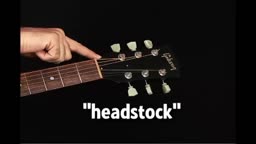
Parts of the Guitar
Just like you can be a better driver when you know how a car's gas pedal, clutch and brake work, a cursory understanding of the guitar's functional parts will help you make your way around the instrument. It also provides a vocabulary for the upcoming lessons as we discuss string numbers and fret positions.
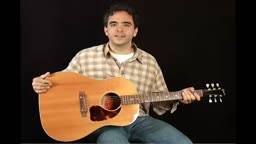
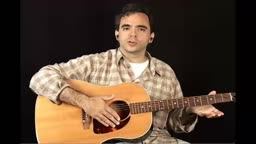
Holding the Guitar
If you start out holding the guitar comfortably, the only pain you should ever experience is on your left-hand fingertips - and even that will go away after the first few days of practicing. Mind these tips on posture to play in comfort. You'll also want to make sure your guitar is in good working condition. Even the finest guitars go out of whack. Since wood is an organic material, it's vulnerable to changes in temperature and humidity. Any guitar that is new or has been sitting around unused for a long time will benefit from a quick tune-up and restringing at your local music store.
Tuning the Guitar
An electronic guitar tuner is a sound investment in your playing and in your sanity. You'll develop a good ear in time, so that you can tell when you're in or out of tune, but for a few bucks you can take out all the guess work. Also get yourself some thin picks (flat picks), and a strap if you want to play standing up. You'll also want a metronome or some other way of keeping time. The Jam tracks in our player will be helpful for that, and if you don't want to drop a dime on an actual metronome, search for one online (there's a good one at Metronomeonline.com). The numbers you see on a metronome represent pace or "tempo," which is measured in beats per minute, often abbreviated BPM.
Strums - Beats
Rhythm is the beating heart of music, and playing a steady rhythm is what keeps your music alive. To start playing strums in good rhythm, get in the habit of tapping along to a beat when you're listening to music. (If it's tricky to find the beat, concentrate first on what the drummer is playing.) But instead of tapping on your desk or slapping your leg, pick up your guitar and strum the strings. Lay back casually into the feel of the rhythm you hear and let your elbow swing like a pendulum as you strum. Don't worry about the left hand for now - just lay it across the fretboard to mute the strings.
Measures
Like the majority of rhythmic feels in popular music, the rhythms in this course break down neatly into blocks of four beats each. You could even count along instead of strumming or tapping: 1 2 3 4, 1 2 3 4, 1 2 3 4. Each four-beat block is referred to as a "measure" or "bar" of music. When four evenly spaced beats fill up a measure, each beat is a quarter note. So if you strum down on each number ( 1 2 3 4 ) you're strumming quarter notes. If your arm is swinging steadily and you catch all the strums on the way back up as well (1 and 2 and 3 and 4 and), each beat is an 8th note.
Strumming Chords Pt.2
Once your strumming hand is in motion, you're ready to start playing chords. So first we want to establish some terms so we can talk about how chords are fingered: - From lowest to highest, we're referring to the strings as 6, 5, 4, 3, 2 and 1. - Chords are played in the frets, which are actually the fret spaces between the lead fretwire. Now just place your fingers in the crosshairs of a string and a fret, and you'll be playing notes that make up chords. You want each note of a chord to ring cleanly whether the note is fretted (pressing down on a fret) or open (no fingers on the string).

+ 33 more lessons

Start Course

Reviews

2 results

jimculver

Verified buyer

01/07/19

Very easy to follow.

Huss S.

Verified buyer

11/15/17

Rich Maloof's Acoustic Guitar For Beginners - Fast-track course for getting up and strumming on acoustic. Rich and his jump-start method ensure you are playing the guitar quickly and easily. This ensures you get the positive reinforcement of hearing yourself playing music on the guitar. Forget scales, theory and boredom just fun all the way through this course. It's so much fun you won't even realise how much you are learning and improving. Don't worry if you haven't got the time to spend hours every day practicing or the patience to wait years for results, this is the course for you.

Stop searching. Start improving with All Access.

Try 14 days free. Cancel any time.