Musicarium Songbook

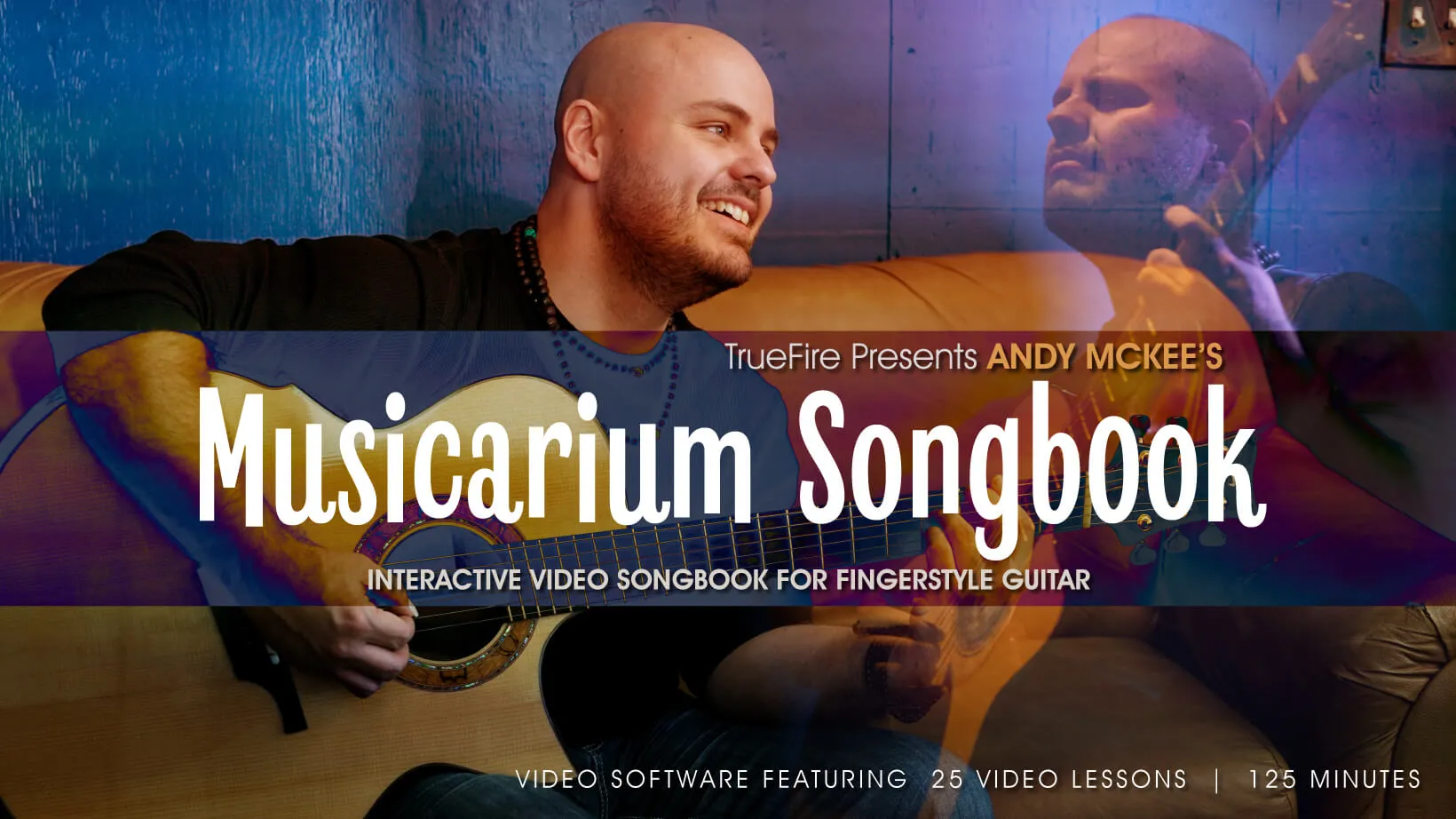
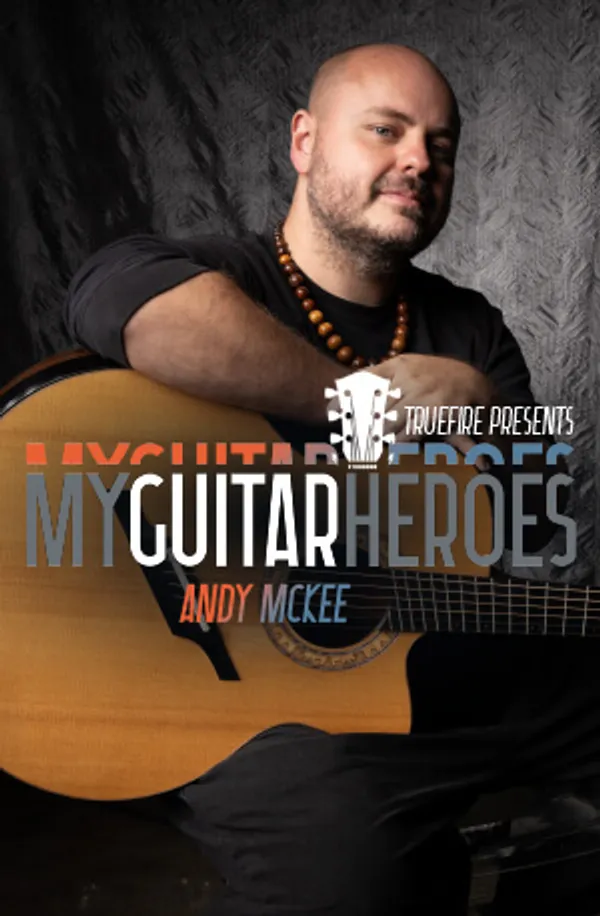
Learn how to play Andy McKee songs from the fingerstyle master himself

Marty FriedmanTommy EmmanuelSteve VaiEric GalesEric Johnson

Get this course and 1,000+ more with All Access

Try 14 days free. Cancel any time.

Purchase Individual Course for $24.99
Musicarium Songbook

About this course

It's very rare for a young musician to achieve worldwide recognition and earn mega respect from both peers and fans early in their career. Andy McKee has accomplished just that by pushing the boundaries of what is possible on acoustic guitar, and he's done so with explosive impact.

Fortunately for students of guitar, Andy is also a gifted and passionate educator, which is clearly, if not mind-blowingly apparent here in his first TrueFire course, Musicarium Songbook. We're very proud and excited to welcome Andy to the TrueFire family!

"I'll take you through five of my original tunes that best exemplify my playing style. These five songs are not only fan favorites, but they're also the tunes that other guitarists always ask about, and they've all been very popular online. We'll start with Drifting, and then I'll show you how to play Ebon Coast, Heather's Song, For My Father, and Rylynn."

Andy will perform all 5 of the tunes in their entirety, and then break them down note-by-note, section-by-section. Andy will drill down on all of the right- and left-hand techniques, as well as the percussive techniques used in each tune.

All of the performances are tabbed and notated for your practice, reference and study purposes. Andy includes a legend for some of the non-traditional techniques used in the course. You'll also get Guitar Pro files so that you can play, loop and slow down the tab and notation as you work through the lessons.

Grab your guitar and let's enter the Musicarium with Andy McKee!


Free Bonus Download: "Africa" Performance Video & Tab

FREE BONUS! Andy was kind enough to perform Toto's "Africa" for us while we were filming his course. The fingerstyle acoustic cover blew us away of course and we thought you might like to have a peek at that video as well. We even tabbed it for you!

It's yours to download for free here!

What you'll learn

  • Master complex fingerstyle arrangement
  • Master complex fingerstyle techniques
  • Learn complex fingerpicking patterns
  • Understand partial capo techniques
  • Learn advanced melodic construction
Release date: 06/08/2017 • 3h 03m runtime
Start Course
Sample lessons
Drifting
Drifting
Overview
Drifting
Drifting
Performance
Drifting
Drifting
Breakdown: Intro
Drifting
Drifting
Breakdown: Verse

What's included

38 lessons • 5 charts

Musicarium Songbook
Hi, I'm Andy McKee, and welcome to the Musicarium Songbook. In this course, I'll take you through five of my original tunes that best exemplify my playing style. These five tunes are fan favorites that other guitarists always ask about, and that have proven themselves as popular online. We'll be starting out with "Drifting", and then I'll take you through "Ebon Coast", "Heather's Song", and "For My Father", then finally running through "Rylynn".

First I'll perform each of the tunes in their entirety, then break down each part note-by-note, section-by-section. We'll also drill down on all the right hand and left hand techniques, as well as the percussive techniques used in each tune. Tab and notation are included for each of the tunes, as well as a legend for some of the non-traditional techniques used in the course. So, grab your guitar, and let's dig in!
Gear Talk & Practice Tips
Before getting into the songs, I wanted to run through my guitar and some of the gear I use. My guitar is a Greenfield guitar, built by a private luthier in Montreal. The fretboard on the guitar has fanned frets, which helps with the intonation - a similar concept to a harp or a piano, in which the bass strings are longer than the treble strings. The guitar also has a couple of bevels that allow the guitar to sit more comfortably when being played.

The pickup in the guitar is a K&K Pure Mini, a great amp if doing anything percussive with acoustic guitar. When playing unplugged, I use a ToneWoodAmp. This sends a light vibration through the guitar to amplify it, and even has effects like reverb, delay, and a Leslie effect.

The capos used in these lessons are Shubb Capos, which allow the pressure on the fret to be changed so there's perfect intonation every time.

The strings on the guitar are medium gauge Ernie Ball aluminum bronze strings. The medium gauge strings do a better job than the light strings of holding the tuning, especially when tuning the low strings to something like C or even B.

When practicing these songs, it might be discouraging at first trying to play them and use some of the unusual techniques, but take it slow and it will start to come together. And if you find other ways of playing them, that's fine too. Have fun playing!
Drifting
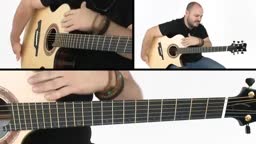
The first tune is "Drifting", inspired by the playing of the guitarist Preston Reed. The song features some unusual percussion, and the left-hand is playing above the guitar neck through most of the tune to play chords as well as facilitate some of the percussive ideas on the upper part of the guitar body.

This piece is in DADGAD (from low to high), so the sixth string goes down to D, second string down to A, and first string down to D. This creates a Dsus4 chord, and is somewhat of a common alternate tuning, used exclusively by guitarists such as Pierre Bensusan.

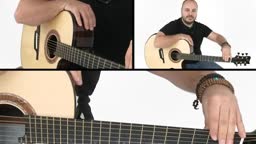
During much of this song, the left hand is above the guitar neck, similar to something Preston Reed would do. This allows you to hammer on chords, similar to how you'd play power chords while in drop D tuning. Place your thumb on the back of the neck and stack your index and middle finger on top of one another to get more strength, and just hammer them. This may look cool, but the main reason to do it is so you can hit the top of the guitar body as well to take advantage of the great clapping noise it makes. The right hand is also doing some percussion and tapping on the bottom of the guitar.
Drifting
The first tune is "Drifting", inspired by the playing of the guitarist Preston Reed. The song features some unusual percussion, and the left-hand is playing above the guitar neck through most of the tune to play chords as well as facilitate some of the percussive ideas on the upper part of the guitar body.

This piece is in DADGAD (from low to high), so the sixth string goes down to D, second string down to A, and first string down to D. This creates a Dsus4 chord, and is somewhat of a common alternate tuning, used exclusively by guitarists such as Pierre Bensusan.

During much of this song, the left hand is above the guitar neck, similar to something Preston Reed would do. This allows you to hammer on chords, similar to how you'd play power chords while in drop D tuning. Place your thumb on the back of the neck and stack your index and middle finger on top of one another to get more strength, and just hammer them. This may look cool, but the main reason to do it is so you can hit the top of the guitar body as well to take advantage of the great clapping noise it makes. The right hand is also doing some percussion and tapping on the bottom of the guitar.
Drifting
The first tune is "Drifting", inspired by the playing of the guitarist Preston Reed. The song features some unusual percussion, and the left-hand is playing above the guitar neck through most of the tune to play chords as well as facilitate some of the percussive ideas on the upper part of the guitar body.

This piece is in DADGAD (from low to high), so the sixth string goes down to D, second string down to A, and first string down to D. This creates a Dsus4 chord, and is somewhat of a common alternate tuning, used exclusively by guitarists such as Pierre Bensusan.

During much of this song, the left hand is above the guitar neck, similar to something Preston Reed would do. This allows you to hammer on chords, similar to how you'd play power chords while in drop D tuning. Place your thumb on the back of the neck and stack your index and middle finger on top of one another to get more strength, and just hammer them. This may look cool, but the main reason to do it is so you can hit the top of the guitar body as well to take advantage of the great clapping noise it makes. The right hand is also doing some percussion and tapping on the bottom of the guitar.
Drifting
The first tune is "Drifting", inspired by the playing of the guitarist Preston Reed. The song features some unusual percussion, and the left-hand is playing above the guitar neck through most of the tune to play chords as well as facilitate some of the percussive ideas on the upper part of the guitar body.

This piece is in DADGAD (from low to high), so the sixth string goes down to D, second string down to A, and first string down to D. This creates a Dsus4 chord, and is somewhat of a common alternate tuning, used exclusively by guitarists such as Pierre Bensusan.

During much of this song, the left hand is above the guitar neck, similar to something Preston Reed would do. This allows you to hammer on chords, similar to how you'd play power chords while in drop D tuning. Place your thumb on the back of the neck and stack your index and middle finger on top of one another to get more strength, and just hammer them. This may look cool, but the main reason to do it is so you can hit the top of the guitar body as well to take advantage of the great clapping noise it makes. The right hand is also doing some percussion and tapping on the bottom of the guitar.
Drifting
The first tune is "Drifting", inspired by the playing of the guitarist Preston Reed. The song features some unusual percussion, and the left-hand is playing above the guitar neck through most of the tune to play chords as well as facilitate some of the percussive ideas on the upper part of the guitar body.

This piece is in DADGAD (from low to high), so the sixth string goes down to D, second string down to A, and first string down to D. This creates a Dsus4 chord, and is somewhat of a common alternate tuning, used exclusively by guitarists such as Pierre Bensusan.

During much of this song, the left hand is above the guitar neck, similar to something Preston Reed would do. This allows you to hammer on chords, similar to how you'd play power chords while in drop D tuning. Place your thumb on the back of the neck and stack your index and middle finger on top of one another to get more strength, and just hammer them. This may look cool, but the main reason to do it is so you can hit the top of the guitar body as well to take advantage of the great clapping noise it makes. The right hand is also doing some percussion and tapping on the bottom of the guitar.

+ 31 more lessons

Start Course

Reviews

16 results

ErreBi60

Verified buyer

07/28/25

Andy eccezionale maestro

Molto professionale e spiegazioni comprensive. Ottimo
Bok13

Verified buyer

03/18/25

Musicarium Songbook

Engaging with these tutorials and resources can significantly enhance our fingerstyle guitar skills, providing both technical guidance and inspiration from one of the genre's masters. I had fun!

ermacon

Verified buyer

01/29/25

great

The best teaching video I have seen so far

bivio

Verified buyer

06/10/22

Very good teacher. He teaches you to a little bit complex fingerpicking. But he helps you to learn the tunes. Great player. His songs are beautiful. Happy to have bought this video. I will look for other fingerpicking lesson and author. Bye

michaelstpierre

Verified buyer

01/03/21

Great fun to learn Andy's tunes

Good mixture of different guitar tunings and degrees of difficulty. Often, it is some of his comments or little tricks he shows that have enhanced my understanding and honed my skills. Definitely worth the money

Stop searching. Start improving with All Access.

Try 14 days free. Cancel any time.