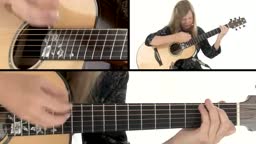
Here I'll explain what harmonics are and demonstrate some of the many different ways you can do them. Once you get the whole concept of harmonics, you can come up with your own techniques. I've come up with a couple of different variations on technique just to get a sound that I was looking for. My "Silent Night" arrangement uses 19 different harmonic techniques between the different strings to pluck and the different notes to do as harmonics.
First, I'll explain a little bit of the physics of harmonics to help you understand the basic concept. Then, I'll cover several kinds of techniques for harmonics:
- Natural harmonics: the harmonics you get from touching the halfway point as well as the 1/3, 1/4, and other fractions of an open string, the "node" while plucking the string.
- Artificial harmonics: fretting notes to change the pitch while playing harmonics at the halfway point (or other fraction) of the active string length
- Harp harmonics (as learned from Chet Atkins/Lenny Breau): alternating harmonics and regular notes. You may hear Tommy Emmanuel doing lots of these. I also created a variation on this in which one harmonic alternates with two regular notes to get an arpeggiated sound. See my youtube video and instructional on "View From Space".
- Palm harmonics: touching the node with the side of palm while sweeping downward with the back of the index finger (all with right hand) to get a sweeping chord. If a chord is fretted with the left hand, the right hand follows the shape of the chord 12 frets higher (an original technique some have called "Muriel harmonics").
- Backward raked harmonics: the opposite direction of the palm harmonics, touching the node with the index finger and sweeping with the ring finger of the right hand.
I also show you many ways you can finger and pluck harmonics and the advantages of each - there are a lot of ways to be efficient and creative to get an effect you want in your music.
Be patient - it may be awkward at first to get these techniques, but it's kind of like riding a bike: once you've got it, you've got it and it's not as hard as it seems at first.
Remember, you can do these techniques on any kind of guitar, the physics are the same.