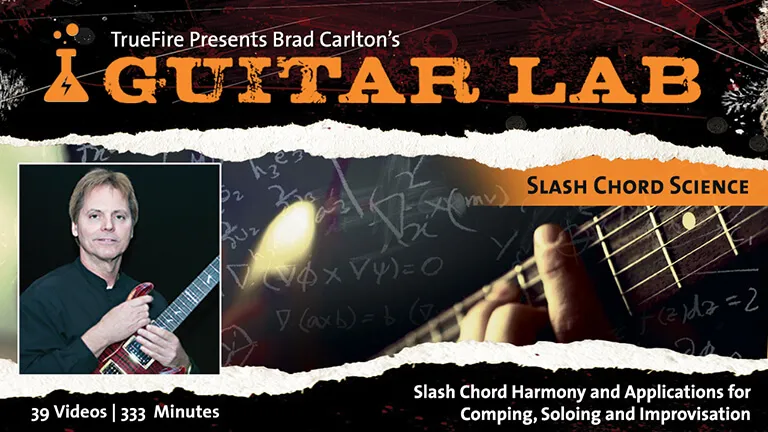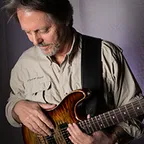
Guitar Lab: Slash Chord Science

Slash Chord Harmony and Applications for Comping, Soloing and Improvisation

Marty FriedmanTommy EmmanuelSteve VaiEric GalesEric Johnson

Get this course and 1,000+ more with All Access

Try 14 days free. Cancel any time.
Purchase Individual Course for $5.00
Guitar Lab: Slash Chord Science

About this course

Slash chords are an effective way of notating inversions of triads, extended harmonies, and tension oriented sonorities. The concept of a triad over a bass note serves not only in the solo guitar realm, but also in an ensemble situation in which the bass note is played by the bass player thus freeing up the guitarist both technically and texturally to use major or minor triads in various inversions as a springboard for melodic fills. Another added benefit of viewing harmony via slash chords is the ease of determining what scale or scales apply for comping and soloing.

This Brad Carlton course will develop your skills in the following areas: visualizing major and minor arpeggios and chord voicings over the entire fingerboard, understanding street key versus theoretical key analysis, chromatic bassline options under major and minor chords, and common slash chord formulas applied to bichordal progressions.

You will be challenged from a technical standpoint by looking at all of your fingering options when playing these slash chords. These options include: one finger per note fingerings, double stop fingerings with one finger, crossbarres, pivot and guide fingers, and barres of various sizes.

Slash Chord Soloing will present 13 bi-chordal vamps that are common building blocks for compositions across all styles. Each progression will be analyzed according to both the street key and the theoretical key. In some cases, more than one theoretical key will be an option. By understanding these vamps using the number system, you will be able to play them in any key and also recognize them by ear.

Diagrams will be provided for each lesson which will be color-coded using red scale degrees for the chord tones (arpeggios) and black scale degrees for the remaining notes available in the applicable scales/modes. You will learn how to enhance your rhythm playing in a pianistic style by using the theory as it applies to each chord. This same theory will be used for soloing over these progressions. I will demonstrate both horizontal and vertical approaches based on stylistic considerations.

You will receive two jam tracks for each lesson, one consisting of just bass and drums which you will use for your rhythm playing, and one with bass, drums, and guitar for practicing your soloing.

Slash Chord Workouts will focus on the seven diatonic triads in the key of C and the slash chords produced when these triads are played over any of the seven notes in the key of C. You will learn to visualize the arpeggios for these seven diatonic triads through a one note per string format for all three inversions. Various examples of bi-chordal progressions will be demonstrated with specific emphasis on moving voices and chord embellishments. You will learn how to play the slash chords with the bass lines thus enabling you to approach the guitar and piano style. This will present technical challenges that will help you understand harmonically the " big picture". Lesson eight will provide jam tracks which include a bass line thus freeing you up to play in more of a band context.

This workout will help your ears, your hands, and your brain.

What you'll learn

  • Execute slash chord voicings across multiple areas of the fretboard
  • Create sus2sus4 sounds by selectively moving chord voices
  • Apply multiple fingering options for the same chord progression
  • Use pedal tone technique with changing upper voices
  • Understand how changing the bass note creates different harmonic colors
Release date: 12/16/2010 • 5h 33m runtime
Start Course
Sample lessons
Major Triads
Major Triads
Minor Triads
Minor Triads
Major Slash Chords
Major Slash Chords
Minor Slash Chords
Minor Slash Chords

What's included

39 lessons • 37 charts • 20 Jam Tracks

Slash Chord Science
Slash chords are an effective way of notating inversions of triads, extended harmonies, and tension oriented sonorities. The concept of a triad over a bass note serves not only in the solo guitar realm, but also in an ensemble situation in which the bass note is played by the bass player thus freeing up the guitarist both technically and texturally to use major or minor triads in various inversions as a springboard for melodic fills. Another added benefit of viewing harmony via slash chords is the ease of determining what scale or scales apply for comping and soloing.

This course will develop your skills in the following areas: visualizing major and minor arpeggios and chord voicings over the entire fingerboard, understanding street key versus theoretical key analysis, chromatic bassline options under major and minor chords, and common slash chord formulas applied to bichordal progressions.

You will be challenged from a technical standpoint by looking at all of your fingering options when playing these slash chords. These options include: one finger per note fingerings, double stop fingerings with one finger, crossbarres, pivot and guide fingers, and barres of various sizes.

Slash Chord Soloing will present 13 bi-chordal vamps that are common building blocks for compositions across all styles. Each progression will be analyzed according to both the street key and the theoretical key. In some cases, more than one theoretical key will be an option. By understanding these vamps using the number system, you will be able to play them in any key and also recognize them by ear.

Diagrams will be provided for each lesson which will be color-coded using red scale degrees for the chord tones (arpeggios) and black scale degrees for the remaining notes available in the applicable scales/modes. You will learn how to enhance your rhythm playing in a pianistic style by using the theory as it applies to each chord. This same theory will be used for soloing over these progressions. I will demonstrate both horizontal and vertical approaches based on stylistic considerations.

You will receive two jam tracks for each lesson, one consisting of just bass and drums which you will use for your rhythm playing, and one with bass, drums, and guitar for practicing your soloing.

Slash Chord Workouts will focus on the seven diatonic triads in the key of C and the slash chords produced when these triads are played over any of the seven notes in the key of C. You will learn to visualize the arpeggios for these seven diatonic triads through a one note per string format for all three inversions. Various examples of bi-chordal progressions will be demonstrated with specific emphasis on moving voices and chord embellishments. You will learn how to play the slash chords with the bass lines thus enabling you to approach the guitar and piano style. This will present technical challenges that will help you understand harmonically the " big picture". Lesson eight will provide jam tracks which include a bass line thus freeing you up to play in more of a band context.

This workout will help your ears, your hands, and your brain.
Major Triads
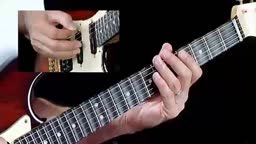
This lesson covers the three diagonal one note per string arpeggios for the major triad. In diagram one these arpeggio forms are clearly notated with alternating red and black chord tone numbers. The lowest form (in terms of pitch) is diagrammed in red and is based on the C form from the CAGED system. By viewing each group of three adjacent strings, all three inversions are available: second inversion on strings six through four, root position on strings five through three, first inversion on strings four through two, and second inversion on strings three through one.

The next one note per string arpeggio is diagrammed in black and is based on the G form from the CAGED system. The inversions are as follows: root position on strings six through four, first inversion on strings five through three, second inversion on strings four through two, and root position on strings three through one.

The final one note per string arpeggio is diagrammed in red and is based on the E form from the CAGED system. The inversions are as follows: first inversion on strings six through four, second inversion on strings five through three, root position on strings four through two, and first inversion on strings three through one.
Minor Triads
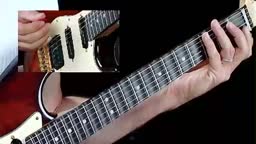
This lesson covers the three diagonal one note per string arpeggios for the minor triad. In diagram two these arpeggio forms are clearly notated with alternating red and black chord tone numbers. The lowest form (in terms of pitch) is diagrammed in red and is based on the Cm form from the EDCAG system. By viewing each group of three adjacent strings, all three inversions are available: second inversion on strings six through four, root position on strings five through three, first inversion on strings four through two, and second inversion on strings three through one.

The next one note per string arpeggio is diagrammed in black and is based on the Gm form from the EDCAG system. The inversions are as follows: root position on strings six through four, first inversion on strings five through three, second inversion on strings four through two, and root position on strings three through one.

The final one note per string arpeggio is diagrammed in red and is based on the Em form from the EDCAG system. The inversions are as follows: first inversion on strings six through four, second inversion on strings five through three, root position on strings four through two, and first inversion on strings three through one.
Major Slash Chords
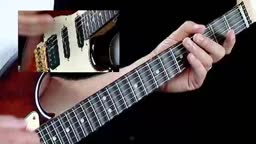
This lesson presents an overview of the concept of a major chord over any bass note derived from the chromatic scale. The chromatic scale is presented in appendix A in terms of scale degrees. This appendix also displays the formulas for 21 commonly used scales/modes in music. This information will be valuable for looking at scale possibilities over different harmonies. Diagrams 3a through 3f show the layouts for playing chromatic basslines underneath a C major triad. In the video, I will demonstrate various fingering options necessary for executing these slash chords. Each of these six diagrams applies this chromatic slash chord approach underneath a different inversion of the C triad.
Minor Slash Chords
This lesson presents an overview of the concept of a minor chord over any bass note derived from the chromatic scale. The chromatic scale is presented in appendix A in terms of scale degrees. This appendix also displays the formulas for 21 commonly used scales/modes in music. This information will be valuable for looking at scale possibilities over different harmonies. Diagrams 4a through 4f show the layouts for playing chromatic basslines underneath a C minor triad. In the video, I will demonstrate various fingering options necessary for executing these slash chords. Each of these six diagrams applies this chromatic slash chord approach underneath a different inversion of the Cm triad.
I ii/I
This lesson presents the following bichordal slash chord progression: I ii/I. The street key for this vamp would be C. B is a chart of the major scales and the diatonic chords are built from those scales. To determine the theoretical key, consult appendix B which is a chart of the major scales and the diatonic chords are built from those scales. If we analyze this progression, the C Dm/C could function as a I ii/I in the key of C as well as a V vi/V in the key of F.

In the video I will demonstrate playing the complete slash chord (triad over the bass note) as well as playing along with the jam track in which the bass note is already being played in the rhythm section. You will see how I use different triad voicings to create a keyboard style of playing.

Diagrams 5a and 5b show these available triads over the entire fingerboard based on the three one note per string arpeggio forms that you learned in lessons one and two.
I IV/I
This lesson presents the following bichordal slash chord progression: I IV/I. The street key for this vamp would be C. To determine the theoretical key, consult appendix B which is a chart of the major scales and the diatonic chords are built from those scales. If we analyze this progression, the C F/C could function as a I IV/I in the key of C as well as a V I/V in the key of F.

In the video I will demonstrate playing the complete slash chord (triad over the bass note) as well as playing along with the jam track in which the bass note is already being played in the rhythm section. You will see how I use different triad voicings to create a keyboard style of playing.

Diagrams 6a and 6b show these available triads over the entire fingerboard based on the three one note per string arpeggio forms that you learned in lessons one and two.

+ 32 more lessons

Start Course

Reviews

1 result

hooty29340

Verified buyer

10/16/20

Effective Course to understand Slash Chords!

Brad leaves no stone unturned in his courses as he explains different focused aspects. Not only are the bass notes that are added, aka 'Slash chords', but the triads are thoroughly covered. He explains how to know what the actual chord is and what scale might be used since bass notes are usually the indicator, but with slash chords it can be deceiving. Develop a good understanding with this effective course.

Stop searching. Start improving with All Access.

Try 14 days free. Cancel any time.