The Blues Shuffle is a cornerstone of blues music, a rhythmic pattern that defines the genre’s signature groove. The shuffle forms the foundation for countless blues songs and improvisations. Mastering the blues shuffle enhances your rhythmic skills and deepens your understanding of blues phrasing and feel. It’s a versatile and timeless pattern that transcends genres, making it an indispensable tool for any serious guitarist.
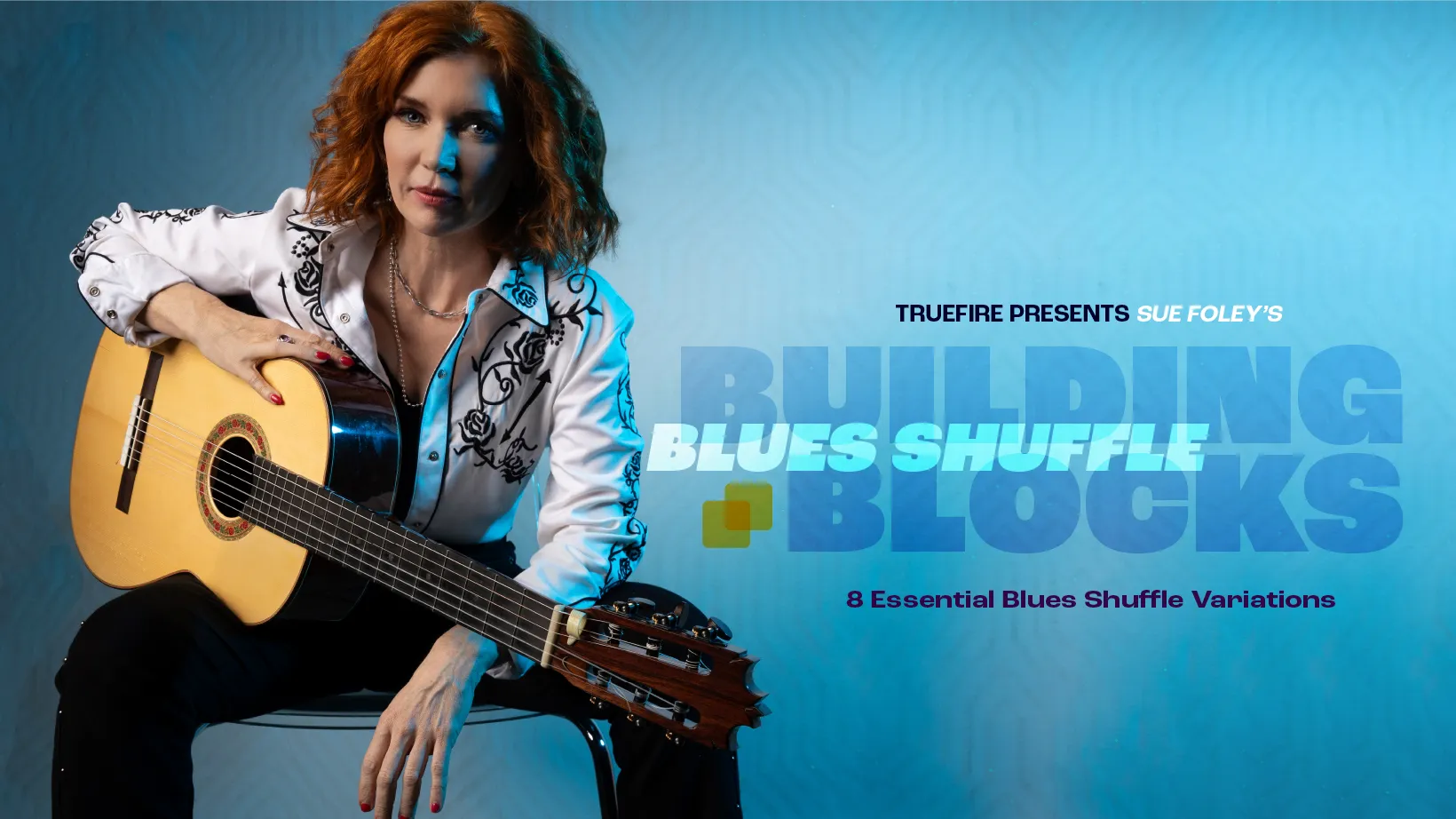
Sue Foley, one of today’s most accomplished blues artists known for her fiery playing and soulful voice, is also widely respected for her deep knowledge of the blues and her expertise as an educator. She brings these strengths to bear in her course, “Blues Shuffle Building Blocks.”
“The blues shuffle is the backbone of countless classic and modern blues songs and is one of the most important rhythms for blues guitar players to learn and master. I’ll break down the technique for you step by step, and then we’ll practice and play it together over backing tracks. You’ll learn essential variations, and I’ll show you how to bring out that soulful, swinging feel at the core of blues shuffles.
I organized Blues Shuffle Building Blocks into eight lesson sets. Each one comes with its own practice session, ensuring you get plenty of hands-on experience.”
Sue’s insights and tips will elevate your understanding and execution of the blues shuffle, empowering you to groove with confidence and style. She will guide you through a comprehensive series of blues shuffle lessons: The Essential Blues Shuffle in E, Walking Bass Basics for a Shuffle, Expanding the Walking Bass, Three Essential Blues Turnarounds, Triplet Patterns for the Shuffle, Shuffle Rhythm Variations, Embellishing the Shuffle, Putting it All Together, and Transposing to Other Keys
Whether you’re a beginner or an experienced player, this course will help you build a solid foundation to enhance your blues rhythm playing.
You’ll have TrueFire’s interactive learning tools at your fingertips to customize your workspace and learn at your own pace.
The demonstrations and performances are tabbed, notated, and synced to the video lessons with controls for looping, slow motion, fretboard animation, and other tools designed to accelerate your progress.
You’ll also get the tab and standard notation files to print out, downloadable Guitar Pro files, and backing tracks to practice and record.
Grab your guitar, and let’s dig in with Sue Foley!
What you'll learn
Use triplets to accentuate chord changes and create tension/release
Play triplet patterns (1-2-3, 1-2-3) over blues progressions
Apply turnarounds in various contexts
Understand the foundational elements of blues shuffle rhythm
Develop the ability to respond appropriately at blues jams
The blues shuffle is the backbone of countless classic and modern blues songs, and it's one of the most important rhythms for blues guitar players to learn and master. I'm going to break down the technique for you step by step, and then we'll practice it and play it together over backing tracks. You'll learn essential variations, and I'll show you how to bring out that signature, soulful swinging feel at the core of blues shuffles. I organized blues shuffle building blocks into eight lesson sets. Each one comes with its own practice session, ensuring you'll get plenty of hands-on experience. You can use True Fire's looping and slow-motion controls to progress at your own pace. Ready to get started? Grab your guitar and let's play!
Hey there! In this lesson, I'm diving into some foundational aspects of blues guitar playing. I love refreshing my own memory on how I learned the blues, how I got that signature bluesy sound. It's crucial to really get into the basics of blues, whether you're a beginner or an advanced player. Going back to these simple approaches can solidify your skills and help you sound more authentic. I'll be sharing my approach, which involves using a thumb pick and an open hand technique, inspired by greats like Muddy Waters. But don't worry, everything I do can also be played with a flat pick. We'll start with a basic blues shuffle in the key of E, emphasizing the importance of rhythm. Rhythm is everything in blues, and I'll show you how to keep your sound even and controlled, especially when working with open strings. We'll practice keeping the ringing strings even and hitting them intentionally, like Jimmy Vaughn. Plus, I'll show you how I use my right hand for semi-muting to control the sound.
Hey there! In this lesson, I'm diving into some foundational aspects of blues guitar playing. I love refreshing my own memory on how I learned the blues, how I got that signature bluesy sound. It's crucial to really get into the basics of blues, whether you're a beginner or an advanced player. Going back to these simple approaches can solidify your skills and help you sound more authentic. I'll be sharing my approach, which involves using a thumb pick and an open hand technique, inspired by greats like Muddy Waters. But don't worry, everything I do can also be played with a flat pick. We'll start with a basic blues shuffle in the key of E, emphasizing the importance of rhythm. Rhythm is everything in blues, and I'll show you how to keep your sound even and controlled, especially when working with open strings. We'll practice keeping the ringing strings even and hitting them intentionally, like Jimmy Vaughn. Plus, I'll show you how I use my right hand for semi-muting to control the sound.
Now that you've got the blues shuffle down, it's time to spice things up a bit by walking the bass line. This is a classic blues move that'll take your shuffle to the next level. I'll show you how to add a simple walk from E to G, G sharp, B, and beyond. It's a great way to make your playing more dynamic and fun. We'll move this walk to the A and B notes too, which really keeps the beat moving and adds some flair to your shuffle. Let's dive in together, practice this walking bass line, and see how it builds on our basic E shuffle.
Now that you've got the blues shuffle down, it's time to spice things up a bit by walking the bass line. This is a classic blues move that'll take your shuffle to the next level. I'll show you how to add a simple walk from E to G, G sharp, B, and beyond. It's a great way to make your playing more dynamic and fun. We'll move this walk to the A and B notes too, which really keeps the beat moving and adds some flair to your shuffle. Let's dive in together, practice this walking bass line, and see how it builds on our basic E shuffle.
To build on our walking bass line, I've got a cool little move for you. We've already covered the basic blues shuffle and a simple walk, but now let's add a bit more to it. We'll walk up and back, and this time we'll hit the seventh note. It's a common move that you'll recognize right away. When turning back from the B chord, you'll notice I don't always do the full walk-up because of time constraints. Instead, you can do a quick change or different variations like a five-four or five-five turnaround. There are so many ways to play these progressions in blues, and we'll dive into more of those soon. Also, I'll show you a handy technique I use with my right hand to slightly mute the strings. It helps control the ringing of open strings and gives a fuller sound. It's light and easy, and it makes a big difference.
To build on our walking bass line, I've got a cool little move for you. We've already covered the basic blues shuffle and a simple walk, but now let's add a bit more to it. We'll walk up and back, and this time we'll hit the seventh note. It's a common move that you'll recognize right away. When turning back from the B chord, you'll notice I don't always do the full walk-up because of time constraints. Instead, you can do a quick change or different variations like a five-four or five-five turnaround. There are so many ways to play these progressions in blues, and we'll dive into more of those soon. Also, I'll show you a handy technique I use with my right hand to slightly mute the strings. It helps control the ringing of open strings and gives a fuller sound. It's light and easy, and it makes a big difference.
The building-block way Sue Foley put this course together made working my way through the simple twelve-bar blues and into more complicated, interesting shuffles both educational and fun. I really enjoy her style and her music. I highly recommend this course!
1
1jimmy4u
Verified buyer
06/15/26
Thanks Sue
Being that my initial learning path left sink holes and minor corrections, I enjoyed Sue breaking it down in a way that helped me reinforce, improve and/or correct in a fast and useful way for playing live in a band/jam setting or by myself. There’s only thank you for your attention to detail etc,.
S
Sue B.
03/26/26
Brilliant Blues Course
I got so much from this course. Great coourse, great teacher.
M
markernestknight
Verified buyer
03/17/26
Sue Foley blues
First class…. . well structured, thoughtful and great fun.
Thank you Sue
P
Pumpingnylon
Verified buyer
12/18/25
She makes it fun and also gives me material for a repitoire.