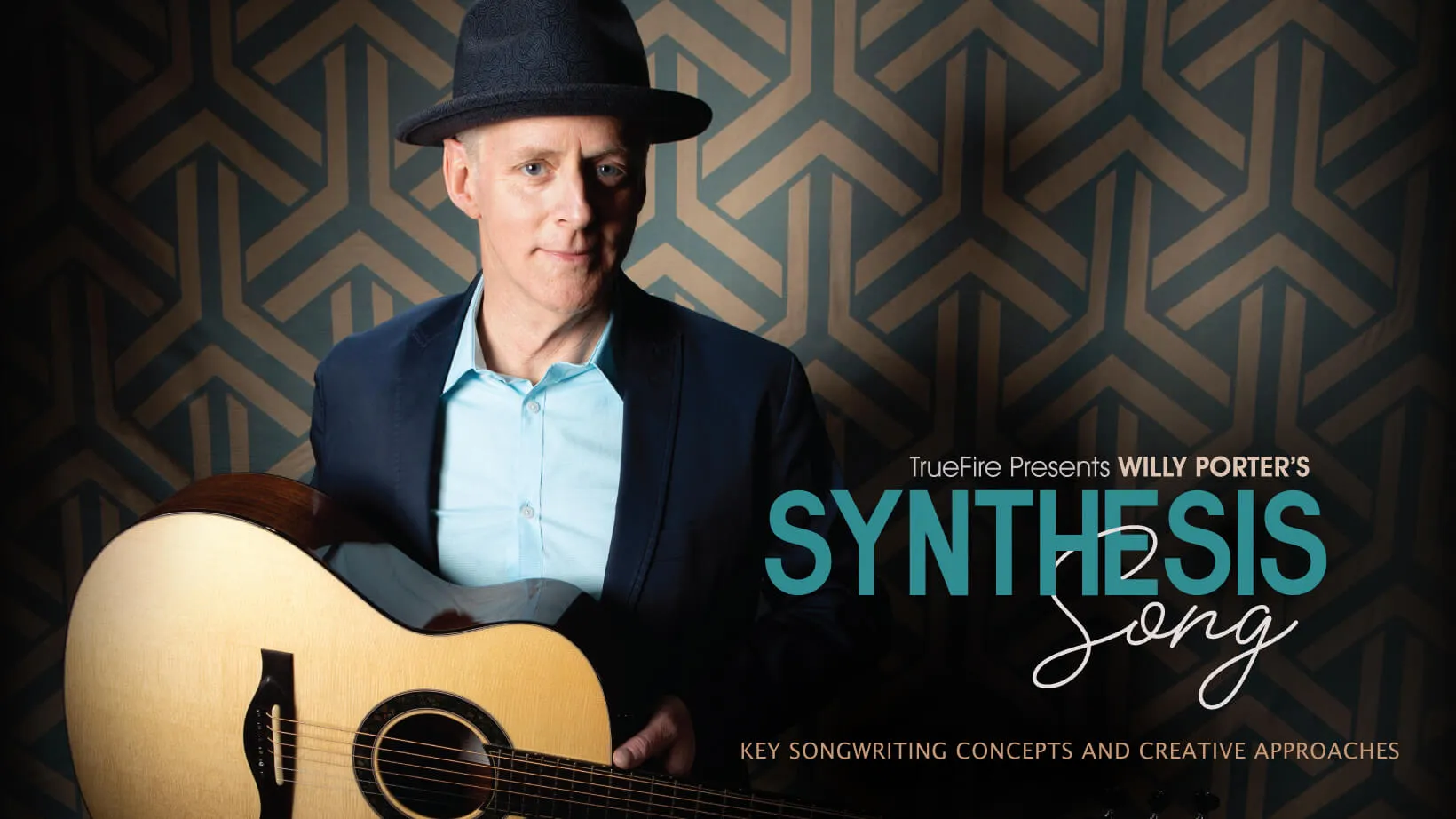
Song Synthesis

Key Songwriting Concepts and Creative Approaches for Guitar Players

Marty FriedmanTommy EmmanuelSteve VaiEric GalesEric Johnson

Get this course and 1,000+ more with All Access

Try 14 days free. Cancel any time.

Purchase Individual Course for $14.99
Song Synthesis

About this course

The Boston Globe calls singer-songwriter Willy Porter “an acoustic picker with the Olympian speed of Leo Kottke, bolstered by rootsy vocals and twisting, offbeat lyrics.” Listen To This agrees; “If you’ve never heard of this guy before, you are in for the musical discovery for a lifetime — he plays guitar perhaps greater than anyone else on the planet.“

The Washington Times says Willy “captivates an audience as completely as can an entire rock band,“ which is why he has toured the planet opening for the likes of Paul Simon, Sting, Jeff Beck, Jethro Tull, Tori Amos, Rickie Lee Jones and The Cranberries amongst many others.

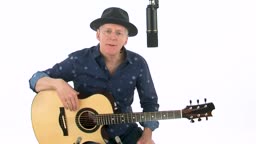
We’re thrilled to welcome Willy to the family with his first TrueFire course, Song Synthesis. Guitarists, songwriters, and singers alike will also be thrilled on this ear- and eye-opening learning adventure that reveals Willy’s creative, harmonic, and rhythmic approaches for songwriting.

”Taking a core concept and using the guitar, lyric and vocal performance to distill and to identify the emotional content and synthesize it into a song is my approach to songwriting. I’m excited to share some of the key concepts and techniques that go into the synthesis of my own songs.

We’ll dig into the relationship of the guitar and vocals and how they come to be. I’ll show you how I create grooves, use open tunings, dynamics, and how ideas on the guitar evolve toward a polished part.

We’ll then take an in-depth look at three-song studies to help you better understand the way I apply these approaches in both composition and performance — and how you also might use them in your own songwriting and performance.”


In the first section of the course, Willy presents and demonstrates 7 of his key concepts and techniques: The Marriage of Guitar & Vocal, Writing Genesis, Advantages in Alternate Tunings, Rhythmic Groove, Using Dynamics, Embellishments & Polish, and Sonic Approaches & Gear.

In the second section of the course, Willy illustrates all of the key concepts and techniques from the first section across 3 comprehensive song studies of "Paper Airplane", "Hard Place", and "This Train".

Willy will explain and demonstrate all of the key concepts and approaches along the way. You’ll get standard notation and tabs for all of the key examples and performances. Plus, you’ll be able to use TrueFire’s learning tool to sync the tab and notation to the video. You can also loop or slow down the videos so that you can work with the lessons at your own pace.

Grab your guitar and let’s dig deep into song with Willy Porter!

What you'll learn

  • Practice maintaining consistent rhythm throughout a full song performance
  • Observe a complete performance of 'This Train' with guitar accompaniment
  • Learn song structure and arrangement approach for this traditional-style song
  • Understand dynamics and expression in performance context
  • Develop skills in accompanying vocals with guitar
Release date: 07/15/2019 • 3h 12m runtime
Start Course
Sample lessons
Rhythmic Groove
Rhythmic Groove
Concept 4
Embellishments & Polish
Concept 6
Sonic Approaches & Gear
Concept 7
Song Study 2: Hard Place
Overview & Story

What's included

35 lessons • 22 charts

Song Synthesis
Hi, I'm Willy Porter. Welcome to Song Synthesis!

Taking a core concept and using the guitar, lyric and vocal performance to distill - to identify the emotional content and synthesize it into a song is my approach to songwriting.

I'm excited to share some of the key concepts, techniques, and approaches that go into the synthesis of my own songs.

We'll dig into the relationship of the guitar and vocals and how they come to be. I'll show you how I create grooves, use open tunings, dynamics, and how ideas on the guitar evolve toward a polished part.

We'll then take an in-depth look at three song studies to help you better understand the way I apply these approaches in both composition and performance - and how you also might use them in your own songwriting and performance. Everything is tabbed and notated for you and you can loop and slow down the videos so that you can work with the lessons at your own pace.

Grab your guitar and let's get started!
The Marriage of Guitar & Vocal
The narrator voice in your songs is obviously defined by the lyrics you choose and the emotion that you're packing into the performance as a singer. How you deliver what's being said defines the narrator to a great extent, but the music (provided by the guitar in this case) really has to work in marriage with the melodic content and with what you're saying lyrically. You're creating a symbiotic relationship between the two elements. I want the narrator's position and believability to be as much defined by what is being said as the musical context in which it's being said.

So, I've really used the guitar to underpin and support that voice - both rhythmically (in what rhythmic techniques I might use) and also in my use of juxtaposition between the guitar and vocal. I might have something that's very aggressive on the guitar, and the lyric might be something desperate - the narrator is someone who's reaching and digging and working and striving. So, starting from there, I felt the guitar had to be something that was really driving.

As another example, playing a really active guitar part against a very legato vocal phrase is a way to support the narrator and the statements that are being made. I try to do that in all the songs I write to create these landscapes where the voice and character of the tune is being supported by what the guitar is doing.

And so, that has been a journey for me from the beginning, largely because the guitar is a seemingly endless landscape for me. I keep digging into it to find what's buried there, and it keeps pulling me back to work harder and unearth these voicings that are carried within it.

One of the songs in this course that we'll dig into with a lot more depth is a tune called "Hard Place". In the tune, I use the guitar to really support the narrator's voice of a solder. It was fun for me to really invest in that character and through that I went to the guitar to find the right sort of energy to find what's being said by the character in the song.

So, the main adjective here is to uncover different ways of looking at the guitar so that you can take something you've written - a piece or something you've written - and take your time and figure out what's in the instrument that's going to support it.
Writing Genesis
Songs come to me in two main ways: Sometimes, the guitar defines what's going to happen - the guitar groove comes and you try to build on that and try to find a lyric that goes with it. In other cases, the lyrics obviously come first and then you're faced with the conundrum of lining up music with them.An example of a song where the lyrics came first is "Paper Airplane". In that tune, I was journaling a lot, and I came up with the opening lines I want to walk through your open doorways/I want to drink all your cheap wine. From there, I felt that I had something. I wasn't sure what it was, so I just did some free writing and let whatever spill out. This is a great activity when writing lyrics - it's clearing the stuff that's on the forefront of your mind, and there's something about getting it out onto the page that allows you to get some distance and push it out of the way. You'll have this open space in your mind where lines like I want to walk through your open doorways can live and work.So, once I have an idea like this, I can build on it: I want to walk through your open doorways/I want to drink all your cheap wine/I want to answer the phone when your old man calls/I want to tell him you're doing alright. This is the solution I found for the lyrics, but there's so many different approaches you can take that are valid musically and try to support it. It's as vast as our collective imagination; there's no right answer, there's just your answer. To me, that's the beauty of music and humanity...that we have so many ways to solve the same Rubik's cube together. I stand at awe in the ways that people express themselves based on the same information.In my case, my toolbox is some rock 'n'roll riffs, Celtic and Irish music, Appalachian music, etc. So, where do I go from these lyrics from there with these tools? With the lyrics for "Paper Airplane", at first I thought maybe Lou Reed or something. I didn't go with that one, it didn't speak to my guy and give me the "eureka" moment. I'll run through a myriad of approaches to try and figure out what that song wants to be. I give myself great latitude and not be too self-judgmental in the process. You gotta let this thing be what it wants to be!Our second way is when the guitar groove comes to you first and figuring out how the lyric might go over top that. A song for which this happened is "This Train", where I wanted to emulate the sound of a train on the guitar. The groove was so much fun to play, so I wanted the lyrics to speak to the joy of playing the guitar part. So, knowing it's about a train, why not just sing about a train? From there I applied some unitarian theology to it and worked towards some spiritual lyrics related to this "train". I worked up a duet style vocal with my pal Carmen, and the song really took flight!Another thing I was trying to keep in mind is that in the lyrics, I was trying to balance the sweetness of the guitar part. I don't want things to be too saccharine, or too earnest. So, by adding a lyric like this train won't run on money/this train won't run on blood we can achieve that.
Advantages in Alternate Tunings
So: Open tunings on the guitar, and why bother? Why go down this road? This journey for me has been largely defined by playing in bars when I was starting out. I had a residency gig at a place in Milwaukee called The Celebrity Club every Tuesday night, and in the course of working/playing solo there, I realized a very important thing. I put new strings on the guitar, and in the process of doing that, it drifted flat...the guitar was a half-step off pitch. I decided to go with it that night, and I discovered that if I went to a drop D tuning (which would have been a open Db tuning in this case) the bottom end of the speakers blossomed and opened up and I was able to hold the attention of the beer drinking crowd.Now, could this have been due to just what I was playing, and not the tuning? That's possible - so I decided to retest my theory, and the next week I tuned down a half-step and went from there. What I learned is that the low end of the PA, between 40 and 100 Hz, suddenly there's a little extra information down there. So, you're able to hear the bass/kick drum register when you play percussive on the guitar. Human beings, as Frank Zappa said, utilize music as a strange mating ritual - and what I realized is that the music was communicating in a more primal way. I was able to play bass and drums without having them there.This led me to keep digging and working with open tunings - open B, open A, etc. and over time, I've gravitated to tunings that are really stable for me that I use quite often. The latest one is just starting with the guitar tuned down a whole step, from D to D, the benefit being from being in this "bass camp" is that I don't lose any playability. If I really want to play cowboy chords, I simply just capo on the second fret and I'm back at that voicing.The real breakthrough comes from taking the capo off and finding new chords. Just as well, when I accompany someone, I have a lower register to work with and voicings I wouldn't have otherwise. That adds depth, and is a great way to contribute in a two guitar situation if they're playing in standard tuning. That's a lot of fun!Furthermore, by tuning down we can reduce the string tension, thus diminishing hand fatigue when playing. Especially if you're playing medium gauge strings! There's also an inherent warmth in the way that you touch the guitar when the tension is lessened.
Rhythmic Groove
So, my approach to the guitar to try to extract some rhythmic information out of it is largely derived in sort of an "osmotic transference" from the great Michael Hedges and Leo Kottke who both did so much to put the guitar into a space where it could really drive a rhythm section (and be it by itself). So, I've borrowed heavily from their approaches without studying their music formally, just as someone who loved their music.

I saw Michael Hedges when I was in college, and when he got on stage, he absolutely changed the way I saw the guitar forever. What really spoke to me is that he was treating the whole instrument like it was a drum, and was using the guitar as the vehicle for composition. He was just a really great composer who happened to play the guitar. He approached the instrument to extract different rhythmic tonalities, which is something that other players like Antoine Dufour and Andy McKee have taken and really run with.

I have as well, in my own way, try to incorporate that in how I support my tunes. So, just looking at the guitar as having a kick drum, a snare and different hits allows me to extract different tonalities out of it. You can do things like use your palm hitting the guitar to keep a four-on-the-floor rhythm. The reason I do it is because I want to move the room, and so I have a dynamic peak that I can draw from.

Using the guitar in this Michael Hedges-style way, it sort of becomes the band. It's really a fun way to create a lot more energy. Throughout the songwriting that I've done, I try to change it up, but I seem to come back to the palm muting, different percussive strumming techniques and holding out notes to juxtapose against them. These rhythmic structures have brought on all these different songs for me, and the guitar just seems to have an endless ocean of them within it. It's fun to keep going back to!
Using Dynamics
So, here we're talking about using dynamics to musically create space and draw people in. I came to understand dynamics very much in reverse: I always felt, since I was always playing bars when I started out, that I had to drive the room and draw attention to myself through volume and intensity.

It's only through experience that I came to understand the importance of dynamics. As David Wilcox once said to me, "One of the greatest ways to draw people into what you're doing is to suddenly get really quiet." And that, to me, is something I've arrived at over time. Now I use these quiet sections and shifts in dynamic range to both make pieces more interesting to play as well as have "signposts" along the way that reactivate the listener. I think it's really important in performance to figure out what your low threshold is. Everyone likes to figure out what the loudest you can be in a room - something an engineer figures out during soundcheck is how loud your guitar can be before it clips and peaks - but figuring out where you're comfortable playing as quietly as you can helps reveal the power of what you're doing.

A song that has a lot of drive in the meat and marrow of the tune can often benefit from an intro that is very quiet and intimate and draws people in. In the song "Hard Place", I added an introduction that serves two purposes: It takes us out of the musical motif of the song and introduces a whole new cultural flavor, as well as giving it a sense of "setting". Let's take a look at the song to get a sense of what dynamics can offer us.
Embellishments & Polish
How do songs evolve over time so that you can polish them up and take them into performance? One of the things that I'm always struck by is how the song morphs and changes through the repetition of performing it, but also how you build on your technique so that when you actually go out and try to play it live, you actually have a baseline of performance that you know you have, before you get in front of people with it. I think for me, songs will start in crude form, and from there they evolve to have different ornaments and different elements in them that give them depth but also consistency.

For example, in the song "This Train", the groove came to me first. But looking at the guitar and refining what I was doing, a lot of stuff cropped in over time from the basic pattern that I was playing, particularly from my right hand to build this intro groove into a larger, more involved and moving piece of music.

This happens of the course of several days, and takes time to get the groove together. Not over the span of an hour or two! Sit with the pattern, and figure out what embellishments you can add in to make it sound finished, and ready for performance.

+ 28 more lessons

Start Course

Reviews

8 results

walkercharleson

01/11/22

Unbelievable

I can't believe this class exists. Willy has inspired me for decades and it's a joy to discover this set of lessons.


BradleyM

Verified buyer

09/27/21

Song Synthesis Initial Thoughts

I love the learning approach in the first part of the course as it prepares you for the three original songs. Willy takes it very slow and is a pleasure to listen to both as an instructor and a performer. A lot of good take aways for a song writer. Really enjoyed the sessions on writing genesis and embellishments & polish. Glad I purchased this one as I will come back to it again and again.

rob09

Verified buyer

09/04/20

Great Stuff!

Willy Porter is a superb guitarist and songwriter and it's a real pleasure to get some insight into his process and detailed tutorials of three of his songs. I'm looking forward to the next installment!

Jimbo35

08/29/20

Songwriter in a class of his own

Mind blowing, horizon expanding insight into a great songwriter. Thank you for producing this.

richardlahaie

Verified buyer

08/15/20

Synthesis

Good Lessons of creativity..

Stop searching. Start improving with All Access.

Try 14 days free. Cancel any time.