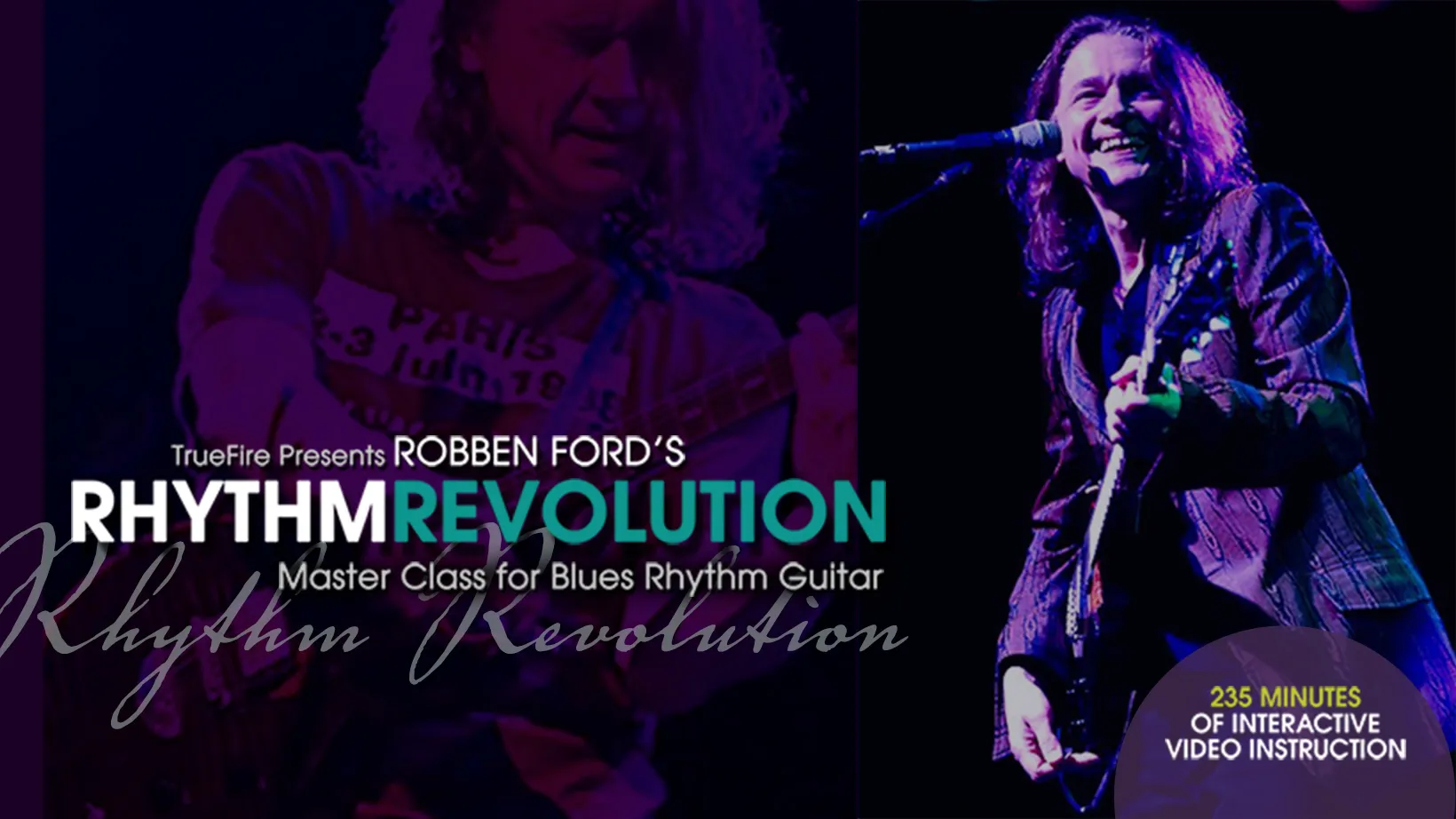
Rhythm Revolution

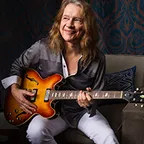
Master class for blues rhythm guitar with Robben Ford

Marty FriedmanTommy EmmanuelSteve VaiEric GalesEric Johnson

Get this course and 1,000+ more with All Access

Try 14 days free. Cancel any time.

Purchase Individual Course for $24.99
Rhythm Revolution

About this course

Over the course of his 40-year recording and performing career, Robben Ford’s rhythm guitar work has excited the ears of his audience, fired up his musical collaborations with dozens of top artists and simply amazed his fellow guitar players. “Playing rhythm guitar is the greatest joy in my musical life,” says Robben, “I love the subject of rhythm guitar, I love talking about it and I’m thrilled to have the opportunity to finally present my rhythm guitar approaches in this Rhythm Revolution video course.”

Robben organized the Rhythm Revolution curriculum in two sections. In the first section, Robben presents brief top-line overviews of the rhythm guitar concepts and techniques that underpin his signature approach and style.

Robben summarizes concepts like single-note rhythms and fills, use of space and air, playing with a second guitar player, the importance of consistency, the art of simplicity, sonic qualities, essential right-hand techniques, chord vocabulary, harmonic approaches, dynamics and best ways to practice rhythm guitar. All of these topics are covered and demonstrated in much greater depth and detail in his Blues Revolution master course.

In the second section, Robben demonstrates all of his signature concepts and techniques across a series of 12 rhythm guitar studies. You’ll first learn the rhythm guitar parts as Robben performs them by studying his video performances, breakdowns, charts and tabs. You’ll then practice the parts by playing along with Robben until you’re ready to perform them yourself over the supplied rhythm tracks.

The twelve rhythm studies cover a wide variety of feels and grooves. You’ll work on an 8-bar blues with a bridge using a Freddie Green approach, an E minor rhythm groove from Tell Me I’m Your Man, a C minor blues, an 8-bar uptempo shuffle blues with a bridge in the key of A, a 12-bar D minor blues with a twist, a Bb funky blues focused on the use of sixths, a two-part vamp-like groove, a Hendrix-inspired rhythm part, an open jam in the key of F, a James Brown-ish funky blues groove, a chord progression from When I Leave Here and a John Lee Hooker-inspired Delta blues approach.

Robben demonstrates all of the parts over rhythm tracks that he recorded in the studio with a live rhythm section (band members Brian Allen on bass and Wes Little on drums!). Everything is tabbed and notated and all of the rhythm tracks are included for the student to work with on their own.

Robben also included three individual course reference eBooks; Master Tab and Notation (a compilation of all course tabs and notation), Rhythm Track Lead Sheets (lead sheets for all 12 of the rhythm tracks) and his own Chord Dictionary (features dozens of Robben’s favorite chord voicings).

What you'll learn

  • Execute percussive, rhythmic chord stabs with proper dampening
  • Create space in rhythm guitar parts
  • Choose appropriate chord voicings for sparse funk arrangements
  • How to use common tones to connect different chords smoothly
  • How to create harmonic variations by changing bass notes under a consistent melody
Release date: 01/31/2014 • 3h 55m runtime
Start Course
Sample lessons
I'm Your Man
I'm Your Man
Performance
North Carolina
North Carolina
Overview
North Carolina
North Carolina
Performance
North Carolina
North Carolina
Breakdown

What's included

47 lessons • 24 charts • 12 Jam Tracks

Rhythm Revolution
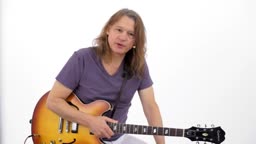
Hi. I'm Robben Ford and welcome to Rhythm Revolution. Playing rhythm guitar has become just about the greatest joy in my musical life and as a guitar player. It's something that I didn't necessarily explore when I first started playing. I, like many others, wanted to be a hot shot lead guitar player. It took being thrown into situations where it was demanded of me before I really started learning rhythm guitar. The more I got into it, the more pleasure I got from it. So I'm very pleased to be able to present this course with TrueFire. It's a great opportunity for me because I love the subject of rhythm guitar, I love talking about it and I hope you learn something from this.

I've organized the material in this course into two parts. In the first part I'll be sharing many of the musical concepts that I've learned over the years. Some of these things I've learned on my own through listening to records, seeing people perform, but also in many cases one on one with musicians that I've had the good fortune to study and play with. In the second section I've prepared twelve rhythm studies that we'll work through together. Each features a rhythm track that I recorded in Nashville, TN with a couple of great musicians living and working there and now working with me. Wes Little on drums, and Brian Allen on bass. These studies cover a variety of keys and feels and I will first play through a rhythm track, demonstrate a rhythm part for you, and then we'll break it down. So I encourage you to follow along with what I play on these rhythm tracks first, just listen to it and take it in. Learn the chord voicings that I'v used, then play along with the tracks yourself using these chord voicings and find your own way to use them yourself. It doesn't have to be identical to what I'm doing. It's good to imitate a little bit, but it's better to emualate and just take this information and run with it. We'll work with an eight bar slow blues with a bridge, similar to Freddie Green style. Also a rhythm and blues song based on the changes for a composition that I wrote some years ago called "Tell Me I'm Your Man". We'll take a very simple approach to a C minor blues. We'll look at an eight bar up-tempo shuffle with a bridge. I'll show you a variety of chord voicings that you can use over a 6/8 minor blues. We'll focus on a Bb blues with a funky beat to it. We'll work with a minor shuffle that I'm currently working on to create a new composition. Next up a dominant chord progression inspired by the music of Jimi Hendrix. We'll mix some rhythm and single-note parts in a one chord vamp. We'll cover a James Brown inspired jam. We'll find some variations on a traditional riff that I used in a song called "When I Leave Here" from the album Handful Of Blues. Finally we'll cover some down home Delta blues akin to Muddy Waters and John Lee Hooker. All of my performances are tabbed and notated plus you get twelve rhythm tracks with just bass and drums for you to work with on your own. So go ahead, grab your guitar and let's get started.
Consistency & Simplicity
Something that is really important to digest and also is kind of a relief is keeping things simple in your approach to rhythm. There's no harm in repeating yourself. My favorite example of this, for instance, is if you are a rhythm guitarist, rhythm is the key word, guitarist is the second word. Rhythm is the key word. And a drummer and a bass player, they are very accustomed to just laying something simple down and keeping it running through a piece of music. Almost to the point to where you wouldn't necessarily notice them. So rhythm guitar has that same quality. You want to be in a pocket, you want to be in a supportive role and the key to performing that role is to keep things consistent in your playing, not a lot of variety. There's no need to play a lot of different chords. There's no need to play a lot of different rhythms. But to keep something running, a consistent thread running through, just as the drummer does and just as the bass player does. One of the great bass players, Abraham LaBoriel, is a very old friend and his bass teacher told him to think of himself as a bass drum. What a great piece of advice. When he said that to me it really struck a note for me in that you are kind of like one part of a mechanism that's working. You're the carburetor or the alternator. The car, people are digging the car, you're a part of that and keeping it running. So, simple, less is more, and remember that you are a supportive player in this position as a rhythm guitarist.
Single Note Rhythms & Fills
It's been not uncommon, and especially I would say starting around the 80's where this kind of single-note rhythm playing developed. You started to hear it on R&B records a lot. It's something that I brought into my playing more and more over the years. Just playing little single-note riffs, little rhythms. You're performing, once again, a percussive rhythmic role. You're not playing chords but you are adding some kind of harmonic and sonic information to the picture that would otherwise be missing. Very famous throughout James Brown's work, that kind of guitar playing. It became more and more prominent. In the 80's in particular, maybe late 70's, this was being introduced more and more into popular music. Sometimes all you want to hear is just the sound of the guitar. You're not necessarily in need of any harmonic information, but just the sound of it. Just the fact that it's there. I did a recording with The Yellowjackets, a song called "Monmouth College Fight Song", it was on a live recording from the Montreux Jazz Festival called "Casino Lights". On the solo, the piano solo, rather than playing chords it was kind of a two-chord jam, but rather than playing any chords at all I just played octaves. Just the sound of the guitar and the sound of the octaves, which is a nice sound unto itself. You are just adding the color. You don't have to say a lot or play a lot, you can play very little. That's the idea behind the single-note rhythm thing where you're just introducing the sound of the instrument, pushing the rhythm along as well.
Space and Air
I had a lot of experience in the Los Angeles recording studios in the 70's and 80's. I wasn't actually a studio guitarist but I would often be called to play and people knew who I was so I would be on people's lists of people to call. It was a great mystery to me how people like the guitarists at that time, who were kind of the king pins in that world, like Larry Carlton, Steve Lukather, a very young Steve Lukather, Dean Parks, one of the great studio guitarists and record producers. These people would just craft the most wonderful parts behind people in songs. Michael McDonald records or Dolly Parton records, any number of artists. These guys were on all of those records because of how well they were able to just produce themselves, create their own sonic world and would know how to fit and come in and out of the music. It was a real mystery to me. It took me many years before I finally relaxed enough and felt confident enough that I could do that too. It really just comes down to listening. The most important thing that you have, your most important asset, is your ears, your listening. There's something going on around you so your job is to fit into that situation. So space is actually the beginning of that. Not playing is actually the birth, the place where everything else happens. So not playing is the perfect place to start. In fact, that's what I always do. If I'm in a situation with a group of musicians I kind of pretend to play for a minute. I listen to what everybody else is doing. I'll play a little something and see if it fits and kind of move and morph whatever it is I'm doing until we finally all come to a very agreeable space with the roles that we're performing. It's the place where you have to start, not playing, and once you do play you can basically fit in and around everything else that's happening. You listen, you wait, then you find the place for what it is that you might add to the situation. And it can be the simplest of things. You can play very little and be making a tremendous contribution. It requires a lot of confidence, quite honestly, to take this approach. You have to be pretty relaxed and comfortable with yourself to play with other people and feel like you have the luxury of not playing anything or waiting. So it takes time and a lot of experience to really develop that chop. It's one of my favorite things that I learned, one of the most important things that I learned in the L.A. studios.
2 Guitar Players
Playing in anything other than a trio situation, obviously you are finding yourself alongside another guitarist or a keyboard player. Two harmonic instruments, so a lot of people are curious as to how you make that work. I have worked over the last few years, quite a bit with a great guitarist, Mike Landau, with a band we had called Renegade Creation and it was a delight for me. I am rarely in the position to be able to play with another guitar player. Larry Carlton and I have also done some touring and travelling together in that way. I really like working with another guitar player more than a keyboard player. I come from a Buddhist tradition and there's something referred to as Mandala principle. Basically every situation has a center and it has four directions, it has a fringe. So there's a center to every situation so somebody is the king. For instance in the case of our band, Renegade Creation, we have a very strong rhythm section and anybody can shine and come through at any moment. But the way it worked is that Mike wrote his songs, sang his songs and he soloed on his songs. I wrote my songs and sang my songs and soloed on my songs. Every now and then the role of who took a solo would change. So right away something is already established, there is already a center to this Mandala. Somebody's driving the boat here! And if somebody isn't then you should drive the boat. Somebody has to step up at some point, or it's already established. In most situations it's already established, who that center is. You're playing in a band and somebody is singing, so it's all about them. You are about making them sound good. So that being established, it's a listening situation. This is Mike's tune, he's singing it, he's got a riff that he's written and that he's playing, so there you go - bass drums Mike. Bass drums and the guitarist singer and his riff. You fit in and around that. Whatever the bass player is playing is going to have a profound effect on what you are doing, whatever the drummer is playing is going to have a profound effect on what you're doing. You need to have a big mind. You need to have big ears. You're taking in all this information that's already being presented and it's strong. What I used to do is first of all not play and then wonder what the heck I'm going to play. Eventually I just started throwing myself into the situation, you have to step out there, you have to take a chance and start playing something. Eventually you find your seat within the context of whatever that situation is. So you let other people lead and you fit into that situation or if you know that everyone is fishing, step up and play something. It could be anything that you are inspired to play. I guarantee you that people are waiting for that to happen. People love it when someone steps up and presents something because everyone is feeling the same way you do. Trust the situation that you're in, don't be afraid to step forward and do something. Once you've invested yourself into the situation you all start coming together. If you're holding back too much then people are waiting for you. If you're just stepping all over everything then nobody wants to play with you anyway. This is my advice.
Sonic Qualities
There are a lot of ways to achieve sounds with the guitar. The guitar is an extremely versatile instrument sonically. There are all kinds of guitars that you can play, from strats to the Les Paul to the Tele, 335 and even this Epiphone for me. Many humbucking pick-ups, it's a whole different sound than a humbucker or a strat pick-up, or a Tele. The guitar is incredibly versatile that way. And amplification - there are many different amplifiers you can use. I myself like to keep things really simple. I think any guitarist should really push himself to be able to get a good sound with one amplifier and one guitar and be able to just play. With nothing else beyond that. No overdrive, no pedals. Reverb is kind of important. There actually is natural reverb. You need some kind of an ambience otherwise the guitar can sound very dry and very flat, so I always want a little bit of reverb. I actually need it, even though for a while I've gone to just a delay because I couldn't find a reverb that worked well with my particular amplifier which is the Overdrive Special. I've finally come around to using a little bit of pedals and I spent a lot of time developing a pedal board - tried out a whole bunch of different pedals, different delays, different tremolos or chorusing effects. Wah wah pedal, boost, bright, switch - a lot of different things and after really working with that for a couple of years I've come right back to just the guitar, amplifier, maybe some reverb, a little delay and occaisionally just a little bit of a boost. Very basic things. I recommend that you ask this of yourself, especially when you're in the formative years and just learning. Beyond that it all comes down to taste and what you're looking for. As a blues player I've found myself using a Fender Telecaster for my blues guitar. I'm fortunate enough to have a 1960 that is a great Telecaster and it has served me so incredibly well. My last record was called "Bringin' It Back Home" and it's basically an old school approach to sound and how we play and I used this guitar because this mini humbucker in the rhythm position just has this woody hollow sound that I was looking for. I was looking for something very particular and I found it on this guitar with this pickup and I wouldn't have had it with the telecaster, close but not exactly what I was looking for. The type of music that you're making can require a certain instrument. The Les Paul has basically been my humbucking pickup guitar of choice for the last several years. It's got that big meaty treble pickup sound, and I would almost never use the rhythm pickup on a Les Paul because they are just too dark for me. The mini humbuckers give me a rhythm pickup that I like the sound of. It's a little more akin to the Telecaster rhythm pickup, it's a little more clear. Also just a little darker and woodier than the Tele can be. These are very basic and classic guitars. I've got the Overdrive Special but in a pinch I can be very happy with a good Super Reverb. I have a very classic sound and a very classic approach. I like the Fender amp sound and these classic guitar sounds. I never really became much of a strat player because it was uncomfortable for me. My hand kept running into the volume control. The telecaster has been by great friend for many years. I'm not a big effects guy, as I've said, but some people have done incredible things with effects such as Jimi Hendrix, and Eric Johnson does wonderful things with delays and reverbs. Mike Landau is just an amazing master. If you don't know who Mike Landau is you should really find out because this guy does so much with the sonic possibilities of the guitar, it's amazing. Of course, Jeff Beck as well, but just the way he plays and the way he uses slide and bending and things like that. It's not so much effects, he just really knows what to do with a guitar. I would recommend that you really try to establish yourself with just a guitar and an amplifier. Make sure that you're doing something with those two things that is already substantial before you start investigating what you can do with pedals and effects. As a rhythm player how do you fit into the mix of a group of musicians playing together? There are a variety of ways of doing that of course, which is pretty much dictated by whatever is going on around you. I've been on my own as an instrumentalist, a solo career, for many years now but in the past I played with some pretty great artists. When I would go out there to play, if I could hear myself better than I could hear everybody else then I was too loud. I literally would hear myself a little less than the other instruments on the bandstand. It can't be all about you and what you are doing. It has to be an integrated situation. You have to give up a little bit of your ego. That was a great lesson to not be so attached to making sure I'm being heard. Instead it's like what's going on with these people, what can I do to enhance what's already going down there? That could be playing very little, generally it's a temperate approach to whatever you are going to play. There are times when you want to step out and you can step out and inspire the people around you. The guitar has so many ways it can integrate into a situation, it's wonderful that way. I think that other instrumentalists could actually take that same approach. Piano players have ten fingers, they have eighty-eight keys, they have a lot they can do. When you're talking about rhythmic music, again rhythm is the key word here. So a rhythm section - it's about rhythm. So paring things down to a minimum is a good place to start. Then where things need to be filled in, you can tell, there's kind of a hole in that area of the sonic spectrum, right in the middle or in the lower mids. If no one's playing high, I'll play high. If no one's playing low, I'll play low. If no one's playing in the middle, I'll play in the middle. If somebody's playing loud, I'll play softer. If somebody is playing softly, I'll wait for a point that I can play something that will jump out a little bit. It doesn't get in the way of what that person is doing. When there is a space for it I will just jump in with a little riff or a chord, then wait and listen to hear what else this person is going to play. So you separate yourself from everything else that's going on, but really you are integrating yourself into the situation and you are adding to the situation. So it's very important for you to be listening to what's going on around you. I have sat down with students having them play a little bit to see what's going on with them. The guy's amplifier will be pointed right at me and all I can hear is his amplifier, I can't hear myself at all and he doesn't even notice it. We are supposed to be playing together, it's not just you playing at me. You have to really appreciate that it's a sharing situation, we're here for each other and can you hear me well enough to even have an idea what I'm doing. Listening is number one and joining in the situation with a good attitude is important too.

Right Hand Techniques
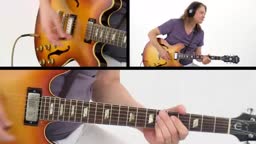
I'm going to talk a little bit about the way I use my fingers and the way I use my pick. I find that I do a lot of things with my hands. My approach to the instrument is constantly changing. The pick is going away, it's coming back, I'm playing with the tip of it, I'm playing with the round end of it. I'm playing single notes, I'm playing chords. It's not something that I did by thinking about it. I just found myself constantly exploring the possibilites of the instrument. A lot of double stops in my playing. A lot of thirds and sixths in my playing. So it's not just chords. I do want you to learn a lot of chords. Once you learn those chords there are a lot of different things you can do with them. That's kind of like a harmonic device, talking about thirds and sixths. Kind of left hand technique, but that's more of a harmonic thing. As far as my actual technique goes, almost the first thing that I do is to start playing with my fingers. I went through a lot of changes with how I held the pick and how much I used my fingers. There was a period when I used to play with my fingers fanned open. It was a long time ago. I don't play the same way anymore and to do that right now feels very uncomfortable. I play pretty much with my fingers tucked in. They go out and come back in. I like to have more possibilities available to me than if I had a strict technique of back and forth picking. If I really worked out my fingerings to play, I'm going to play it the same way every time. That's what happens when you really practice things very deliberately, you're developing a very specific technique and you can get really good at it and some people have. I have a little bit of all kinds of things going on. It just seems to suit me. I like the ability to be playing with my fingers and then switching to the pick, and then doing pull-offs and maybe I've never even done that before. But I've given myself the room to do that. Anything could happen and I like that openness. It's actually harder for me to play the same thing twice than it is to play it the first time. The first time just happens, then if I have to duplicate myself then I am thinking about it. I just taught myself to play a different way, by keeping a big open field. I think that anyone can do this. Don't take it too seriously. What I mean by that is you don't have to be a master of picking back and forth, or a master of playing with your fingers, just do it. You'll figure something out. Play with back and forth picking technique, maybe you'll develop some speed, you might really take off with that and find yourself. You might never pick up a pick again. So allow yourself a lot of room on the technique thing. You don't have to have somebody show you how to do it. You can do it. Have a little faith. I've described my playing technique. We are talking about physical techniques here. My playing technique fits into the same concept - I've spoken about this particular image before, about fingerpainting. My left hand is just fingerpainting the guitar, that's how I look at it. I'm pushing notes along the neck of the guitar. I know where all the notes are that I want to play and I just fool around with them. A very open approach, you don't have to get all locked into any one thing. That having been said, you can, many people have, and produced incredible results. This is just the way that I have learned, the sensibility that I have developed over the years of how I approach the instrument, of how I approach music. It's kind of an open approach as to what might happen. It suits me and it also keeps my music pretty simple because you can't do that playing giant steps. You have to be more zeroed in. I moved away from playing a lot of chords so that I could have more room, more freedom. Actually Miles Davis, that's very much who he was as a musician. He was able to play it all at one time pretty damn well, but he really found himself playing modal music and playing melodically, playing slow, playing ballads, and going for tone and nuance. For me technique is the same way. I'm looking for nuance and tones. If I was locked into any one technique I wouldn't be as good at what I play. I'm playing the pentatonic scale but you hear it in a different way, it's not just the pentatonic scale. I can approach these things several different ways and the reason I like that is because each way sounds different, each way has its own little thing on it. I'm working with colors. By messing with my technique, I'm working with colors and nuance and emotional things. Many years ago when I first starting getting some recognition living in Los Angeles, I'd been playing with Jimmy Witherspoon and living there for a couple of years and people were hearing me with him. I eventually got the gig with Joni Mitchell and the L.A.Express going on tour. Larry Carlton had been the guitar player on the records. When I hooked up with them to start learning the music, Larry came along and I met him for the first time. I was not aware of who he was. I didn't know anything about anyone other then B.B. King and Wes Mongomery. L.A. was a new thing for me. So he and I connected and got together at his house to jam a little bit. I didn't have a clue as to what it was to be a rhythm guitar player. At that time in my life, up until joining that group, I basically took solos and then laid out with my bands. I kind of viewed myself as a tenor saxophone player on the electric guitar. My rhythm playing was almost zero. I get together with Larry and we start to play something and I'm really not knowing how to accompany him. He says "Where is it, man?". I told him "I'm not sure". And he told me to just keep going. So I just kept my right hand moving. People always ask how to keeps the strings from ringing and the only answer is that you just do it. You don't let them ring. You just find a way to do it. Once again. we're talking about rhythm guitar playing, it's included in the chords that your are hearing. A piano doesn't have that. I'll play with my fingers or I'll play with my thumb. I was playing basically the same as I would have before, whatever the chords were to whatever the piece of music that we were doing, or whatever the jam was. I was attuned to more of a jazz approach of playing the guitar and chordally what I was hearing piano players do. Thirteenth chords and flat nine chords in a more deliberate way - jazz guitar plays like that. This rhythm thing was a revelation for me and I've spent all the years since reveling in rhythm playing. I love playing rhythm guitar. It's one of those leaps that you have to take, just dive into it. Even with shuffles, like a B flat shuffle, keeps going and going. It never stops. It opened the whole thing up to me. This static, almost pianistic approach to comping behind an instrumentalist comping. Rhythm guitar is certainly comping but that was just a different way. It was about chord voicings, you don't play and then you do play. This is a combination of all of those things.

+ 40 more lessons

Start Course

Reviews

16 results

WGM11

Verified buyer

01/22/26

Great lesson from a master guitarist

Very good an unique take on guitar style

littlesister

Verified buyer

10/25/24

Excellent.

dwa79

Verified buyer

09/26/23

Nice Pace

Robben Ford…of course it’s good!

cazalisx

Verified buyer

12/27/21

Robben Ford Rhythm Guitar

One of the best rhythm courses I have bought. A must have for all guitarists. Robben Ford is an awesome teacher.

vincenzo1310

Verified buyer

08/24/21

RF, guitar genius

RF is also one of the greatest rhythmic of the history!

Stop searching. Start improving with All Access.

Try 14 days free. Cancel any time.