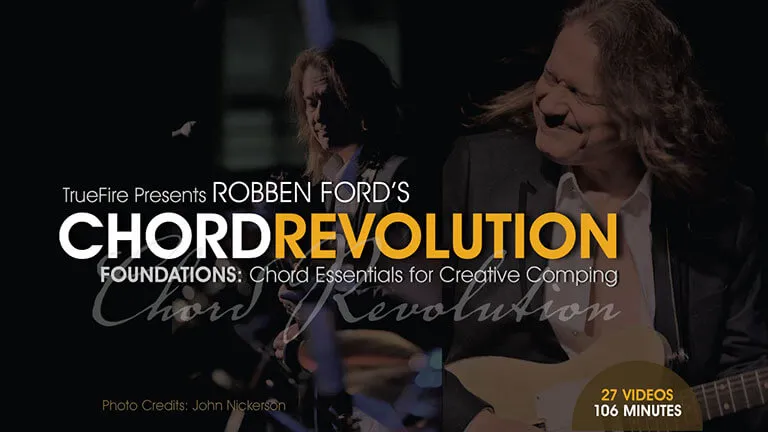
Chord Revolution: Foundations

Chord essentials for creative comping.

Marty FriedmanTommy EmmanuelSteve VaiEric GalesEric Johnson

Get this course and 1,000+ more with All Access

Try 14 days free. Cancel any time.

Purchase Individual Course for $24.99
Chord Revolution: Foundations

About this course

“Chords are at the foundation of everything that I do.” - Robben Ford

Robben loves chords. He’s said that many times across a wide range of instructional presentations. He has a vast vocabulary of sophisticated blues and jazz voicings and is widely respected for his rhythm guitar work and chord selection both as an accompanist and as a songwriter. Robben also loves to teach and he’s shared many of his favorite chords, chordal approaches and rhythmic techniques with us over the years.

This course is different. Other than 7th and Diminished chords, you won’t find a single other extended or altered anywhere in the course or in the 107-page manual that accompanies it. Yet, this is the course that will change your rhythm guitar playing forever and for the better.

Don’t let the “Foundations” word in the title fool you into thinking this is a beginner course. It’s far from that and in many ways, it may very well be the most advanced course you’ve ever studied. Yet, so simple to grasp and start applying immediately. It’s here in Chord Revolution: Foundations that Robben reveals the underlying logic — the Foundation — of his signature approach to chord selection and comping.

Robben first shows you how to harmonize a major scale into three major triads, three minor triads and one diminished triad. He’ll show you how to identify the relative minor triad. He’ll then show you how to break those triads down into even smaller harmonic devices we know as thirds, fifths, sixths and octaves. You may know how to do this already and that’s a good thing, but it’s not THE thing.

Your first monster revelation in the course will be learning how to determine the key of any prevailing chord progression or vamp, and then selecting the most appropriate triads, thirds, fifths, sixths and octaves to comp with. Yes, you will be comping with these smaller basic chord forms and it will sound incredible to your ears and your audience’s ears. Robben will teach you how to do this, and it’s this identification and selection process that is THE thing.

Your next major revelation will occur after Robben steps you through a series of lessons focused on major triad inversions on both low and high strings. Add these inversions to your triads, thirds, fifths, sixths and octaves for even more color and sonic qualities in your comping.

Multiple revelations will also occur in the following series of lessons covering Major and Minor 7th chords, Dominant 7th chords, Diminished chords, Modes and the use of full voicings. Robben caps this last sequence of lessons with some very enlightening guidance and demonstrations on creative comping.

To supplement all of the lessons and demonstrations in the course, Robben also includes a 107-page manual filled with tabs and notation for all of the key demonstrations, PLUS annotated reference charts for Major Scales, Major Triads, Minor Triads, Relative Minor chords, Thirds, Fifths, Sixths, Octaves, Dominant 7th and Diminished chord — ALL of it in ALL 12 keys. You’ll also get all of the rhythm tracks that Robben uses throughout the course to work with on your own.

So many of us tend to overlook simple approaches and explanations believing that the more complex and sophisticated an approach is, the better it must be. With music in particular, that is a widespread fallacy and there’s no better testimony to that than Chord Revolution: Foundations — you will be amazed when you hear the music that Robben makes using these simple chords and harmonic approaches. Adopt these principles as your own foundation and you’ll likewise be amazed at the music you make.

What you'll learn

  • Play sixth intervals across the entire fretboard
  • Apply sixths in improvisation over chord progressions
  • Understand how songs can use scale degrees from a relative major key
  • Recognize the relationship between 6th and 9th chord voicings
  • Understand how to harmonize a major scale
Release date: 09/18/2014 • 1h 47m runtime
Start Course
Sample lessons
Thirds
Thirds
Demonstration
Fifths
Fifths
Overview
Major Triad Inversions on Low Strings
Overview
Major Triad Inversions on Low Strings
Demonstration

What's included

28 lessons • 25 charts • 7 Jam Tracks

Chord Revolution: Foundations
Hi I'm Robben Ford, and welcome to Chord Revolution: Foundations. Chords are at the foundation of everything that I do. We're going to focus on the essentials, and that is major scale, chords that come out of a harmonized major scale. And I find that these are the things that I'm using in my own music today. I've moved away from the use of a lot of altered chords and really focused on these things myself. Very naturally. It's a musical choice that I'm making. It feels so good to have a foundation in this kind of material. To really know chords. Really understand scales and chords. Without them, you really can't go any further. We'll start off with a major scale and harmonizing that major scale. Discovering all the chords that exist within a simple major scale. We'll look into relative minor chords. The three basic major triads and the relative minor chords that are related directly to them. In certain contexts you might want to pare a chord down to just thirds. You don't necessarily have to use the fifth. We'll take a look at using thirds. The same thing is true of fifths, the absence of the third in your chord and how you can use that to great impact.

We're going to look at major triad chord inversions, first using the low strings on the guitar. Then I'll show you how to use major and minor triads on the higher strings of the guitar. We'll take a look at another very useful tool, which is the use of the sixth interval. We'll take a look at major and minor seventh chords, which basically expands the triad into a four note chord. We'll give you a brief description of the modes and maybe de-mystify them a little bit for you. We'll take a look at the diminished triad, which is based off of the seventh degree of the major scale. We'll go in-depth on the dominant seventh chord, which is again probably the most popular chord used in music today. And then of course at the end we're going to put all of these things together in a segment we call Creative Choices. Everything will be tabbed, charted, and notated, and you'll have a very sizable manual that you can reference throughout the course. All right, so grab your guitar, sit down, let's start building that foundation.
Chord Reference Guide
Use the CHART button to download the 104 page course reference guide, which contains additional material as well as all material covered in the course.
E Major Triad and Scale
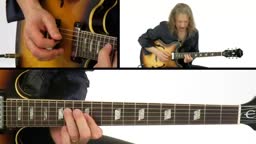
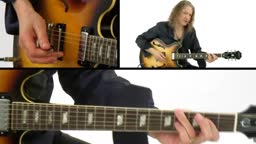
The first thing we're going to do here is take an E major triad and break it down. What is it composed of and what does it intimate for the future? Everyone basically knows this chord voicing. We call it E. Your basic major and minor chords are generally referred to as triads. So, an E major triad. Right there you would have what would be referred to as first position, E major triad. E is in the root. Then the third, then the fifth. Like that. When you play an E chord, you're playing an E major triad, but some notes are duplicated. The E, root, octave. An octave above that. There are three of them in this particular chord voicing. There are two fifths, which is B in this case. One on the open B string and on third. Notes are being duplicated.

The reason something is called a fifth or a third - I want to explain that to you very briefly. If you play an E major scale, there is a major scale running through every chord. That would be the second. One, two, three. The third, fourth, fifth, sixth, seventh. And the root note again, an octave above E. One, two, three, four, five, six, seven, eight or octave. And then we can play it again up to high E. One, two, three, four, five, six, seven, eight. So tonic, or root, third, fifth. That's your basic major triad. And again, you're just duplicating notes when you play that. Still, there's only tonic, third, and fifth there. So that's your basic E major triad, E major scale. We're going to find a lot more things are held within that basic information.
Harmonizing the Major Scale
Now what we're going to do, and this will really be the focus of most of what we talk about within the context of this lesson, this course - we're going to harmonize the major scale. We're in the key of E. So play the basic triad and you're going to use that same fingering. We're just going to play on the D, G, and B strings. The tonic, third, fifth. So these are our three notes of the E major scale. Which came first, the chicken or the egg? Which came first, the triad or the scale? I leave it up to you to decide. And we're going to play the tonic, third, and fifth, which would be called first position triad in the key of E. So if we take each individual note of this E triad and move it as it would naturally occur if you were playing the scale itself, the B would come up a whole step, fifth would go to the sixth. This is the third of E, which would go to the fourth naturally. The root note would go to the second naturally. So everything's going to move together instead of one note at a time. That's the only difference here.

So we have the E triad. Everything moves naturally as it would occur in the course of playing a scale with the individual notes. This chord is F# minor. It would also be referred to as the two chord. So if you hear somebody say "play the two chord in the key of E", now you know. Root. There's the two chord, which is F# minor. Now we're going to move everything again as it would move if we were playing the scale. You have the three chord, which is called G# minor in this case. The next movement is going to be the four chord, which is A major. The five chord is B major, six chord is C# minor. The seven chord is D# diminished. The octave above is again, E major. So we've just harmonized the E major scale. To me this is just like playing that E major scale and harmonizing it in that way, it sounds kind of glorious to me. It sounds kind of beautiful to me. I love the way it sounds. It's music right there. You're already playing music.
Relative Minor
We're going to move to the key of G, and the reason being, once again, it's a very friendly key on the guitar. You could use basic triads very easily in this key. I play a G major using open strings. This is the way it's generally taught, but I find that a little awkward. The way I play it allows me to move to other chords a little easier. And also you don't necessarily need to play the third there. Because you're duplicating it up here, and it sounds better up there, anyway. A little further away from the root of the G. To do this, it's a little heavy. Basically I would play it like that and I'm damping the A string with this finger. Easy to get to E minor with that. You don't have to do this. We're in the key of G. As demonstrated before, playing the E major harmonized scale, here is your basic 1st position G triad when not using open strings. I very rarely play bar chords, I'll play this. Sometimes I will play that low G and sometimes not - so key of G. Let's harmonize the G major scale. Root chord - Second chord or two chord, which is, in this case, A minor. Three chord, four chord, five chord, six chord, seven chord, and the octave. So now you know, if somebody says, "let's do a I-IV-V thing, a blues". The key of G, so one chord, four chord, five chord. Now you know.

These triads - One chord, two chord, three chord, four chord, five chord. Let's just stop right there. So you've probably heard reference to what is known as the relative minor. Within the context of a harmonized major scale there are three major triads. There's G major. Your two chord is a minor chord, A minor. Your three chord is a minor chord. Again we're in the key of G. B minor. Four chord is a major triad. Five chord is a major triad. E minor. F# diminished. G major triad. So G, C, and D are your three major triads in the key of G. Very conveniently on the guitar, and I think it's one of the reasons (if not the main reason) why just playing major chords and using the open strings exists, is because these relative minors are very handy. Key of G. Standard open G voicing. The relative minor is E minor. Basically because they sound identical, save for the fact that you are putting a different root underneath that G major triad. It's a minor third below. You could also refer to it as a sixth above. It's either a minor third below, G with an E below. If you were to play it like that, that'd be your six chord in a literal sense. Just moving up the scale - One, two, three, four, five, six. So G major, E minor is the relative minor.

The C major triad, minor third below in the root, gives you A minor which is the three chord in the key of G. The third major triad is D. Minor third below in the root gives you B minor 7. So G, E minor. C, A minor. D, B minor. Now again, the point being, these chords sound almost identical. Just by putting a different root below the triad, you get a different sound. You get a different feeling. You get a different application of those same notes of the major scale. The fingers don't even change. The voicing doesn't change. Just the root note changes. It's a little different when you hit the D chord and put minor third in the root. This is your standard jazz voicing of a B minor 7 chord. Visually, it's the same chord, just with a different root. We're already moving into a broader way of viewing the major scale and the basic triads that exist in a harmonized major scale.

Harmonizing the Major Scale
I want to demonstrate a little more on the relative minor triad to the major triad of the G major scale. So we're still in G. Major triads in this key being G, C, and D. The other triads in the scale are minor, A minor, B minor, and E minor. So three major triads, three minor triads and the seventh one being a diminished triad. So the relationship between G major and E minor is very obvious, and especially if you play this open G on the guitar, E minor. Virtually the same chord. And with a different root note, being the sixth degree of the G major scale, the C. The minor triad relative to it is A minor, down a minor third, D, B minor. Then again, we have the diminished chord going into G.

So these things are what most songs are made of. Especially if you listen to older rock n roll, you really hear the flat out use of those chords exactly. Very little variance in keys. Keys don't change so much, and so you're basically using that information in most music. You're just in different keys, but the chords all have the same relationship. The scale is one major scale. There's so much that can be done with just this information. These triads are the blues chords - I, IV, V and their relative minor chords. So you can play most songs with just that information, and one of the classic examples, the best example I can think of, that really just demonstrates the use of harmonization of the major scale - Bob Dylan's "Like A Rolling Stone" is virtually just the harmonization of the G major scale. Then he goes down after this little bit, right down the scale. Then it's the major triads of the major scale.
Thirds
We are looking at a G major triad and the scale that runs through it. We've learned that we can harmonize that major scale, and we have all these chord voicings within the context of a major scale. They have names. Tonic, two chord (second chord), three chord, four chord, five chord, six chord, seven chord, one chord. So we have G major scale, all these wonderful triads. Now we don't have to play all three notes of the triad at once to define the chord. We're not locked into it. I want to talk to you a little bit about thirds. It's referred to as thirds because we're playing tonic and third, and we keep that relationship between those two notes.

Throughout the major scale you can play thirds. I'm just playing a vamp, G to E minor. There is so much you can do with just those two notes. Also, basically, with just a G major scale. Everything is flat out G major and you want to learn how to play these all over the guitar. This is something that should not be difficult for you - To learn how to play these little third voicings all over the guitar. There are certain things you really need to know how to do. You should really learn how to do this. Just like you should learn how to play the pentatonic scale all over the guitar, just walking all over the guitar. You really need to know about thirds. They are a simplified version of a triad. It's the same activity, just broken down.

+ 21 more lessons

Start Course

Reviews

18 results

django888

Verified buyer

03/26/26

Chord revolution

Robben ford est un tres bon pédagogue. Il propose des outils indispensable pour progresser sur son manche de guitare. C est tres progressive et facile a appliquer pour son propre jeu .

pawelmajor

Verified buyer

11/06/25

get it!

great course.

WR

11/03/25

Open my mind!

Though not yet complete the course, this really open my mind about scales, chords. It's not about you want to play rhythm, so you go for chords, or you want to play solo, so you go for scales. they are the same thing by harmonizing the scale. Though not everything Robben Ford showed are tabbed, it's comprehensive by follow the lessons. So I think it's fine. Great course and highly recommended!

65horsepwr

Verified buyer

02/07/23

Great artist!

Looking forward to starting this course! So much good information and training. Fortunate to have such a talented artist share his knowledge with the rest of us.

cmlourensz

Verified buyer

09/19/21

It's a bit out of my league at the moment but I'm enjoying the way it is presented.

Stop searching. Start improving with All Access.

Try 14 days free. Cancel any time.