
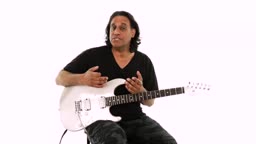
Beginner Rock Improv (JamPlay)

Beginner Rock Improv Made Easy!

Marty FriedmanTommy EmmanuelSteve VaiEric GalesEric Johnson

Get this course and 1,000+ more with All Access

Try 14 days free. Cancel any time.

Purchase Individual Course for $9.99
Beginner Rock Improv (JamPlay)

About this course

Improvisation is central to the expression and development of a musician’s personal style and creativity, especially when you’re playing rock – a genre that thrives on the energy and spontaneity of live performances. It’s also one of the most intimidating skills a player faces when they’re first starting out.

Prashant Aswani’s “Beginner Rock Improv” is designed for newer rock players looking to gain confidence in their improv chops. In this course Prashant will introduce you to the fundamentals of improv and dive into how you can start to incorporate them into your playing. He’ll give you demonstrations and detailed insight that will help you build a solid foundation of skills and get on the path to rock mastery.

“Improvisation is the ultimate form of spontaneous creativity and a never ending well of knowledge and understanding of music - it just goes deeper and deeper and deeper.

I’ve designed this course with a lot of cool different elements. We go into melodic and harmonic passages, articulation, picking techniques, slides, hammer-ons, pull-offs, phrasing, and more! All of these things have been concisely put together for someone just starting out to get you on a really solid path moving forward.

When you’ve completed this course, you’ll have the confidence to improvise and land on good notes with ease.”


You’ll have TrueFire’s interactive learning tools at your fingertips to customize your workspace and learn at your own pace.

The demonstrations and performances are tabbed, notated, and synced to the video lessons with controls for looping, slow motion, fretboard animation, and other tools designed to accelerate your progress.

You’ll also get tab and standard notation files to print out, downloadable Guitar Pro files, and backing tracks to practice and record with.

Grab your guitar, and let’s dig in with Prashant Aswani!

What you'll learn

  • Create rhythmic motifs that repeat across chord changes
  • Use question and answer phrasing techniques
  • Apply the same rhythmic pattern with different melodic content
  • Extract rhythmic ideas from bass and drums to create guitar lines
  • Develop melodic motifs using chord tones
Release date: 07/25/2024 • 4h 02m runtime
Start Course
Sample lessons
Expression
Expression
Bends
Expression
Expression
Vibrato
Expression
Expression
Tremolo
Expression
Expression
Track Demo

What's included

26 lessons • 24 charts • 5 Jam Tracks

Beginner Rock Improv
Hi, this is Prashant Aswani, and welcome to Beginner Rock Improv. Improvisation is the ultimate form of spontaneous creativity and a never-ending well of knowledge and understanding of music. It just goes deeper and deeper and deeper. I've designed this course with a lot of cool different elements. We go into melodic and harmonic passages, articulation, picking techniques, slides and hammer-ons and pull-offs, phrasing, and note choice, both rhythmic and melodic motifs.

All of these things have been concisely put together for someone just starting out to get you on a really solid path moving forward. When you've completed this course, you'll have the confidence to know that you'll be able to improvise and land on good notes 10 out of 10 times.

Grab your guitars so that we can get to work!
Melody & Harmony
In this lesson we'll dive into both harmonic and melodic concepts to help you create pleasing sounds while staying within a key signature. We'll start with the basics of music language and structure, which are essential even when you're just noodling around with scales, arpeggios, or rhythms. The primary focus will be on developing your single-note soloing skills. As your fingers and technique improve, you'll learn how to navigate chord progressions and know exactly what to play when soloing. We'll cover harmony, starting with the key of G major, and explore how each note in the scale corresponds to a chord. You'll understand major and minor chords and how to voice them in different positions.
Melody & Harmony
In this lesson, we're going to build on your basic understanding of harmony and take the next step in improvisation by figuring out where all these notes are on your guitar. This can be a bit challenging at first, especially when you're trying to be creative with your playing. But don't worry, I'll show you some tips and tricks to help you find those target notes—also known as chord tones—which are the root, third, fifth, or seventh notes in a chord. Hitting the correct chord tone will ensure you always sound in key and knowledgeable when improvising. When I started out, I wasn't taught any of this, so I often played random notes and sometimes sounded pretty bad. This lesson is designed to help you avoid that.
Melody & Harmony
Now that we've nailed down what chord tones are and how to find them, let's kick it up a few notches! You're ready for this, and it's going to keep you on your toes. We'll dive into some basic scale patterns that work over a chord progression diatonic to G major. These patterns can be applied to any key signature with a similar chord progression, so you'll have plenty of flexibility. We'll start with the G major scale and show how these notes apply to chords like A minor and B minor. The key thing to remember is that the G major scale notes apply to all these chords, but the character of each scale changes based on the starting and stopping points. I'll guide you through playing the G major scale as a refresher, and then we'll explore how these scales fit into the chord progressions.
Melody & Harmony
Now that we've got a solid grasp on chord scales, it's time to dive into arpeggios. Don't be intimidated by the term—it's just a fancy word for playing a chord one note at a time. Since we're focusing on improvisation, arpeggios are super important because they fit perfectly with single-note playing on the guitar. We'll start with our basic progression, like A minor seven and B minor seven, and break down the chords into individual notes. Unlike scales where notes are played sequentially, arpeggios involve wider intervals, giving your playing a more spread-out, intervallic feel. If you've ever played chords one note at a time, you've already been arpeggiating without even knowing it! In this lesson, we'll arpeggiate the chords in our progression to get a feel for the technique and understand what your right hand needs to do.
Melody & Harmony
In this lesson, we're going to play over a tune in G minor. I'll be incorporating some arpeggios and scale lines in a melodic fashion for you to emulate. After we play through it, I'll break down a few of the techniques I've used and show you some specific lines you can play over the track. We'll revisit some of the techniques you've already learned, focusing on how I use my right-hand picking and the bar. Don't worry if it seems complex now; we'll dive deeper into these as the course progresses.
Rhythm & Pocket
In this lesson, we're diving into the essentials of rhythm and pocket in improvisation. We won't just be focusing on full chords; instead, we'll explore the nuances of quarter notes, eighth notes, and sixteenth notes, integrating them with chord playing and some improvised soloing. Now, when I say "soloing," I'm talking about adding rhythmic lines between chords to enhance your improvisation skills. This technique is crucial for developing a solid rhythmic foundation and expanding your soloing ideas when you're not playing chords. I'll also share stories and insights from my own journey, aiming to teach you the key concepts I wish I had learned early on.

+ 19 more lessons

Start Course

Reviews

1 result

Ryan S.

08/04/25

Very knowledgeable teacher, great player, but I’m not sure who this course is for.

I am coming at this from the perspective of a classical guitarist who plays rock/metal and wanted to get a better grasp on improv - specifically soloing. I have a degree in classical guitarist and have been teaching amongst other music related things for years. I would say that a fairly significant amount of pre-knowledge is required to get the most out of this class. Specifically scale knowledge and fretboard knowledge. He does explain it to a degree, but to my experience teaching, this is not done to the degree or scope that would allow someone coming from nothing to utilize the skill without a significant burden of “sidebar” practice. To my experience, the hours required to attain this from scratch would quash any pedagogic momentum the course had built to that point. This course does a good job at overviewing all major techniques with a loose explanation of each. I could see someone coming from many years of online tabs who also has some fretboard knowledge gaining some terminology and concepts - but not much else. The track demos at the end of each unit I found to be “watch me shred” moments, which had little to no value apart from getting to watch a very good player demonstrate their craft. I feel a reduction in scope and immediate speed would have made this course more useful in a broad sense. I say this with no disrespect to the instructor who is obviously a super nice guy, a great player and very relatable. I simply feel this course tried to bite off more than it course chew and didn’t spend enough time realizing the technique it decided to present in any meaningful/useable way.

Stop searching. Start improving with All Access.

Try 14 days free. Cancel any time.