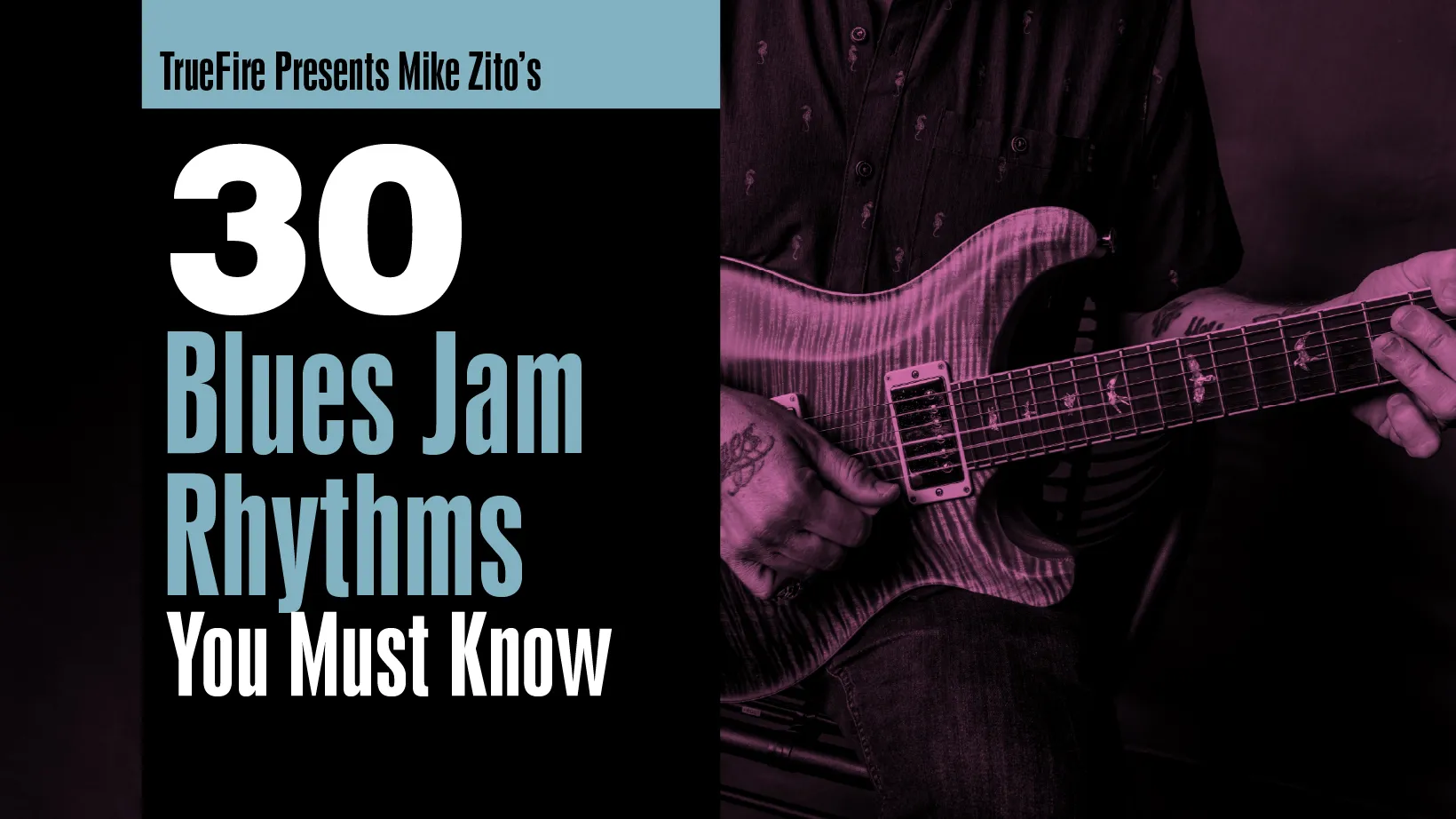
30 Blues Jam Rhythms You Must Know

30 Essential Grooves to Level Up Your Blues Rhythm Game

Marty FriedmanTommy EmmanuelSteve VaiEric GalesEric Johnson

Get this course and 1,000+ more with All Access

Try 14 days free. Cancel any time.

Purchase Individual Course for $14.99
30 Blues Jam Rhythms You Must Know

About this course

Getting stuck in the same old groove when you’re jamming the blues? You’re not alone, and you’re definitely not out of options.

Whether you’re holding down the rhythm at a local jam, playing alongside another guitarist, or just trying to keep your own blues playing fresh, one of the best things you can do is expand your rhythm vocabulary. The more grooves you know, the more confidently you’ll play, and the better you’ll sound.

In 30 Blues Jam Rhythms You Must Know, blues powerhouse Mike Zito arms you with 30 must-know rhythm parts designed to help you show up and fit in at any blues jam. From Texas shuffles and slow burns to one-chord vamps and gritty blues-rock riffs, you’ll develop a deep pocket of go-to grooves you can reach for on the fly.

“We’ll work through 12 jam tracks, and for each one, I’ll show you several rhythm variations that you can mix, match, and build on. These are designed to work in real-world situations, to give you options and keep your playing interesting,” says Mike.

Each set of grooves is built around a classic jam feel, and Mike breaks down the stylistic ingredients that give each rhythm its vibe — including riffs, voicings, chord extensions, feel, and phrasing. You’ll explore:

  • Train boogies, including Basic Train Boogie and Follow the Bass Boogie
  • Blues-rock riffs like Son of a Gun, Mojo Low Down, and Raking up the Blues
  • Funky and soul-infused feels like Horn Stab Shuffle, Soulful Double & Triple Stops, and Soul Blues Chord Comp
  • Texas-style and minor groove workouts like A Bit More Stevie, Mellow Texas Minor Movement, and Cool Minor Shuffle
  • One-chord vamps, arpeggiated comping, and expressive slow blues textures
Whether you're playing lead or rhythm, these grooves are designed to help you support the band, complement other players, and keep the energy flowing without falling back on the same tired patterns.

And with TrueFire’s powerful learning tools, including slow-mo, looping, synced tab, and fretboard animations, you’ll have everything you need to learn, practice, and own each groove at your own pace.

Ready to jam smarter and sound better? Grab your guitar and let’s dig in with Mike Zito!


What you'll learn

  • Apply minor scale double stops to rhythm playing
  • Execute swinging, groovy right-hand rhythm patterns
  • Execute muted rhythm technique with alternating bass notes
  • Use the guitar as a percussive instrument through muting
  • Move double stop shapes up and down the fretboard
Release date: 10/18/2025 • 3h 20m runtime
Start Course
Sample lessons
One Chord Riffin'
One Chord Riffin'
Rhythm 13
A Bit More Stevie
A Bit More Stevie
Rhythm 19
Mojo Low Down Riff
Mojo Low Down Riff
Rhythm 22
Texas Blues Shuffle
Texas Blues Shuffle
Rhythm 25

What's included

33 lessons • 30 charts • 12 Jam Tracks

30 Blues Jam Rhythms You Must Know
Hey everyone, it's Mike Zito. If you've ever felt stuck playing the same rhythm part over and over while jamming the blues, I've got you covered. In this course, I'll show you 30 essential rhythm parts that will keep your playing fresh, whether you're holding down the groove on your own or backing up another guitar player.

We'll work through 12 jam tracks that cover a variety of blues feels and styles. For each track, I'll show you a handful of variations you can mix, match, and build on. Along the way, I'll share stylistic tips and insights to help you lock in with the band and keep things interesting. You'll also have all of TrueFire’s learning tools at your fingertips—synchronized tab, slow-mo looping—so you can break it down, play along, and really make these rhythms your own.

If you’re an intermediate player, or even a late beginner ready to level up, this course will give you the tools to sound like you belong at the jam, not just in the bedroom.

Grab your guitar and let’s get started.
Basic Train Boogie
In this first rhythm, we’re diving into a blues staple that every guitarist needs to know—a swing shuffle in the key of A using the I, IV, and V chords (A, D, and E). We’ll learn how to play it up on the fifth fret with a simple two-note shape, adding hammer-ons for that classic train-like groove that shows up in blues, rock, and country. We’ll keep our right hand loose and fluid, letting the open strings ring and locking into a steady down-up strum that feels smooth and natural. As we move through each chord, the pattern stays the same, so we can focus on keeping the rhythm even and the groove flowing without stiffness. This is the kind of rhythm we’ll get called to play at any jam, and when we lock in with the band, it makes everything sound full and alive—exactly what good rhythm guitar is all about.
Droned Train Boogie
In rhythm number two, we’re building on the first pattern with a looser, open-string variation that creates a droning, train-like feel. We’ll keep that steady shuffle groove, but now the open strings give the rhythm more space and movement, and we’ll add a little color with hammer-ons and the occasional pinky drop to change up the sound. This variation is perfect for opening up a chorus or giving the song a new lift, and it’s a great way to keep things interesting when backing up a lead player or singer. The goal here isn’t to overplay, but to lock into the groove, make the band sound bigger, and support the lead—because when the rhythm feels right, everything else falls into place.
Follow the Bass Boogie
For rhythm number three, we’re shifting into a Chicago-style shuffle that locks in with the bassline, giving us that Buddy Guy backing Junior Wells kind of feel. Instead of focusing on chords, we’re working out of a small box shape on the fretboard, following the bass notes with a tight, muted groove that really sits with the drummer and bass player. It’s all about staying in the pocket, keeping the down-up strumming smooth, and using dynamics—sometimes laying back for a verse, sometimes pushing a little more for a chorus. What’s powerful about this rhythm is that once we learn it in A, we can move it anywhere on the neck and use it at different tempos and feels, building a toolkit of grooves that let us support the band, add variety, and keep the whole thing feeling alive.
Son of a Gun Riff
Rhythm four takes us into that classic “hoochie coochie” Chicago jam feel, built around a punchy riff that locks in with the whole band before opening up into simple but powerful chord hits. We’ll start with the iconic E–G–A–C–A lick, then move through D7, A7, and E7 shapes, keeping things loose and letting the chords ring with a touch of vibrato for extra vibe. The magic here is in the simplicity—laying back, leaving space for the vocals or lead, and driving the groove without overplaying. This rhythm is a must-know foundation that we can build on with countless variations, giving us a solid go-to jam feel that always works on stage.
Arpeggiated Dominants
With rhythm five, we’re taking that hoochie coochie groove up a notch by adding double-stops, arpeggiated dominant chords, and a more intricate picked rhythm that really fills out the Chicago-style jam. Instead of hanging on the low strings, we shift higher up the neck for a brighter tonality, mixing in the classic riff with tasty chord fragments and little movements that bring piano-like textures to the part. The idea is to complement what other players are doing—whether it’s another guitarist, piano, or bass—by adding variation and color without stepping on their space. This one challenges us to think beyond just holding down the groove and pushes us to contribute something unique that makes the whole band sound bigger and tighter.
High Hoochie Riff
In this rhythm, we take the hoochie coochie groove up high on the neck, adding double-stops and even some triple-stop chords for a brighter, harmonized sound. We’ll slide into shapes, mix minor and major flavors, and learn how to use these chords dynamically so the part breathes with the band. This is perfect when there are multiple guitar players—someone holds it down low while we play high—so the whole thing sounds bigger and fuller.

+ 26 more lessons

Start Course

Reviews

16 results

markscott

Verified buyer

06/29/26

Zito'

Mike Zito can teach you raw on fire licks

Ohio5665

Verified buyer

06/14/26

Nice course and great teacher!

Homegrowner

Verified buyer

05/03/26

Fun stuff. Mr. Zito is clear. Only four stars you ask? Like other “must know” courses I’d like a little more. I feel like you just get a bite of each Rhythm.

DeeWhyDude

Verified buyer

02/19/26

Helpful

Easy to use and very informative!

Jordu

Verified buyer

02/15/26

Essential Blues Lead Concepts

Gran curso!

Stop searching. Start improving with All Access.

Try 14 days free. Cancel any time.