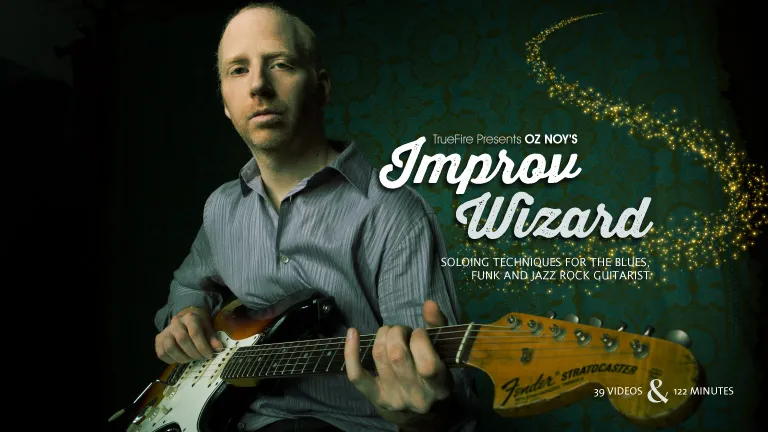
Follow the yellow brick road of bandstands from Israel to the Big Apple with a soundtrack pinched from recording sessions and performances from a star-studded variety of today’s top cats in the modern jazz, blues and funk scene.
As you bounce down the path, you hear magical guitar work that turns your head, grabs your ______ and just won't let go. You're drawn to the curtain behind which sits the guitar wizard of improv - Oz Noy.
We’ve been knocking on that curtain for a real long time in hopes of getting OZ into our studios to present as many of the tricks up his sleeve as he would be willing to share. Success! We’re thrilled to welcome Oz to the family with his first TrueFire course, Improv Wizard.
“I always loved the sound of rock and the blues … and I also love the sound of a fender guitar. But, I have also studied a lot of jazz and have a big appreciation for the sophistication of jazz music.
Over the many years of playing all of these styles, I’ve developed an approach that embraces all of their techniques and harmonic approaches, and at the same time allows me to stick with my favorite fender sound.
I’m excited to share many of my go-to techniques and melodic approaches here in Improv Wizard so that you can use some of these ideas in your own music.”
Oz organized Improv Wizard into two main sections. In the first section, Oz demonstrates a variety of his favorite ways to improvise and work with pentatonics, triads, symmetrical scales, arpeggios and progressions. Symmetrical Scale Concepts, Symmetrical Scales: 3 Notes, Symmetrical Scales: 4 Notes, Symmetrical Scales: 2 Notes, Symmetrical Scales: Applications, Pentatonic Approaches & Concepts, Pentatonic Phrasing Techniques, Pentatonic Targets For Bends , Triads Approaches & Concepts, Major Triads: Targets & Approaches, Minor Triads: Targets & Approaches, Incorporating Triads & Arpeggios, Targeting Triads In Your Scales, Targeting Arpeggios In Your Scales, Approaching The ii V I Progression, Scales & Approaches For Major ii - V, and Scales & Approaches For Minor ii - V.
In the second section, Oz shows you how to apply all of the concepts from the first section across six Performance Studies: Whole Tone Blues, Freedom Jazz Jam, Get Down, Steroids, Ha! and Twice In A While.
“We'll start with a blues progression built over a whole tone scale, improvisation using pentatonic and whole tone scales. Next, we'll focus on a melodic and rhythmical approach for a funky B flat one chord vamp. Then we'll solo using our arpeggio and triad approaches over ii V vamp. Then I'll show you a I IV V funky blues in D working with dominant scales, also showing you an A flat vamp with more colorful approaches. Finally, we'll change up the groove with an old school R&B progression, using chord tones with half-step approaches.”
After each performance, Oz steps you through the key concepts, techniques and creative approach he used to improvise the solo in the study. All of the key demonstrations, performances and examples are tabbed and notated for your practice, reference and study purposes.
You’ll also get Guitar Pro files so that you can loop and/or slow any section down as you work through the lessons. Plus, Oz generously includes all of the rhythm tracks for you to work with on your own.
Put your own wizard hat on, grab your guitar and step behind the curtain with Oz!
P.S. This is another one of those courses that went viral in the pro player/educator community the moment word got out that Oz was coming down to do his first course. If you play blues, jazz, funk or rock — this is a must-have for your library!
What you'll learn
How to solo over a Bb7(#9) chord using pentatonic scales
Visualize major triads in multiple positions across the entire fretboard
How to create melodic phrases that 'say something' musically
Learn to add harmonic and melodic color to basic triad shapes
Develop chromatic voice leading concepts for more sophisticated playing
Hello! I’m Oz Noy, and welcome to Improv Wizard. I love the sound of rock and blues and the sound of a Fender guitar, but I also appreciate the sophistication of jazz. Through all these years of playing different styles of music, I've been able to develop my own style and approach to harmony and melody while still being true to the sound of a Fender guitar. I'm excited to share my melodic approaches and techniques in this course so you can use them in your own music.
I've organized this course into two different sections. The first section focuses on a variety of my favorite ways to improvise on the guitar; looking at pentatonic scales, triads, symmetrical scales, arpeggios, and chord progressions. In the second section, we'll apply these concepts across six performance studies. We'll start with a blues progression built over a whole tone scale, improvisation using pentatonic and whole tone scales. Next, we'll focus on a melodic and rhythmical approach for a funky B flat one chord vamp. Then we'll solo using our arpeggio and triad approaches over ii V vamp. Then I'll show you a I IV V funky blues in D working with dominant scales, also showing you an A flat vamp with more colorful approaches. Finally, we'll change up the groove with an old school R&B progression, using chord tones with half step approaches.
For each of these performances and studies I'll start with an overview, demonstrate an improvisation over a rhythm track, and breakdown the approaches that I used. All the lessons are tabbed and noted, and include all the jam tracks I use as well. Ready to start? Put on your wizard hat, grab your guitar, and let’s dig in!
In the first section, I'll show you a variety of my favorite ways of improvising and working with pentatonic scales, triads, symmetrical scales, arpeggios, and chord progressions.
In the next few videos, I'll talk about symmetrical scales. This isn't necessarily a musical concept, but one that will let you grab control of the neck by helping you find the notes of a scale and reach them better. You can apply this concept to any scale you are using by taking the parts that work and adding them into your playing.
We'll start by looking at a 3 note per string symmetrical scale, using F major as our example. I'll show you how to move it all the way down the neck through the scale’s different degrees.
Now I'll show you the 4 note per string version of the F major symmetrical scale. By sliding the first note per string of the three note version, we can reach the fourth note and spread the scale out on the neck. This will open up the neck horizontally, covering the neck completely by reaching the scale’s fourth degree.
The last version of the symmetrical scale that we'll cover is a two note per string F major scale. The scale starts an octave up because the scale actually moves “backwards” on the neck. We'll cover the neck starting from seventh degree and work towards the fourth degree.
Now that I've shown you the different versions of the F major symmetrical scale, I'll demonstrate how to use this technique with a few different scales. We'll look at the two, three, and four note versions of both the pentatonic and diminished scale.
I like Oz. He should teach more of chord harmony theory. There are many methods to master the fretboard.
T
TySharron
Verified buyer
11/11/25
Lessons from the wizard
So good, right from the get go. Oz is one of the best guitar players in the world, so it's incredible to experience him as a teacher. Even his first few exercises about scales blew my mind about a few things, and I've been playing guitar for 20+ years. Highly recommend!
G
Gemden96
Verified buyer
01/11/25
Great Thus Far
This course already has me working to improve my funkiness. Yes, the basics are pretty easy at this point … but are they? There are nuances you have to pay attention to. Syncopations. Articulations. Techniques to hone.
Looking forward to finishing this course.
L
Luiscalvillo
Verified buyer
01/07/25
Amazing course
Amazing! Oz Noy is one of the best players around. You can learn a lot of outside playing in this course. For those blues guys who want to sound jazzier this is amazing